Home › The Xebec
The Xebec
NEARLY everyone has, at a tender age, read "Robinson Crusoe." So that no one need confess that he or she is not acquainted with the word "xebec," connected with that hero's early adventure when he was a slave upon the north African coast.
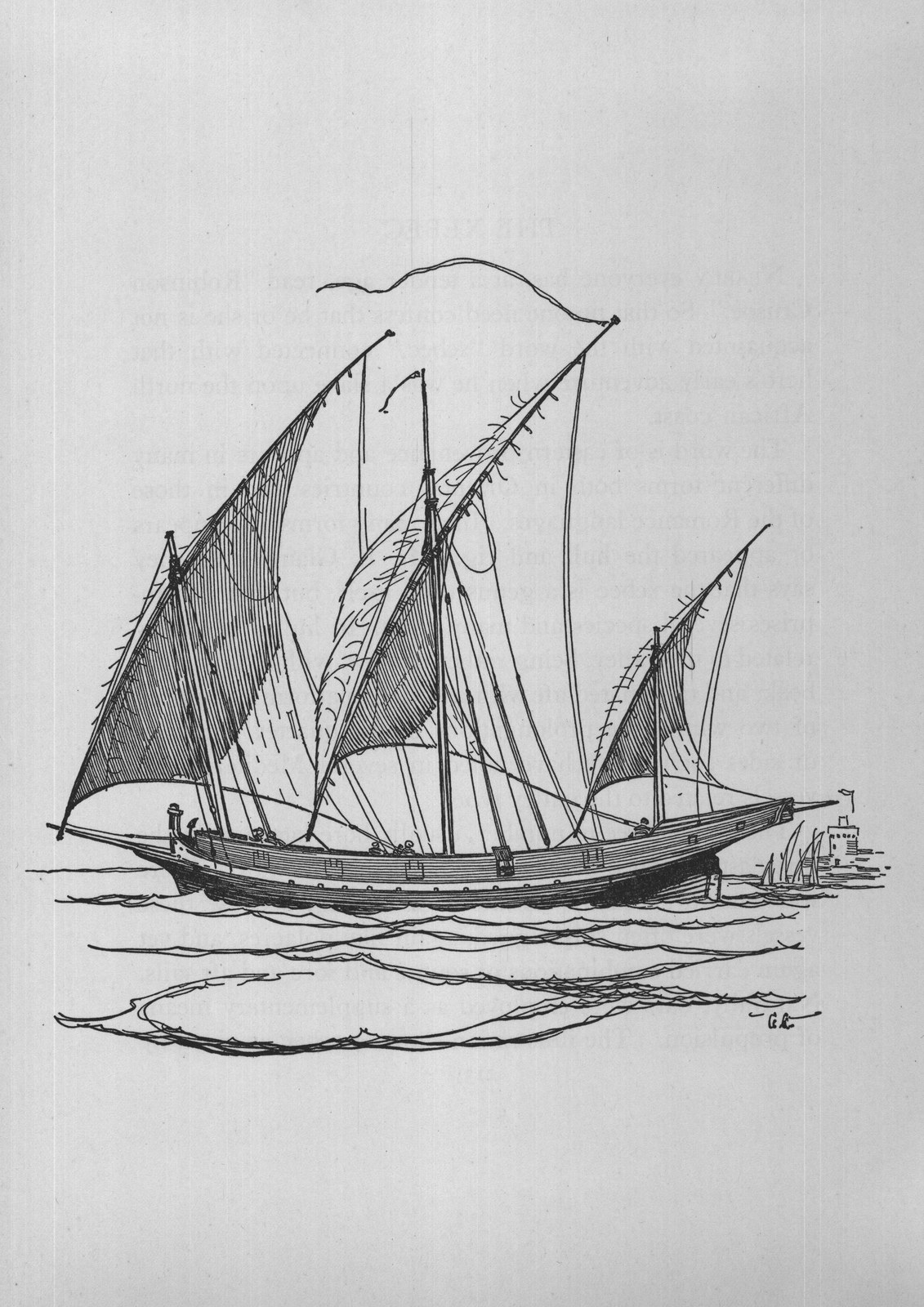
The word is of eastern provenance and appears in many different forms both in Oriental countries and in those of the Romance languages. In as many forms also appears or appeared the hull and rig. Mr. B. Glanville Carney says that the xebec is a genus unto itself, but that it comprises several species and many types. In hull it is closely related to the galley, being rather narrow, with a prominent beak, and terminated aft with an outer platform comprised of two wings, the prolongations of the quarter gunwales or sides such as we have noted in several Mediterranean vessels related to the galley type. The masts, three in number, usually bore lateen sails, the foremast having quite a pronounced rake forward. There were, however, many variations of the rig, because these vessels were often ship rigged, again like polacres, and yet again carried combinations of square and fore and aft sails. Naturally, oars were employed as a supplementary means of propulsion. The illustration shows a xebec as given by Lescallier in his Vocabulaire published in the year 1777. It will be seen that the two forward masts consist of single poles a calcet while the mizzen consists of two parts with a small top and separate topmast.
The British Navy did not disdain to include this form of craft within its programme of construction. Two sloops, the Dart and the Arrow, built in 1796, were xebec shaped, without, however, some of the extreme features, such as the open overhang aft. They had narrow floors, considerable overhang forward and aft, and no "tumble-home." They were ship rigged, and while they appear to have distinguished themselves, the type was not repeated. Mr. Carney points out that this type was not a true xebec but rather a first cousin called the chambequin.
It is interesting to note that the English seamen called the lateen yard carried on the mizzen a "shebeck" yard, probably because that approximated the pronunciation of the French word for "xebec" and "chabek," and because the use of the lateen mizzen was retained longer in the French than in the English Navy. (See Note 8, Appendix.)