Home › The Polacre
The Polacre
THIS is primarily a Mediterranean form of vessel. Its sharp bow has caused M. Jal to suggest that this feature is responsible for its name. This he derived from two Greek words P<??> much, and A<??> pointed.
The rig is also of Mediterranean origin and still exists. It was employed in England as late as fifty years ago. Its peculiarities were that usually it carried three pole masts without caps or crosstrees and a bowsprit consisting of one piece. Cleats were employed upon the masts as stops for the shrouds and stays. Sometimes the mizzen was not in one piece. The rigging was light, as there were no topmast shrouds or backstays--only stays on the upper part of the mast above the hoist of the topgallant. A survival from very early times was the Jacob's ladder on the after side of the mast, connecting the gap between the ending of the shrouds and the masthead.
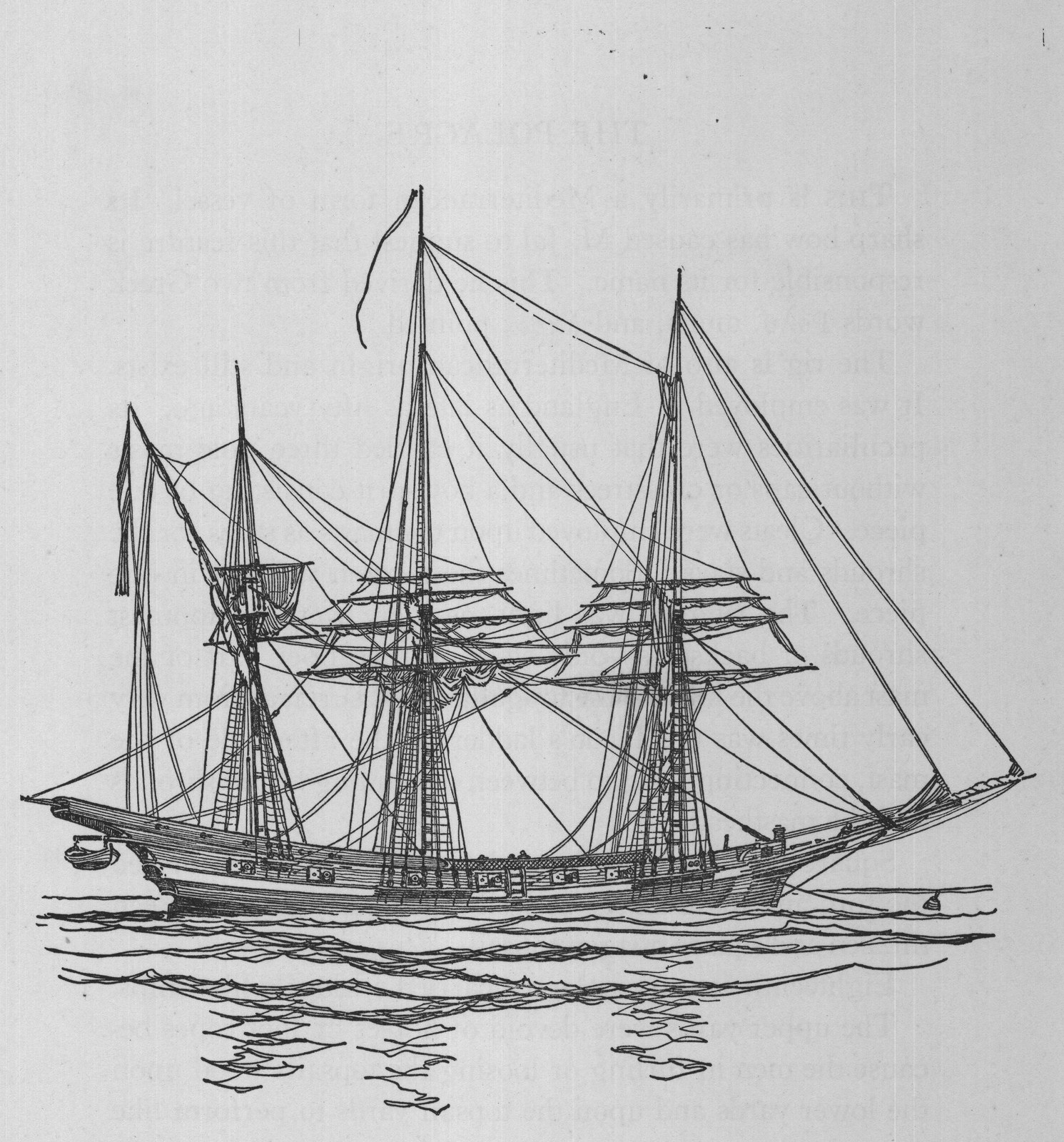
Square courses, topsails, and topgallant sails garnished the fore and main masts, as well as, in early time, a lateen mizzen and square mizzen topsail. Eighteenth-century polacres carried spritsails like ships. The upper yards were devoid of horses or foot ropes because the men in furling or loosing the topsails stood upon the lower yards and upon the topsail yards to perform like offices for the topgallants, because this form of rig permitted the upper yards to come down the masts and to be assembled close together.
As usual, there were variations of the rig. Sometimes the topgallant mast was in a separate piece with the customary crosstrees.
Another closely related rig, according to Steele, was the polacre-settee, having a lateen foremast, like the xebec, and sometimes a lateen sail on the mizzenmast, the mainmast alone having square sails carried in true polacre fashion. This is probably the same rig called by Jal a polacre corvette. It is interesting to note that Lescallier's illustration of a polacre shows the mizzenmast in two pieces with a conventional round top. Brigs and barks were sometimes equipped in this fashion, but they were not true polacres. Extensive inquiry among old-time local ship captains has failed to disclose any evidence that this type was ever employed or even seen on this side of the Atlantic within the last sixty years, although several stated that they were familiar with the polacres of French, Italian, Austrian, and Greek waters.