Home › The Saique
The Saique
THE notions of many persons as to the appearance of the vessels of the Levant are necessarily vague. We like to think of the craft of the Near East as possessing strange lines of hull and bizarrerie of rig. But in this the facts will not bear us out. Even in the earliest times concerning which we have fairly reliable information, that is from the latter part of the 16th Century, the shipping of the eastern part of the Mediterranean Sea did not differ greatly from the more western portions.
We seem to be reasonably certain that during the 16th Century the fore and aft sail, although in use in some of the north European countries had not penetrated into the Mediterranean. The lateen sail was characteristic of that region, but the square sail was also extensively employed. Mr. Nance says that the two typical vessels of Turkey during the 17th Century were the caramousel and saique or saic. They were more or less similar both in rigging and hull, except that the former had a much higher stern. The saique was then a small sailing boat having a considerable sheer, with narrow wales and flat stern, rigged as shown in our illustration.
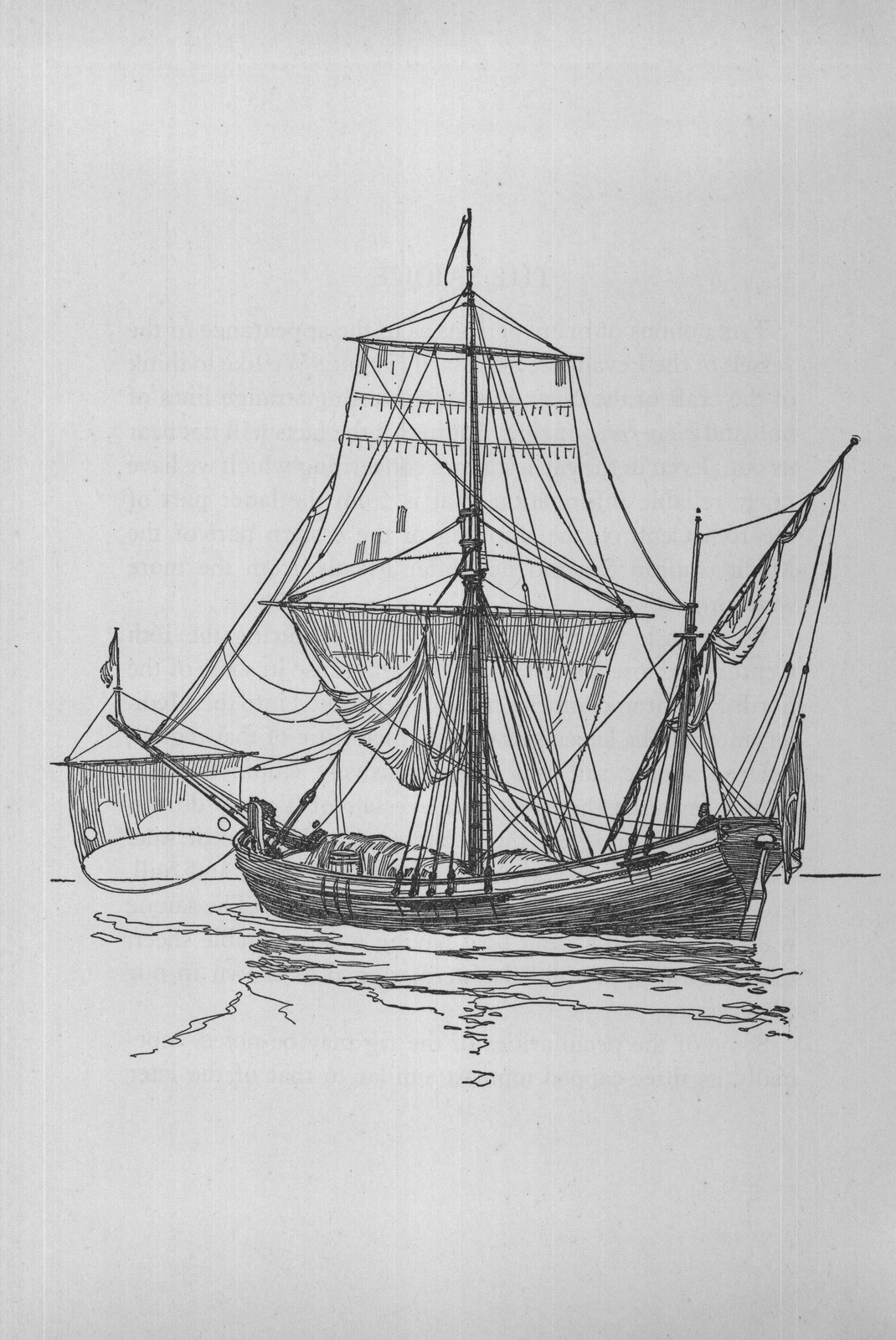
Some of the peculiarities of the rig may be noted, especially its three-capped topmast similar to that of the later polacre rigged vessels. The lateen mizzen is shown outside of the mizzen shrouds, but as it was a small sail it could be conveniently handled and easily changed over as occasion demanded. The spritsail, it will be noticed, has the round holes in the lower corner designed to let out any water caught in the hollows of this piece of canvas, as it frequently dipped into the briny waves; so often, in fact, that it was sometimes called, not ineptly, the water sail.
Mr. Nance also says that the caramousel was probably extinct by the middle of the 18th Century but that the saique was then still going strong with substantially the same rig, about which there certainly is nothing particularly Oriental looking.
Counterparts may be found for practically all the gear in northern ships of the period.
All this goes to prove that both the differences of rig in various parts of Europe in vessels of comparatively similar types, and the changes developed therein during several centuries, are much less than might at first be supposed.