Home › The Viking Long Ship
The Viking Long Ship
SNORRI said, "Harold, seest thou this long ship? It is much like the Dragon which King Olaf Tryggvason (995-1000 A.D.) had built at Hladhamrar after the model of Raud's serpent. He brought that vessel from Halogaland. The stocks were very long and the ship's keel measured over 65 ells. Thorberg Shafhogg was the stem-smith. While the bulwarks were rising, Thorberg had to go back to his farm. He was gone a long time, and when he returned the bulwarks were completed. The same evening the King and Thorberg went to see how the ship looked. Everybody praised it. The King then went back to his house. Early next morning the King and Thorberg went down to see the ship again. All the smiths had arrived and stood there doing no work. `Are you on a strike?' asked the King. They said `No, but someone has spoiled the ship.' Notches had been cut into the gunwale on one side from stem to stern. The King was furious and swore that if he could find out who had ruined the ship from envy, that man should die, but he who could name the doer of the deed should get great reward. Thorberg said, `I can tell you, O King, who did this deed.' The King answered, `Thou, O Thorberg, wast the likeliest man to be so lucky as to ascertain this thing and to tell me.' `I will tell the King who has done it,' he said. `I have done it,' `What,' said the King, amazed, `thou?' `Yes, I,' said Thorberg. The King answered, `Thou shalt repair it so that it is as good as it was before, or thou shalt lose thy life.' Thorberg shaped the gunwale so that all the cuts disappeared. The King and everybody said that the ship was much better on the side which Thorberg had shaped. Then the King asked Thorberg to do the same thing to the other side of the ship and thanked him well for it. Thereafter, Thorberg was chief smith of the ship until it was finished. Its beak and dragon tail were all ornamented with gold. Its gunwales were as high as those of seagoing ships. No better or costlier vessel had ever been built in Norway." (See Olaf Tryggvason's Saga, c. 79, for account of the construction of a Viking ship of this date.) Thanks to the blue clay of the Scandinavian hills which has preserved several examples almost intact, we know exactly how these vessels looked. The story of the finding of the Gogstadt ship is quite as romantic as any treasure-trove tale by Poe or Stevenson, and it is fact, not fiction. The size of the ancient Norse vessels was determined by the number of "rooms" (rums) or rowing benches. King Olaf's ship, the saga says, contained thirty rooms. If the ship was 65 ells or 135 feet on the flat of the keel, it would probably have an additional length fore and aft of fifteen feet respectively for the curving rise of the stem and stern or a total length of 165 feet. Allowing four feet for each room, or 120 feet, this would leave 45 feet for purposes of forward and after decks and space free from the rowing benches. The sailing equipment of these ships was rather rudimentary. Primarily intended to be propelled by oars, their floors were rather flat with very easy lines of entrance and departure. The sides rose almost vertically with quite a sharp turn in the bilge. With a free wind they must have sailed fast. Any one who has had the experience of sailing in a rowing boat of fine lines, such as the St. Lawrence skiff, will appreciate this fact. The mast had an elaborate step, something like a double fish tail, into the forward opening of which the foot of the mast fitted into a step-hold. It was wedged or keyed into its upright position by a stout oak plank, somewhat resembling in shape an old-fashioned bootjack. Stays fore and aft and shrounds on the side supported the mast after it had been raised into its vertical position from the crotches placed aft to support it when horizontal.
When recumbent, the mast served as a part of the ridgepole of the tent which at night covered the whole vessel, the sides of the tent being fastened along the gunwales. The yard was hoisted by a tie passing through a hole in a mast head and was held close to the mast by a wooden cleat or parrel. Braces and sheets led aft, and tracks of the sail were sometimes extended by the light booms. Cleats were provided for the purpose of belaying the several ropes. The rudder was always rigged up the right side, hence the derivation of our word "starboard" from stjonbordi, "steering side," while the left side, backbordi, may be traced through the Normans in the French word babord, port. On the starboard quarter of the vessel a large rounded oak boss was firmly bolted to the outside, the extreme outer surface of which was in a line perpendicular to the gunwale. Through the gunwale, slightly forward of this perpendicular line, two holes were pierced to receive the grommet, a rope passing out one hole, around the rudder post, and then in again through the other hole, belaying inside. A large hole was bored through the upper part of the rudder blade and also through the above described boss and the ship's side. Through this passed a heavy rope knotted at the outer end and terminating inside the ship where it made fast; this served as the axis of the rudder. An iron ring fastened to the after edge of the rudder blade to which was attached a cord leading on deck provided the means, when the grommet was slacked off, by which the rudder could be raised or lowered on its aforesaid axis. A square hole in the upper part of the rudder-post served to receive a transverse tiller. This the steersman sat behind and pushed or pulled, as he desired, to direct the vessel's course. The oars had narrow pointed blades and were thrust through holes pierced in the sides. When the oars were withdrawn, these oar-ports were closed by circular shutters fastened upon the inside. Large ships had several anchors. Merchant ships, the seagoing vessels referred to above, had a single permanent mast and few oars or none. They were heavier, shorter, and had higher sides.
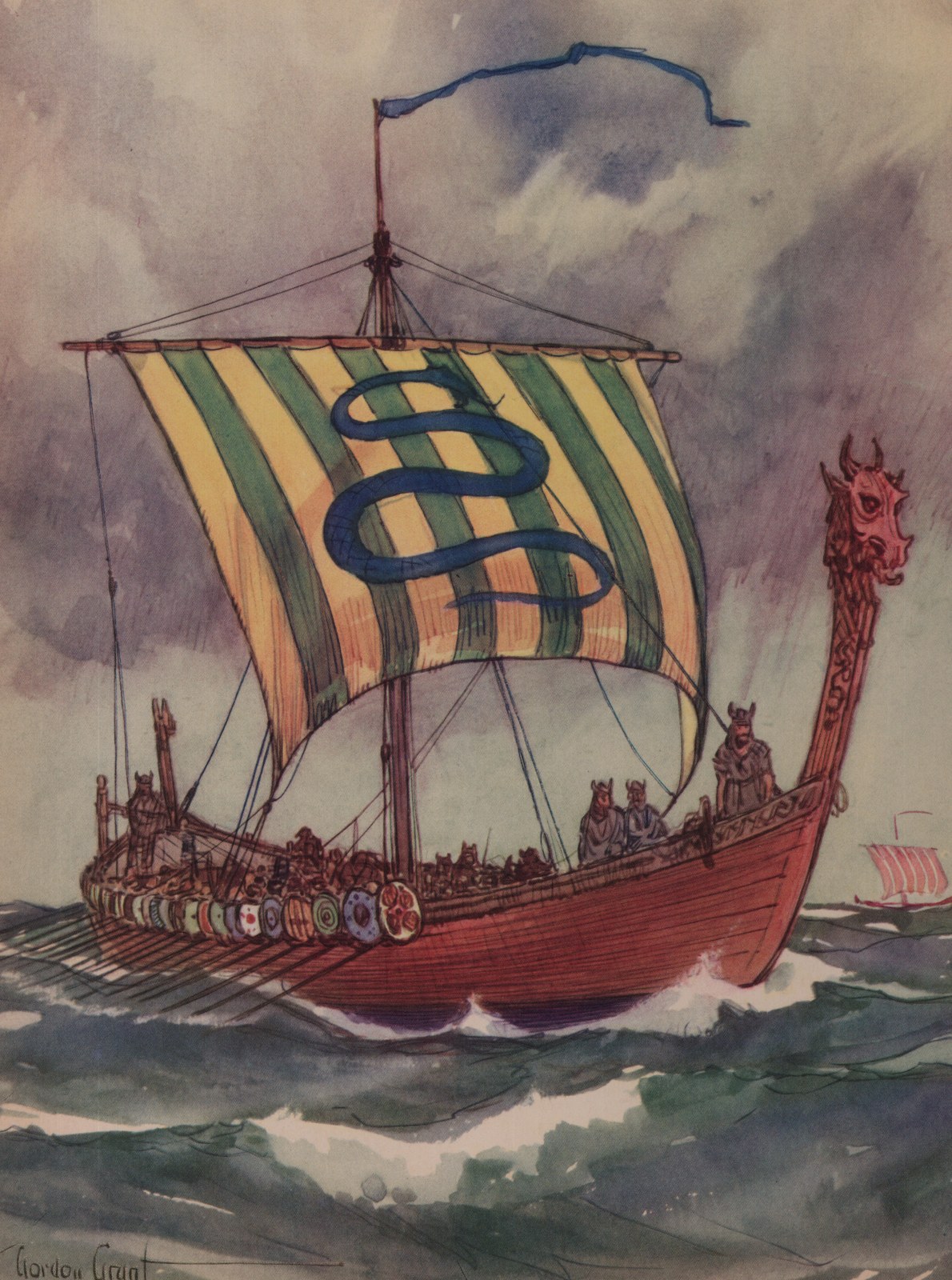
How fine these war vessels or "dragons" must have looked with their golden figureheads, tails, and weather vanes. Their sides were usually painted in red, purple, and golden stripes, the shields of their warriors, usually of two contrasting colours with gleaming metal rims and bosses hanging crescentwise along the gunwales, while the sails of different coloured cloth, often embroidered, and some even of two-piled velvet, swelled aloft. The gaily painted oar-blades rose and fell rhythmically amid cascades of sun-lit jewelled drops, as the vessels dipped and swayed in the heaving waters of the fjords, against a background of dark beetling cliffs and deep coloured evergreens. Good ships, stout warriors, brave seamen.