Home › The Ketch
The Ketch
LIKE many variations from more or less fixed and permanent species, the evolution of the ketch also shows us marked changes from time to time in a type which was itself a derivation (so far as rig goes) from the three-masted ship.
Probably no more apt concept of a ketch can be formulated than that employed by Mr. R. Morton Nance, "a ship without a foremast." To trace the etymology of the term "ketch" would be perhaps almost as complex as to define and state in order its many successive changes in rig and hull. It may be stated with reasonable assurance that the word is derived from the 15th Century English word "cache" as applied to a cargo boat, being the same in its older form as a "catch."
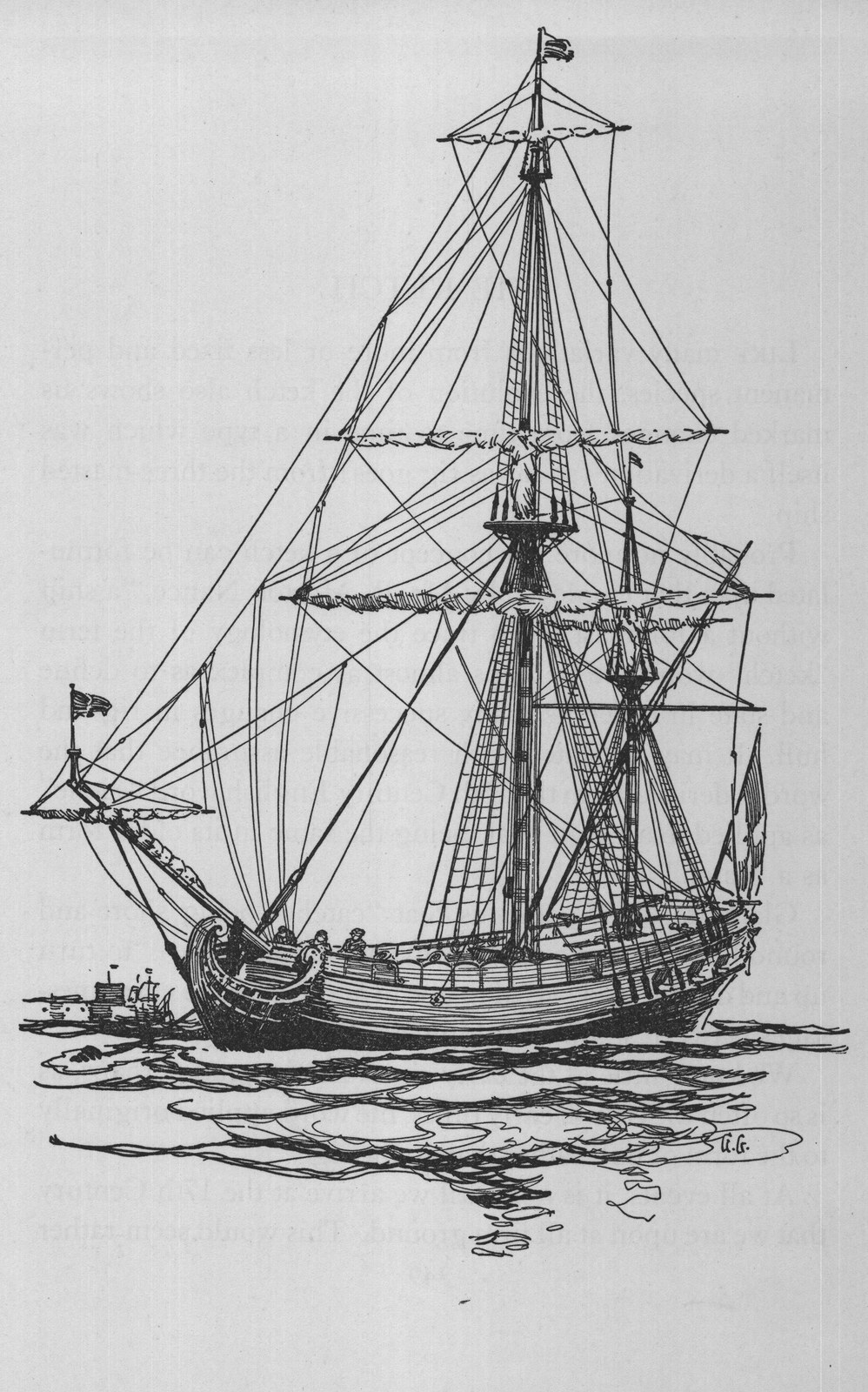
Glanville (1625) tells us that "catches being short and round built, be verie apt" (convenient, not liable) "to turn up and downe, and useful to goe to and fro and to carry messages between shipp and shipp, almost with any wind." We know little of the early rig of ketches and perhaps, as is so often the case in early times, the word applied originally to the form of hull rather than to the rig.
At all events, it is not until we arrive at the 17th Century that we are upon at all firm ground. This would seem rather of an Irishism in treating a subject so closely identified with such an unstable element as the sea. That which holds our interest more than anything else in connection with ketches is a twofold development of the rig, for we may disregard differences of hull and, in so far as the limits of this article goes, confine ourselves to a discussion of the vessel's apparel.
The ketch rig in a way became at an early date closely associated with what would then have been called a yacht hull. But the vessel would then have been called a yacht only if it were hoy rigged; if, on the other hand, the vessel had square yards and a mizzen, it was called a ketch. As an illustration of the variation in terminology and as demonstrating how the requirements of a particular usage may effect a certain type of craft, the necessity of providing a space free from obstructions, for use as a floating mortar battery, may be considered. A vessel without a foremast, with a mainmast stepped amidship, with a mizzenmast, both masts rigged similarly to a ship, and with a stout chain for a mainstay, the forward part of the vessel being equipped with mortars having a free range abeam and forward, was called a galliote a?? bombes in France and a bomb ketch in England. Both the French and the English types were usually pink sterned. The French example naturally enough took its name from the Dutch galliot.
The illustration shows the rig at its nearest point of contact with the late 17th Century and early 18th Century vessels. (See Note 5, Appendix.)