Home › The Seventeenth Century Galley
The Seventeenth Century Galley
PROBABLY little change was manifest in the appearance of the galley during the latter centuries of its existence. It was one of those types whose permanence was the result of an early arrival at full efficiency. When cannon were introduced, some modification of the galley's upper structure was demanded for their installation.
The illustration shows the low narrow vessel with the beak, the apostis, and the elaborate stern elongated by the extension of the after gunwales to a considerable distance beyond the narrow transom, if such a peculiar form of construction can claim that name.
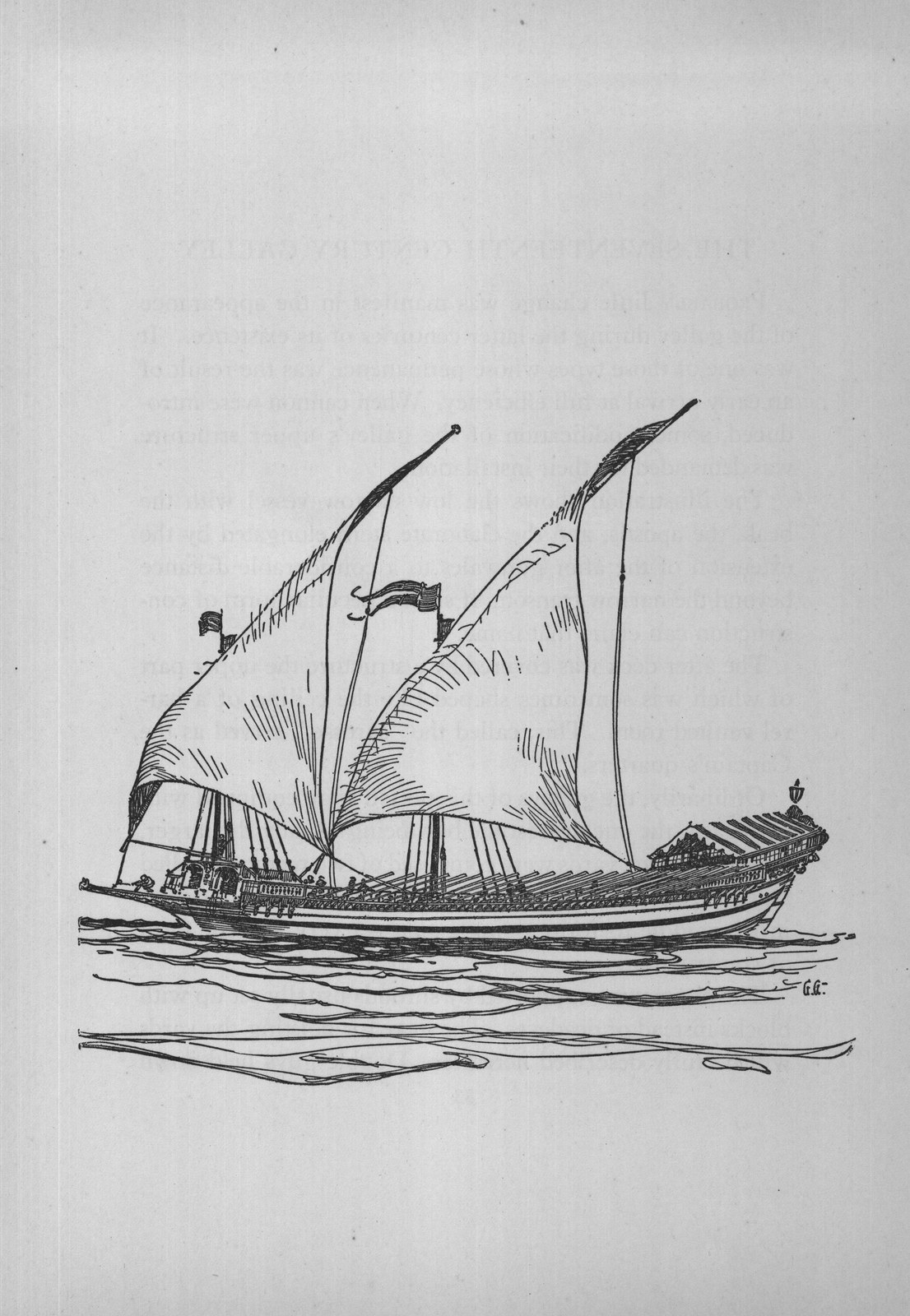
The after deck was covered by a structure the upper part of which was sometimes shaped like the ceiling of a barrel vaulted room. This, called the "carosse," served as the Captain's quarters.
Ordinarily, the galleys of this period were equipped with two masts, the one nearest the bow being usually the larger. The long lateen yards were composed of two members called antennae, the thicker parts of which were lashed together in the middle to form a single spar--a very ancient form of construction.
The masts were supported by shrouds usually set up with blocks instead of deadeyes. The gear for hoisting the yards will be fully described hereafter. Double guys held down the yard and kept it in place toward the foot of the mast, while other tackle, probably similar to the mizzen bowlines, fitted to the lateen mizzens of the round ships, hauled the heel of the yard the one side or other, as occasion demanded. Vangs controlled the after part of the yard, while brails caught up the sail to the yard for furling. Some of the older galleys were fitted with three rudders, one at the stern and one on each quarter.
The rowers' benches were distributed along the sides within the apostis to starboard and port, leaving between them a gangway extending lengthwise called the "coursier." Just in front of the carosse was a balcony extending athwartship with small stages outboard on each side whence ladders gave access to the vessel. Below the carosse was another chamber called the "gavon" lighted by narrow rectangular openings in the vessel's sides, protected by sliding shutters. This form of window was a feature of many old time vessels. A sort of this raised forecastle, well forward, furnished to the sailors a space removed both from the rowers and gunners in which to work the foresail. The galleys of this period were superbly decorated with gilded bas-reliefs and mouldings. Their flags, streamers, and banners were often made of silk embroidered with gold and coloured threads. The carosse was not infrequently covered with a "tendelet"' of crimson silk damask. What a gallant spectacle such a vessel must have presented as with oars held high, lateen sails swelling, with silken flags fluttering, it swept along over the sparkling waters of the azure midland sea!