Home › A Roman Trireme
A Roman Trireme
MONSIEUR JAL had the satisfaction of visualizing his idea of the appearance of the ancient Roman galley. The French Government, of which Napoleon III was then the head, authorized the construction of a trireme at Clichy, one of the districts of Paris, on the Seine. The plans were drawn under the direction of the Ministry of the Marine of which M. Jal was the historiographer and the decorations were designed under the supervision of an eminent classic antiquarian. Skilled ship carpenters from one of the French naval depots were entrusted with the actual work of construction. The launching took place on March 9, 1861, in the presence of the Emperor and a distinguished company. The vessel thus produced was about 130 feet long, 17 feet broad, and 10 feet deep. Two rows of oars were stated to have been arranged upon two superposed decks with one row between the two decks.
From woodcuts appearing in the contemporary English illustrated newspapers ( Illustrated London News, March 21, 1861; Illustrated London Times, March 22, 1861.) from drawings made by artists on the spot, it would seem as if Jal's theories appear to better advantage in print than in a concrete example. Firstly, there is no evidence of the apostis, a fundamental part of the galley.
Secondly, Jal asserted in his "Archaeologie Navale," published in the year 1840, that he could admit that oars could be successfully operated from two superposed decks or stages but not from three. This he reiterates in his "Glossoire Nautique" (1858). And yet the cuts show three superposed rows of oars and the text accompanying the said illustrations confirms this arrangement.
It is little difficult to understand how M. Jal managed two superposed decks or stages in this narrow vessel, one having a ratio of length to breadth of nearly seven and a half to one. Such a craft would necessarily have more draught than would a wider one. It is hardly probable that it drew less than four feet of water. In such a vessel the lowest row of oar holes must necessarily have been located at a point high enough above the water line to prevent a moderately rough sea from entering these openings pierced in the ship's side. Moreover, it would have been imperative to obtain freedom from wave interference in the manipulation of the oars. In a vessel of the size above described, one which would not ride easily over the waves like a wider boat, such a point could scarcely have been less than four feet above the water. Taking into consideration the above figures, and estimating the head-room of the lowest stage to be a minimum of four and one half feet, it will be seen that the upper deck or stage would be about even with the top of the bulwarks, leaving no place for the support of the fulcrum for the highest row of oars.
Thirdly, as regards the intermediate row of oars, one must assume that the oarsmen of this row were seated on benches or stages nearer the medial axis of the vessel, that the inboard portion of their oars was longer in proportion to the lower and upper rows, and that the oar openings were arranged in lines inclined from the perpendicular so that the rowers did not interfere with one another.
Fourthly, M. Jal seems to have rejected entirely in his concrete example the assertion contained in his "Archaeologie Navale," Memoire No. 4, that the arrangement of the oars in triremes, quadremes, penteremes, etc., of the ancient Greeks and Romans was in effect the system called a zenzile and employed in the Mediterranean galleys as late as the 15th Century. The galleys using it were propelled by groups of three or more oarsmen all sitting upon the same bench, each rower pulling a separate oar. The benches were not set exactly at right angles to the keel, the inside end being slightly farther out and higher than the outer end. This arrangement accords perfectly with the evidence alluded to in our introduction as embodied in the apostis shown on the Winged Victory of Samothrace.
M. Jal has, in his said Memoire No. 4, given a number of illustrations from both classical and Renaissance sources, showing this arrangement a zenzile. He discusses the system at considerable length and gives several diagrams to scale to demonstrate the possibility of its application to as many as six oars in a group. It is rather strange that he did not follow this method in his galley of the year 1861.
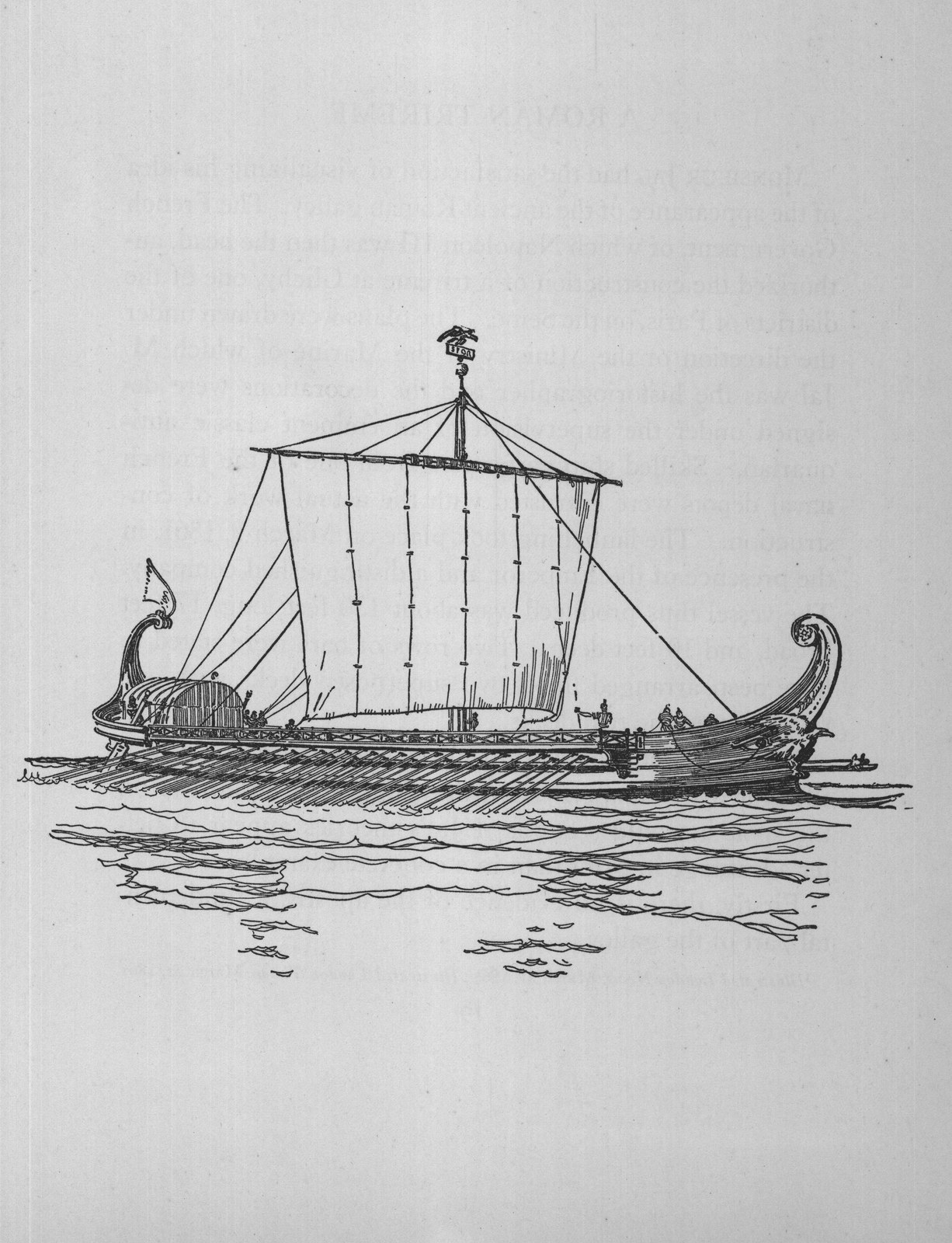
Our illustration shows what we believe is a rational view of a trireme of classical times. The apostis furnished support for the rowing benches and uniform width for the leverage of the oars extended well over the galley's side. The advantage of having all the groups of oars exert their effort in substantially the same line is obvious.
In the appendix will be found a diagram giving a view of the disposition of the oars of a galley so arranged with oars in groups of three.