Home › The Tartane
The Tartane
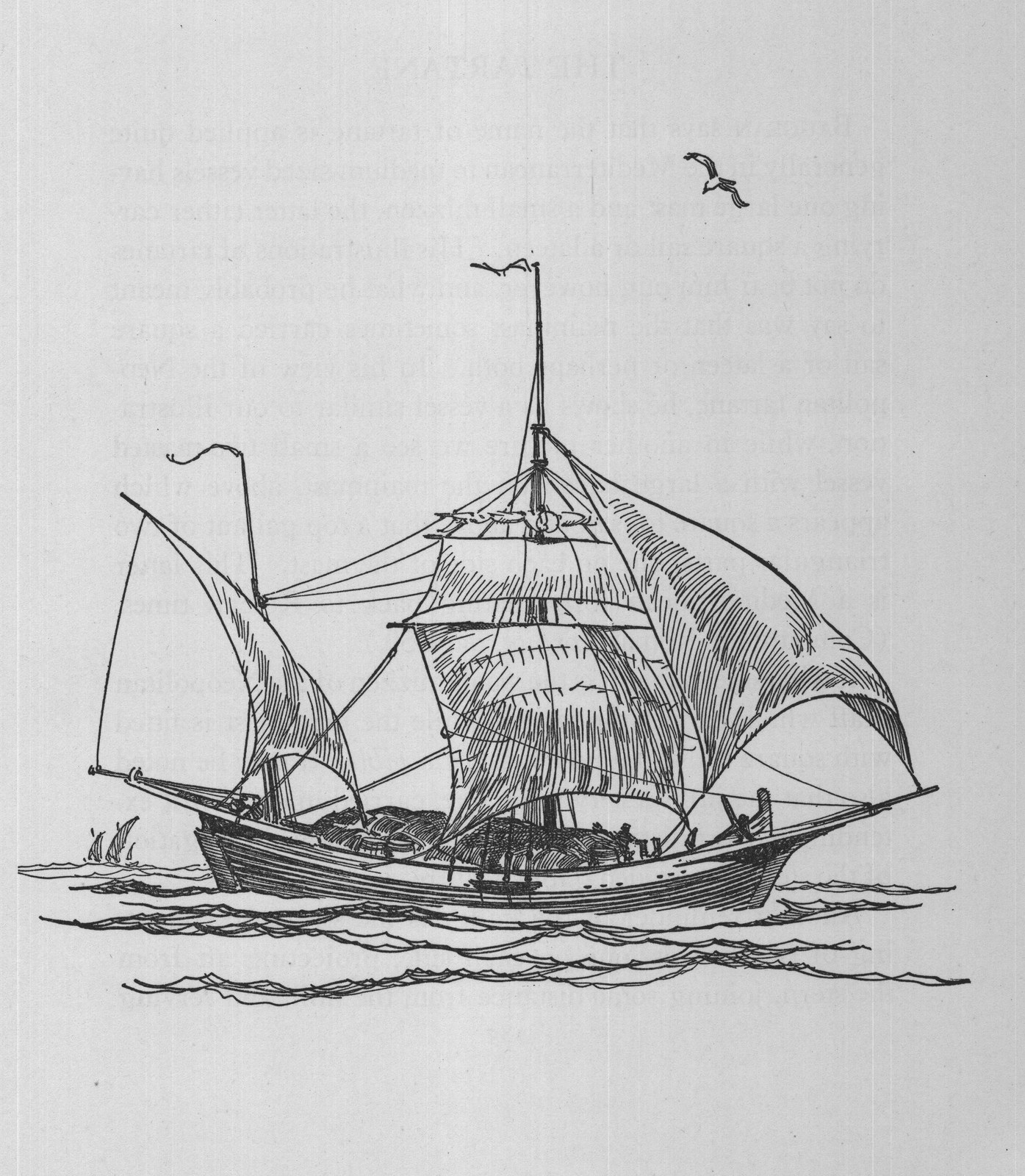
BAUGEAN says that the name of tartane is applied quite generally in the Mediterranean to medium-sized vessels having one large mast and a small mizzen, the latter either carrying a square sail or a lateen. His illustrations of tartanes do not bear him out, however, and what he probably meant to say was that the mainmast sometimes carried a square sail or a lateen or perhaps both. In his view of the Neopolitan tartane, he shows us a vessel similar to our illustration, while in another picture we see a small two-masted vessel with a large lateen on the mainmast, above which appears a square topsail and above that a top gallant of two triangular parts, one on each side of the mast. This latter is a Mediterranean form, dating back to Roman times. (Compare the Roman corbita, page 50.) It will be seen that it is the small mizzen of the Neopolitan craft which carries the lateen, while the mainmast is fitted with square sails on a pole mast or a pible. It may be noted also that the jib is a very large one, carried upon a sprit extending a short distance beyond the pronounced elongation of the stem--a decided galley feature.
Another reminder of the galley is the structure consisting of two boards, one on each side, projecting aft from the stern, joining some distance from the hull, and serving as the support for the outrigger pole, to the extremity of which is affixed the block for the sheet of the mizzen. This extension, sometimes very elaborately ornamented, is to be seen also in the craft of many Mediterranean countries, including those of Turkey. The mizzenmast also serves to hold the brace blocks of the two upper square yards of the mainmast. The hull of this tartane is drawn in at the stern rather sharply so that the craft is really a double-ender. Notice that the stern post comes all the way up to the top of the after-deck. The rudder head rises above this end and the tiller leads forward between the sides of the outrigger structure, also a very ancient form.
Many of the lateen-rigged craft, when the wind became too heavy for these large triangular sails to be carried safely, lowered them and hoisted a short square sail in their place. The small tartane described above was so equipped that such a substitution could be quickly effected. The combinations of the lateen with other forms of sail would appear to be infinite and yet the ingenuity of the Mediterranean sailor seems to have made use of nearly all of them.