Home › The Barque Provencale
The Barque Provencale
SMALL craft in great variety are to be found everywhere in the Mediterranean differing both in the form of hull and in apparel. Many of these are quite generally called barks, but the term is generic.
In southern Europe the inclination toward the lateen sail was strong and as we have noted elsewhere, with good reason. But the lateen may there be seen combined with both square and fore and aft sails.
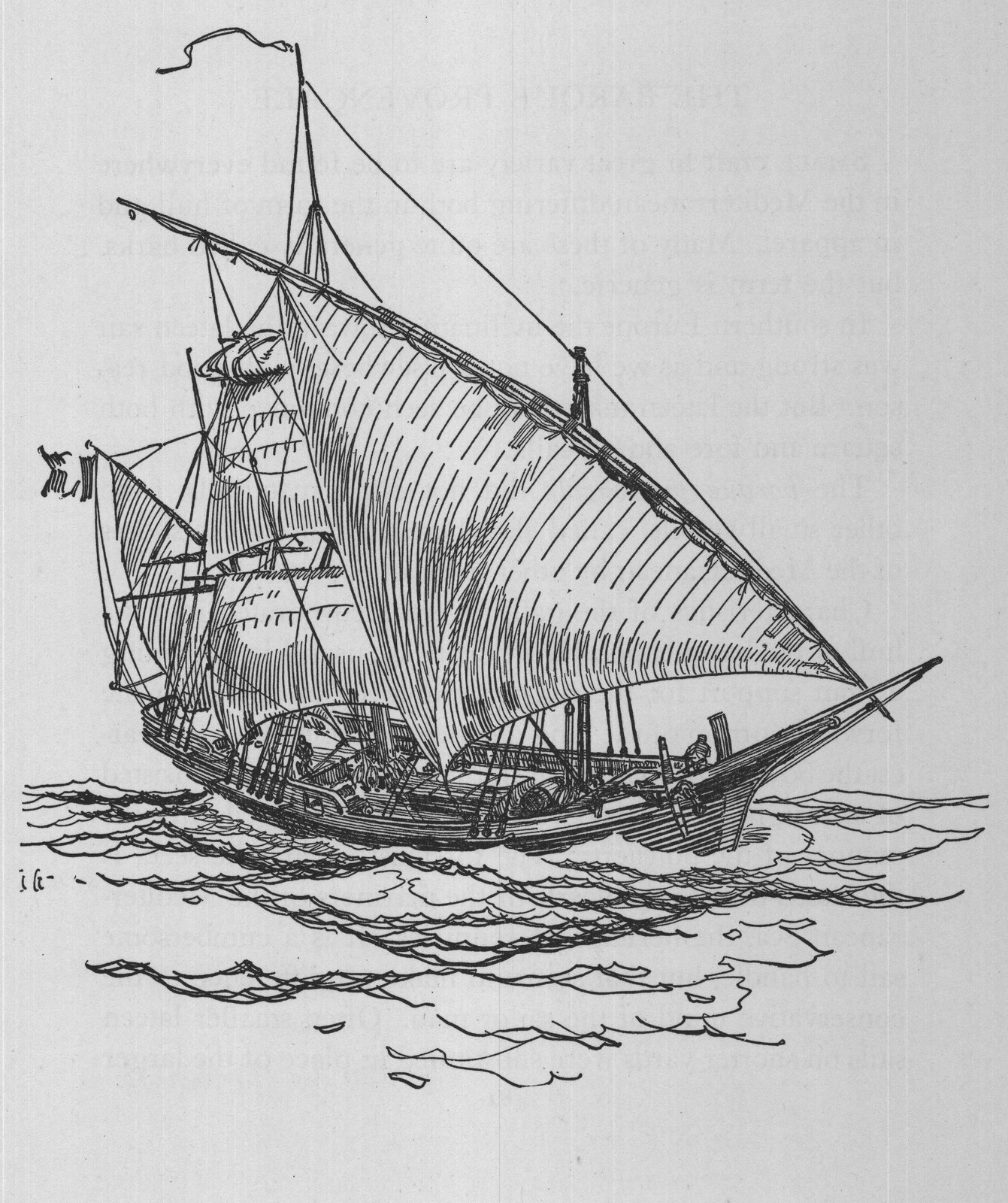
The barque provencale did not differ materially from other small vessels, called elsewhere than along the shores of the Mediterranean by other names. Characteristics of the galley were incorporated into the hull of the barque, notably in the beak, useful in providing a stout support for the rigging employed in operating the forward portion of the long antennae of the lateen sail nearest the bow. The mainmasts of these barks usually consisted of a straight pole, a pible, with three yards rigged after the manner of the poleacre. The foremast, as may be seen, is the lateen dear to the hearts of the mariners of the Mediterranean Sea, the heritage of centuries. It is a cumbersome sail to handle, but that seems to make no difference to the conservative mind of the sailor man. Often smaller lateen sails on shorter yards were substituted in place of the larger ones as occasion demanded, this being a simple way of shortening sail, although it would seem as if the larger lateen, with its long yard, when removed to make way for its smaller substitute, would be more or less "in the way" when lying on deck. The skippers of these small craft were and are hardy and bold but usually ignorant of even the fundamentals of navigation. Quite often they cruise without even a compass, but on such voyages it is safe to say that they never venture out of sight of land.
The writer recalls seeing a few years ago, drawn out on the beach at Amalfi in Italy, a number of boats designated by the natives as barche (barks) ranging between ten and sixty tons. In nearly all of the hulls archaic forms could be seen. They were decorated in most florid fashion. Many had "eyes" painted on their sides near the stem. The diversity of rig was noticeable. Fore and aft sails were in the majority, but the lateen rig was still retained by a few. Unfortunately, there was nothing in the gathering that in any wise resembled the square-rigged barques of a century ago. (See Note 6, Appendix.)