Home › The Norwegian Cat
The Norwegian Cat
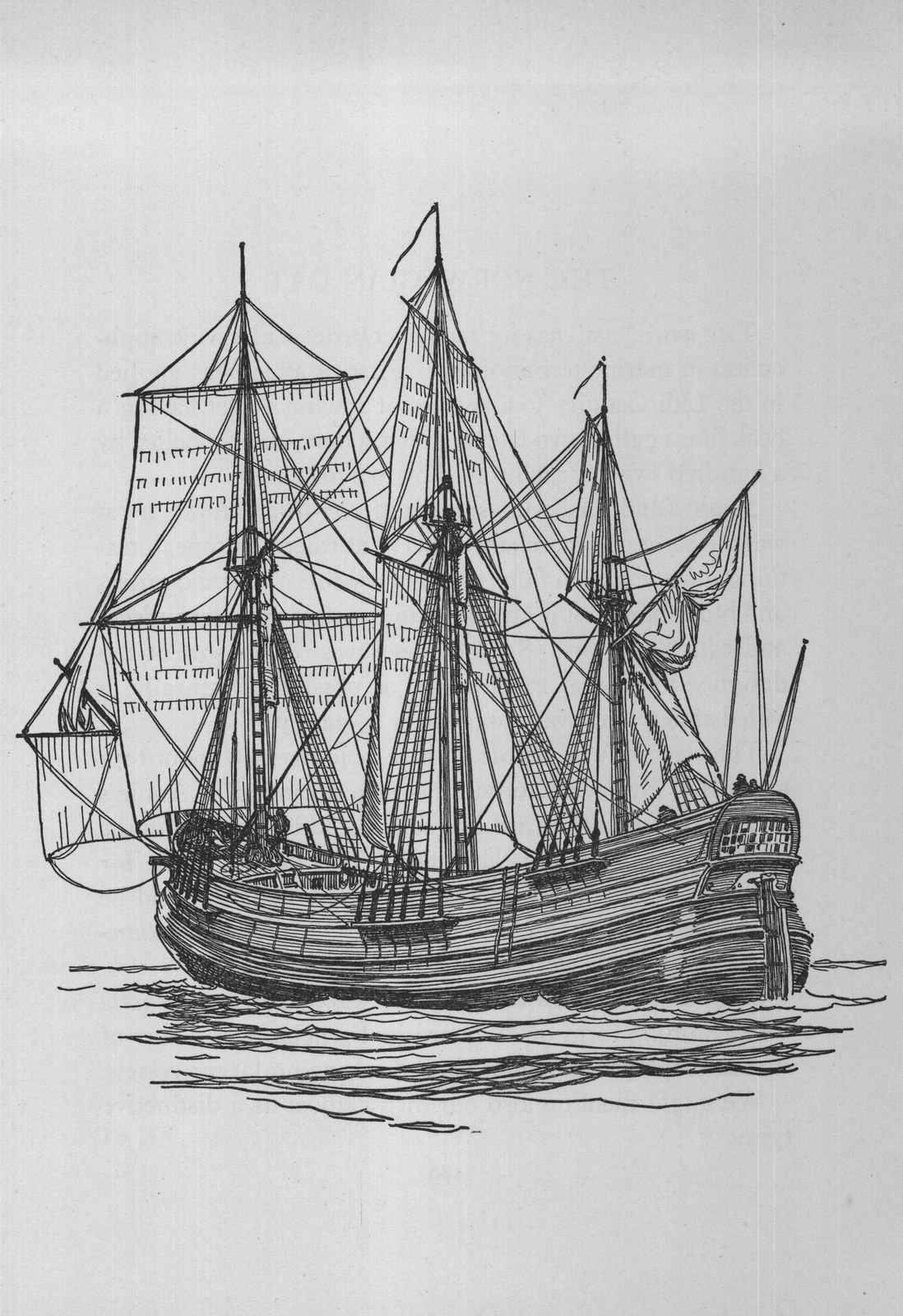
THE word "cat" has for many centuries had a wide application in marine terminology. First of all, it was applied in the 13th Century to a species of rowing vessel having a beak like a galley, two lateral steering oars, and propelled by a hundred sweeps, each rowed by two men. Again (and this is the subject of our illustration), a cat was the name of a merchant vessel of northern Europe, something like the Dutch flute, having very full rounded quarters and blunt bows, with little rake to the stem and stern pieces and with flat floors. Such a vessel was only a sort of tub designed to hold as much cargo as possible. Naturally, it sailed slowly and was sluggish in a seaway.
The rigging was simple. Three pole masts without tops supported lower and topsail yards so arranged in Aubin's time (1702) that the yard and sails could be lowered to the deck in lieu of furling them aloft. This method made for economy of operation, as these simple evolutions could be performed by a small crew. Lescallier mentions that sometimes top gallants were set flying above the topsails.
Another boat to which was given the name cat, or chatte (the feminine form of the word in French), was a sort of lighter employed in loading and discharging larger vessels.
We might mention also our own catboat as a distinctive type. Cat is a favourite word with seamen. The cat-head taking its name probably from the ornament usually sculptured on the extremity of the stout projecting beam designed to keep the anchor when a-weigh well out from the ship's hull, naturally and obviously led to the use of the term to "cat" the anchor. The instrument of punishment called the cat is too well known to need description. The cat-hole was another name for the top or lubber's hole. Cat harpings were the ropes used to constrict the shrouds at the hounds so that the yards could be more sharply braced.
Among this large family of cats one would think that a mouse would be in great danger of meeting a sudden and tragic end. And yet an extended and somewhat careful perusal of naval literature and technical marine treatises has failed to disclose that any such catastrophe (if the pun may be permitted) ever happened from such a cause to any mouse on the old hemp-rigged vessels--for they all harboured several of these rodents as a regular and necessary part of their equipment. For the benefit of the uninitiated it may be stated that a mouse was an enlargement worked with rope yarns designed to retain in place the eye of the stay, thereby forming a loop or collar about the masthead.