Home › The Snow
The Snow
IN OUR article upon the brig, we discuss its possible origin. What is there stated applies to a certain extent as well to the snow. Probably before the year 1600 the brig and the snow had a common ancestor in a type of small two-masted vessel. From the evidence at hand, as Mr. Alan Moore puts it, prior to the year 1700 we are, as to the pedigree of the snow, upon an uncharted sea.
A contemporary drawing of the year 1700 shows a two-masted square-rigged vessel with round tops but no trysail. It is designated a snow. Steele's "Elements & Practice of Rigging & Seamanship" (1794) gives the following definition: "A snow is the largest two-masted vessel, and is extremely convenient for navigation. The sails and rigging on the fore and main mast are similar to those on the same mast in a ship, the braces of the sails on the mainmast leading forward: besides which, there is a small mast, close behind the mainmast, that carries a trysail, resembling the mizzen of a ship. This mast, called the trysail mast, is fixed in a step of wood on deck, and the head fixed by an iron clamp on the aftside of the main top." In his accompanying illustration, he shows a vessel with a large square mainsail set upon a formidable main yard, with a fore and aft trysail set with a gaff but with no boom, and attached with hoops to the trysail mast. His pendant view of a brig shows the fore and aft mainsail with boom and gaff set on hoops on the mainmast, and a thin cross-jack yard bare of any sail. Steele continues, "An Hermaphrodite is a vessel so constructed as to be occasionally a snow and sometimes a brig. It has two mainsails, a boom mainsail when a brig, and a square mainsail when a snow; and a main topsail larger than the fore topsail. Sometimes the boom mainsail is bent to the mainmast, as a brig or on a trysail mast, as a snow." He gives no view of this hybrid nor does he mention the brigantine.
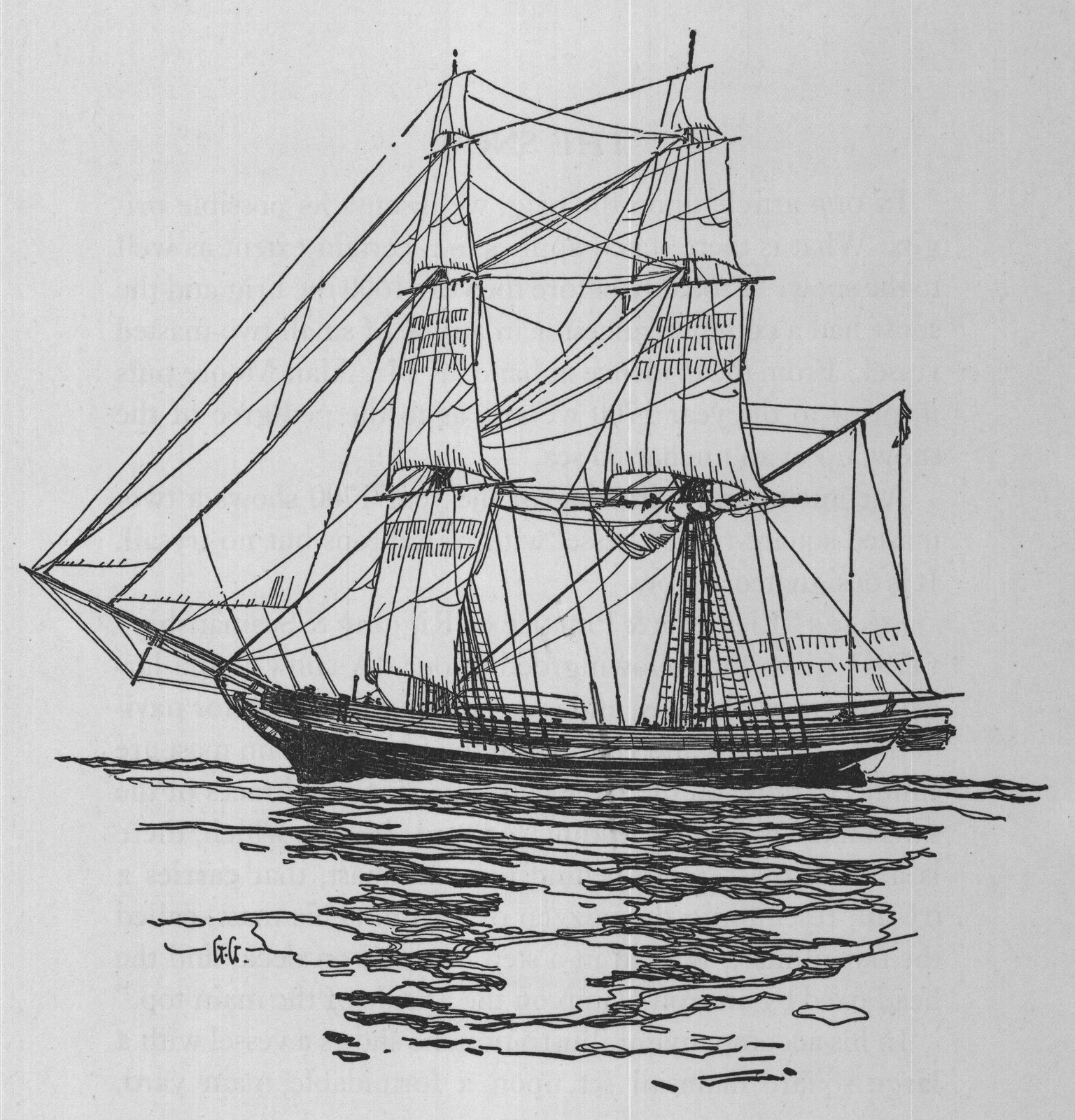
Many persons insist on calling brigantines hermaphrodite brigs. It seems to be more difficult, however, to distinguish between the brigs and snows, as both partook and still partake of the same peculiarities of rig. The claim has been made also, that the trysail mast is not or was not originally the distinguishing feature of the snow; and that it was, rather, the shape of the hull at the bow which gave it the name (snausnout).
Our illustration shows the good old-fashioned snow of Steele's time, with trysail mast, quarter galleries, and bewindowed stern, capacious lanterns, plenty of sheer and tumble-home; without doubt "extremely convenient for navigation."