Home › The Cromster
The Cromster
IN THIS type, which enjoyed prominence in England during Elizabethan days and later in Holland, we find a vessel probably taking its name, according to Mr. Nance, from the shape of its stem piece.
Instead of the stem shaped like the letter "C" which may have been mentioned before as a characteristic of several Dutch vessels, the cromster's beak-head caused the stem to assume a form something like a reverse curve or flattened letter "S." The Dutch word cromsteven, meaning bent or crooked stem, was the name for the counterpart of this vessel as it existed in the waters of the Low Countries.
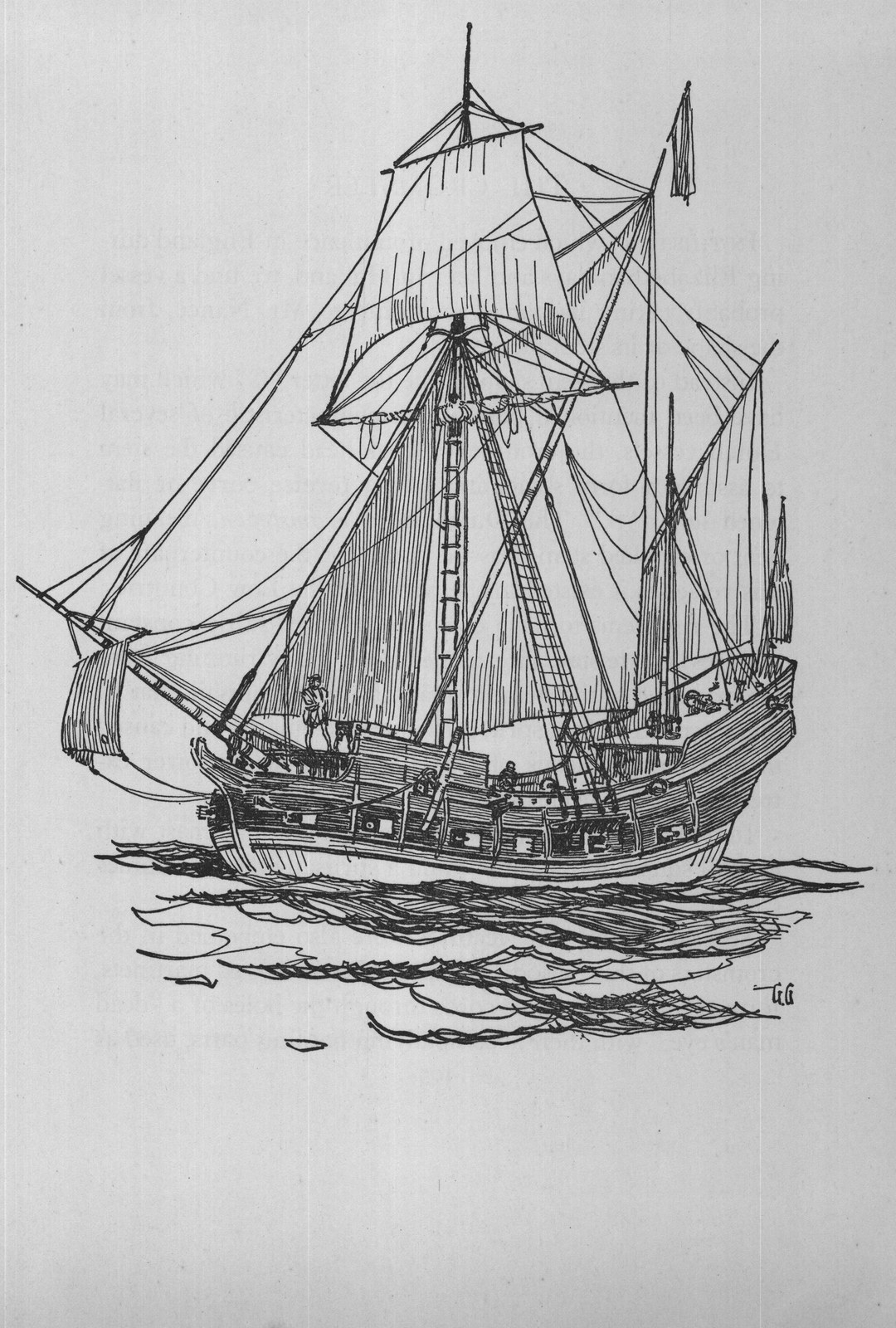
The rig seems to have consisted of three fairly constant features: a fore staysail extended upon a stay running from the masthead to the stem; a smack form of mainsail, that is, one extended upon a sprit, guyed near its middle and caused to peak up by means of a tackle rigged to its lower extremity, and a lateen mizzen.
In addition to these, a square sail on the mainmast with a small square topsail above and a spritsail were sometimes carried. Several "square-rig" features were also embodied in the cromsters of this period. These are the six-legged martinets, formed by passing three cords through the holes of a "dead man's eye," with their accompanying hauling parts, used as brails for the mainsail (the counterparts of our bunt and leach lines of to-day), the topmast stay, set upon a sort of crow's foot passing through a piece of rope nailed to the bowsprit to receive the legs (or should we say the toes?). Another interesting feature is the peculiar yoke employed as a support to the topmast shrouds.
The cromster seems to have been particularly adaptable as a war vessel. Sir Walter Raleigh commends it as being able to carry several good-sized cannon (demiculverins).
These hoy-rigged vessels were often of considerable size, one hundred and eighty tons and more, quite as large as the Mayflower, their contemporary. It is reported that such a vessel was capable of mounting sixteen or seventeen brass cannon besides iron pieces and perriers so arranged that the ordnance appeared at three different heights, and that admirals of the early 17th Century sometimes hoisted their flags aboard them in preference to square-rigged ships.
The cromster was notably too much like the hoy to permit the name to survive long as the designation of a separate class. Like so many other old-type vessels, perhaps the only place where one may now be seen (and then only in imagination) is in that mythical vortex of ancient shipping in the impenetrable centre of the grassy trap where it is claimed are gathered together in an inextricable tangle every form of ship that ever sailed the seas, from the beginning of the world down to the present day, if one will journey thither with Mr. Thomas A. Janvier in his pleasant literary vehicle entitled "The Sargasso Sea."