Home › The Brig
The Brig
THE origin of this type of rig has been variously assigned by students of the evolution of sailing craft. Some would trace its ancestry to a late 16th Century two-masted vessel similar in rig to the buss, or to the buss itself. Others claim that the early brigantine with a fore and aft mainsail was the progenitor of the brig and that the word "brig" is merely a shortening of that longer appellation. Others prefer to think that the brig is an adaptation of a three-masted ship, the mizzenmast being omitted. Whatever may have been their origin, the three terms, snow, brigantine, and brig seem at various periods to have been much confused and applied rather indiscriminately to three kinds of vessels between which we to-day would not hesitate to differentiate. If the brig be compared with a ship deprived of its mizzenmast, we shall note some differences.
In a ship the main braces lead aft to the extreme limit of the quarter. This method is obviously more or less inapplicable to a brig, as such a lead tends to pull down upon the main yard when it is sharply braced. Although perhaps this was not always the method of leading them, the braces of the main yard as well as the main topsail yard and main topgallant sail yard lead forward. These forward main-yard braces correspond to the preventer main braces often employed in ships for hauling the weather side of the main yard forward, instead of placing the major part of the strain upon the leeward main brace. Other peculiarities might formerly have been noted in that brigs during the later years of the 18th Century rarely carried square main courses, their mainsails being of the fore-and-aft character, usually with a boom, the forward side or luff of the sail being attached to the after side of the mainmast by means of hoops sliding upon the mainmast. Such a brig carried a cross jack yard instead of a main yard. These characteristics differentiated the brig from the snow (q. v.) which carried a square mainsail in addition to its fore and aft mainsail, the latter normally rigged upon a try-sail mast. Man-of-war brigs sometimes were fitted with a "horse," that is, a vertical rope to which the luff of the fore and aft mizzen was fastened by hanks in the same manner as a stay-sail or jib. Brigs to-day are often fitted with a square mainsail in addition to their fore and aft mainsail, just as ships now usually carry square mizzen courses on their cross-jack yards. Brigs are very handy and many of them sail fast. They were a favourite medium of privateering, and it was a short step from that occupation to piracy. And the brig was what might have been termed the pirate's own vessel.
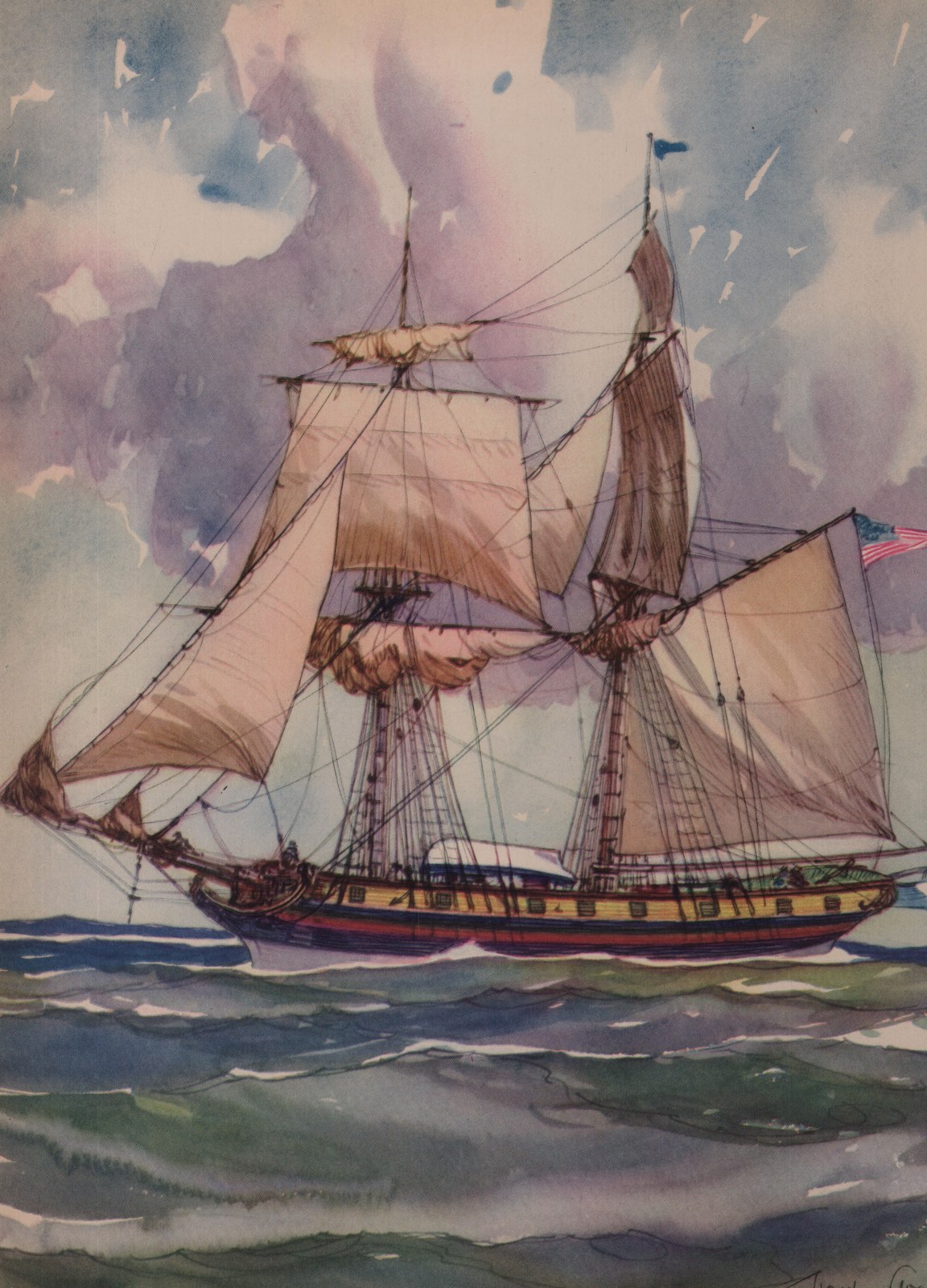
About a hundred years ago brigs were much employed in sea-going commerce. From the many delightful pictures made by Mediterranean artists, the brothers Roux, Corneille, Pellegrini and others, it would seem as if one of the main events of the career of such a vessel, if not absolutely the most important, was to have its portrait painted at Marseilles or Genoa by one of these delightful and competent artists.
Owing to this custom, we have to-day many intimate and spirited representations of these vessels, with their names and those of their masters, information which gives the key to the history of much of the shipping of the period.
Besides their regular cargoes, our vessels often brought back mementoes and treasures for the dear ones at home, carved coral, mandarin coats, laces, fine Chinese and European porcelains, the latter commodity then practically at the height of its artistic excellence.
To judge by the fine examples of many of these works of art still in the possession of the descendants of America's early seamen, the old-time ship masters must have had almost as good a weather eye for the colour and decoration of a fine Derby or Spode tea-set or the delicate modulation and paste of a Kwang He vase, as for the indications of a coming favourable breeze or for bad weather.
One has only to visit the Essex Institute and the Peabody Museum in Salem, Massachusetts, to see many examples of these treasures and the delightful old-time portraits of the vessels which brought them to this country.