Home › The Galleass
The Galleass
JAL says that this name (galeasse in old French) was the name given first to a galley larger and stronger than the common galley, but resembling it closely. This large galley or galleass, as it was called in English, had been considerably developed by the end of the 15th Century. During the middle of the 16th Century, vessels of this form played an important role in all great naval combats. They were the deciding factors in the battle of Lepanto (1571), resulting in the victory of the western nations in their struggle against the menace of Turkish domination in Europe. They also fought valiantly on both sides in what Jal calls the fatal "rencontre" between the Spanish and English, ending in the destruction of the Invincible Armada in 1588. Pantero-Pantera writing in 1614, describing the Venetian galleass of the period, says that such a vessel of twenty-five or more oars on a side, compared with an ordinary galley, would be about a third longer, and wide and high in proportion. Forward and aft it had large platforms or decks upon which stood a part of its broadside artillery. This part of the vessel also served as a vantage point for the soldiery.
A solid deck covered the waist above the rowers and afforded also a large open space for handling the sails, and upon which a considerable number of guns and soldiers could be placed.
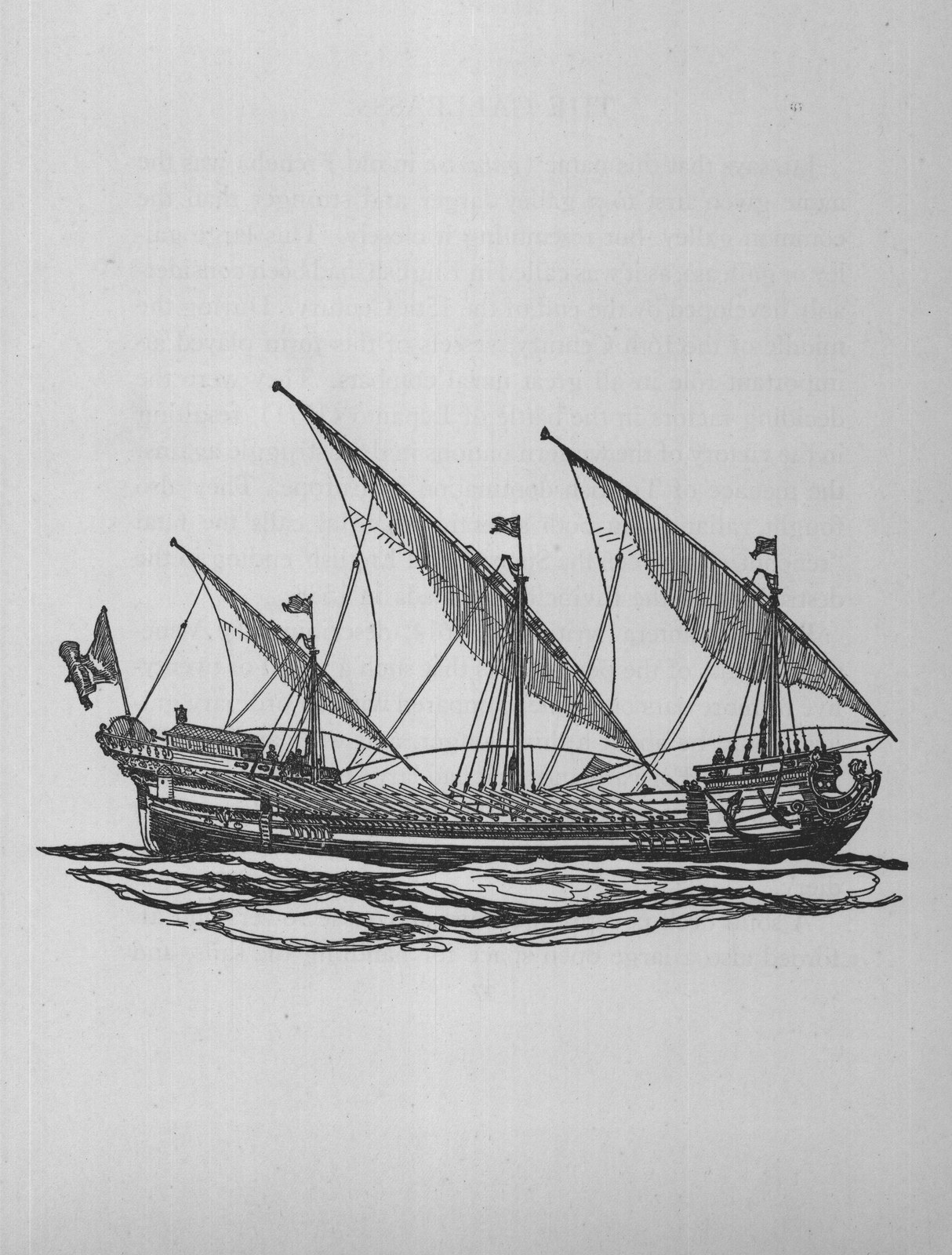
Less swift than the ordinary galley, its usual place was in the second line of the advance guard of the battle, and it was in this position that the largest galleasses of the Armada were placed. And it was from such a vessel that the Duc de Medina Sydonia, who commanded that great gathering of vessels of war, conducted his operations.
The Mediterranean galleass was usually lateen rigged with all the peculiarities of that style obtaining in the galley. In England during the reign of Henry VIII the word "galleass" seems to have been applied to several types of vessels, but by the end of the 16th Century the term was generally confined to a form of large ship with high freeboard propelled by oars either with or without sail power. John Montgomery, in a treatise entitled "Concerning the Navie of England" (1570-1588), says that "Galliasses brook the seas as well as others," and that "Shipes to saile and row have advantages over others." He says that a galleass of six hundred tons and having twenty oars on a side would require five men at each oar. While one of the outstanding and persisting features of the galley was its far-projecting beak-head or ram, it does not seem that this spur was ever a marked characteristic of the galleass. It is true that representations of the vessel are found embodying this feature, but that it was of little use for ramming in a vessel of the type we are considering must soon have become apparent.
This form of beak-head ultimately changed to the form in which we see it in the illustration depicting a galleass of the middle of the 17th Century, and it is in this form that we find it in most of the sailing ships of that period.
The Turkish mahona seems to have been, during the 17th Century, about the equivalent of the Venetian galleass of that time. And probably the respective Christian and Mussulman vessels of a century earlier were quite similar in form and size.
If any one wishes to learn in detail the part that the galleass played in saving western Europe from Turkish invasion, he may find it graphically set forth in the late Commodore F. A. Parker's description of the Battle of Lepanto in his "Fleets of the World, The Galley Period."