Home › An English Sixty-Gun Ship of About the Year 1690
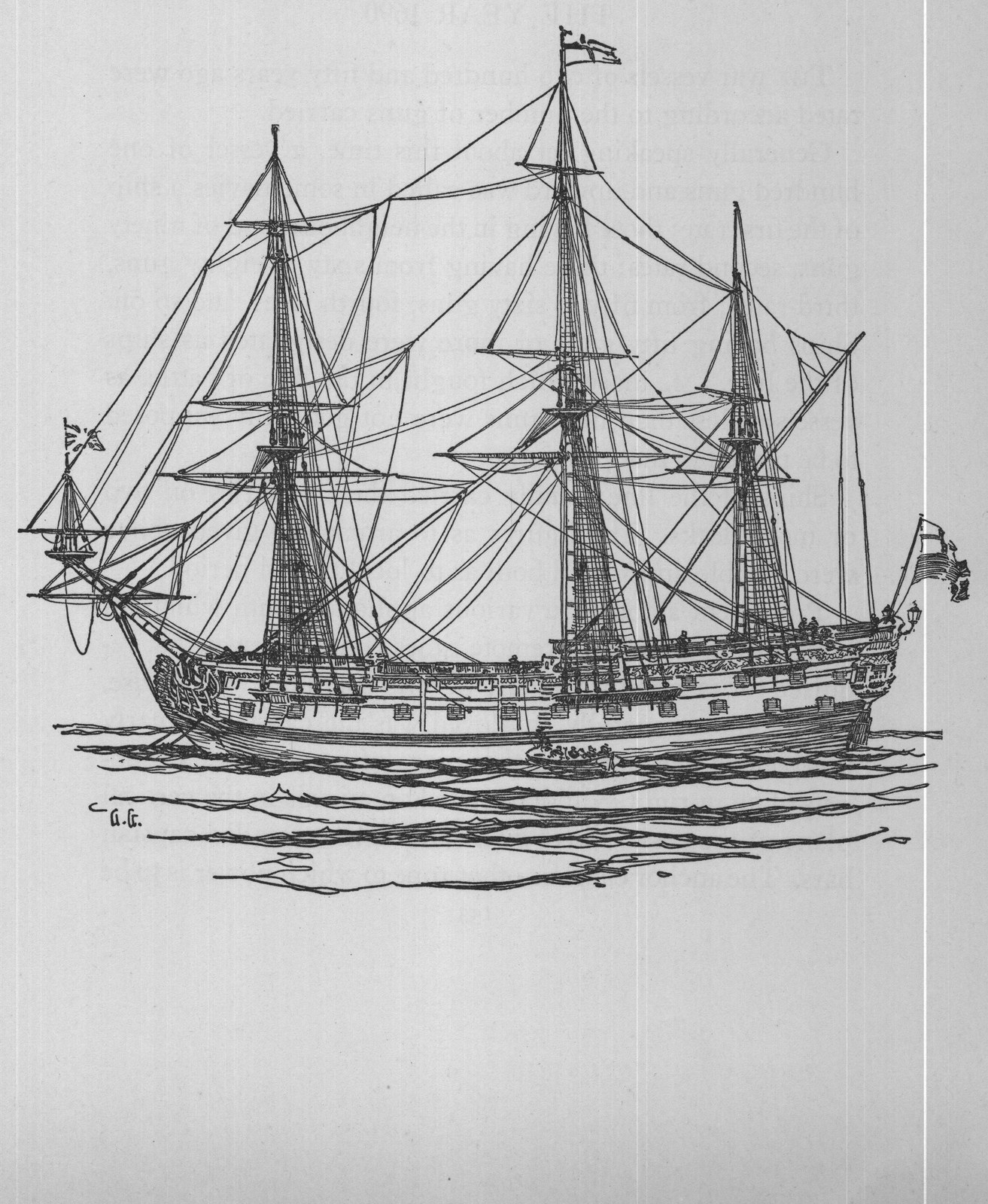
An English Sixty-Gun Ship of About the Year 1690
THE war vessels of two hundred and fifty years ago were rated according to the number of guns carried.
Generally speaking, at about this time, a vessel of one hundred guns and upward was called in some navies a ship of the first rate; those having in the neighbourhood of ninety guns, second rates; those having from sixty to eighty guns, third rates; from fifty to sixty guns, fourth rates, and so on. Ships having fifty guns or more were designated as ships of the line, i. e., those which fought in the line of battle, as vessels of less than fifty guns were not generally supposed to be placed in that position. Ships of the line usually carried their batteries on two or more decks. The figures as to armament given above were flexible and varied both as to locality and period.
Prominent among the various appliances with which all vessels were from most remote times equipped, was that required for raising the anchor. Several machines were in use, but the most generally employed was the capstan. Nearly everyone is familiar with that piece of machinery. It consists of an upright cylinder rotated on an axis in the vertical plane of the vessel's keel by means of levers called capstan bars. The anchor cable or other rope to which power is to be applied passes three or more times around the capstan, and as the hands walk around pushing on the capstan bars, other hands, continually holding the rope taut, gather in the slack. The capstan bars were formerly held in place by a light rope passing through horizontal holes in their extremities. This rope was called a swifter.
To show an example of the complexity of marine terminology, there were not less than three sorts of swifters used on a ship.
The Leconsfield Manuscript, an early 17th Century treatise upon the rigging of ships, thus describes another variety of swifter: "Thei ar as big as the shrowdes and fastened to the head of the mast and chaine wales as the shrowdes. Ther ar 2, on [e] on each side. They serue only to stay the mast and beare with the shrowdes." This means that they constitute the first or the farthest forward of any set of lower shrouds.
In order to tighten the shrouds quickly when it was not feasible to set up on the lanyards in the deadeyes, another device was employed. A single block was seized inboard at the same height (about twenty feet above the deck) to each shroud. A rope also called a swifter was then passed back and forth diagonally between these blocks so that each in turn was brought into the system. When the swifter was boused taut, it constricted all the shrouds equally on both sides by hauling both sets inboard, thus taking in any slackness. This custom was pretty generally followed until wire rigging superseded the old fibre cordage.