Home › The Modern Super Ship a Five-Masted Bark
The Modern Super Ship a Five-Masted Bark
IF A full-rigged ship of, say, one hundred and twenty-five years ago, could be placed alongside a modern steel sailing ship of similar tonnage, it would be interesting to compare the many differences to be observed between the two. Beginning with the hulls, it would be noted that at the bow, the later ship's stem was altogether dissimilar to that of her older sister. In the latter a straight cut-water or stem-piece, raking forward at an angle of about forty-five degrees, terminated in a figurehead set squarely and practically vertically upon it. The stem-piece was joined on each side to the forebody of the ship above the water line by three or more curving pieces of wood called rails of the head, these being again strengthened by vertical ties crossing the said rails at right angles and floored with several curved wooden gratings in the middle of which rose the bowsprit at a quite steep angle or "steeve." This whole structure was called the vessel's beak-head, and all of it was quite separate from the vessel's hull. At this point the hull itself was rounded while lower down near the water line the form still showed a convex curve. The modern bow would be concave at the water line, while on deck the lines would be almost straight and join at an acute angle right at the stem, entirely embracing within the hull's structure all that part of the vessel formerly composing the beak-head. The transition may be traced through the trail boards and the ultimate covering in of all the open framing of the beak-head.
The figurehead has disappeared and in its place one may notice at most a few gilt scrolls, or more likely no ornament whatsoever. The steeve or inclination of the bowsprit has decreased and has approached more nearly the horizontal. Gone are the spritsail yard and spritsail topsail formerly swung under the bowsprit and jib boom. In addition to the bobstays and extending down from the bowsprit cap is a truss for the lower bowsprit stays sometimes called a dolphin striker.
The bowsprit shrouds, no longer needed as guys for the support of the spritsail yard, now stretch from the vessel's hull direct to their points of support upon the bowsprit proper and jib boom. Even the successor of the spritsail yard long used after the disappearance of the square head-sail, as a spreader for the bowsprit shrouds, is rarely to be seen. In fact, in the most modern vessels the jib boom has disappeared.
In many of the more modern steel and iron ships, the forecastle raised above the vessel's upper deck still survives, while a similar structure aft, successor to the old-fashioned quarterdeck but much shorter, is now usually dubbed the turtle back. In the midships sections of the two hulls, not so much difference would appear, for the merchant ship of the beginning of the 19th Century had a flat floor, a quick turn at the bilge, and nearly perpendicular sides with not nearly so much tumble-home as the warships of the period showed. In the stern of the more modern ship a marked difference would be apparent. One would look in vain for the quarter galleries and for the transom with its many windows and fancy "ginger-bread work," as the old salts delighted to call the ornate gilded carvings formerly to be found in rich profusion on these portions of the vessel's structure. In place of all these, the modern ship would be found to have a rounded stern shaped underneath like a melon cut in half along its largest axis. The vessel's sides, too, show many differences. The old longitudinal wales have given place to long lines to rivet heads marking only the joining of large rectangular metal plates. The wide projecting chain wales with their chain plates and deadeyes are gone, and in their places are individual plates riveted to the vessel's side, each terminating with an eye to receive the turnbuckles for setting up the shrouds and stays instead of the old-fashioned deadeyes and lanyards.
Turning to the spars we find steel largely replacing wood, although some of the smaller and lighter members are still wooden. The tops are noticeably smaller, while the form of the crosstrees has altered. Steel and bronze have replaced the standing rigging and to a certain extent some of the running rigging. Those parts of the sheets upon which the wear comes, i. e., those passing through the sheeves let into the yardarms and through the quarter blocks, are of chain.
The change effected by the employment of steel rigging was almost revolutionary. Hempen cordage was subject to quick decay and, what was worse, stretched interminably.
It was no uncommon event for a ship's mainstay, a rope usually about nine inches in circumference, to stretch four feet in the course of a long voyage. This continued lengthening necessitated frequent adjustment and was a constant menace to the security of the masts. Steel wire standing rigging requires practically no attention and is almost unbreakable.
The metal trusses bearing the yards have obviated the need of all the old gear such as trusses and parrels, and by reason of their extension of the yards far out from the masts, have enabled the yards to be more closely braced when on the wind. Double or upper and lower topsails and topgallant sails render easier the tasks of stowing and reefing these formerly unwieldy canvases, while skysails are now almost always a part of the ship's regular equipment. In former days royals seem to have been regarded as only occasional sails. The leads of many of the braces too have been changed, especially those of the fore yard and all of the topmast yards. These now lead to the sides of the ship instead of to the stays and shrouds, dispensing with many leading blocks and much friction in handling, thereby saving both labour and cordage. The blocks are now nearly always steel-strapped or constructed entirely of metal. On many of the later ships, fore and aft sails have made their appearance upon both fore and main masts in addition to that on the mizzenmast.1 (See Note 10, Appendix.) The internal arrangements are similarly changed. Many of the large sailing ships have power for handling the sails furnished by means of steam or internal combustion engines. The pumps are operated by power and the interior of the vessel is adequately heated.
Notwithstanding the many labour-saving devices and appliances for the comfort and sanitary condition of the crew, the life of the common sailor, although not so hard as formerly, is still no sinecure.
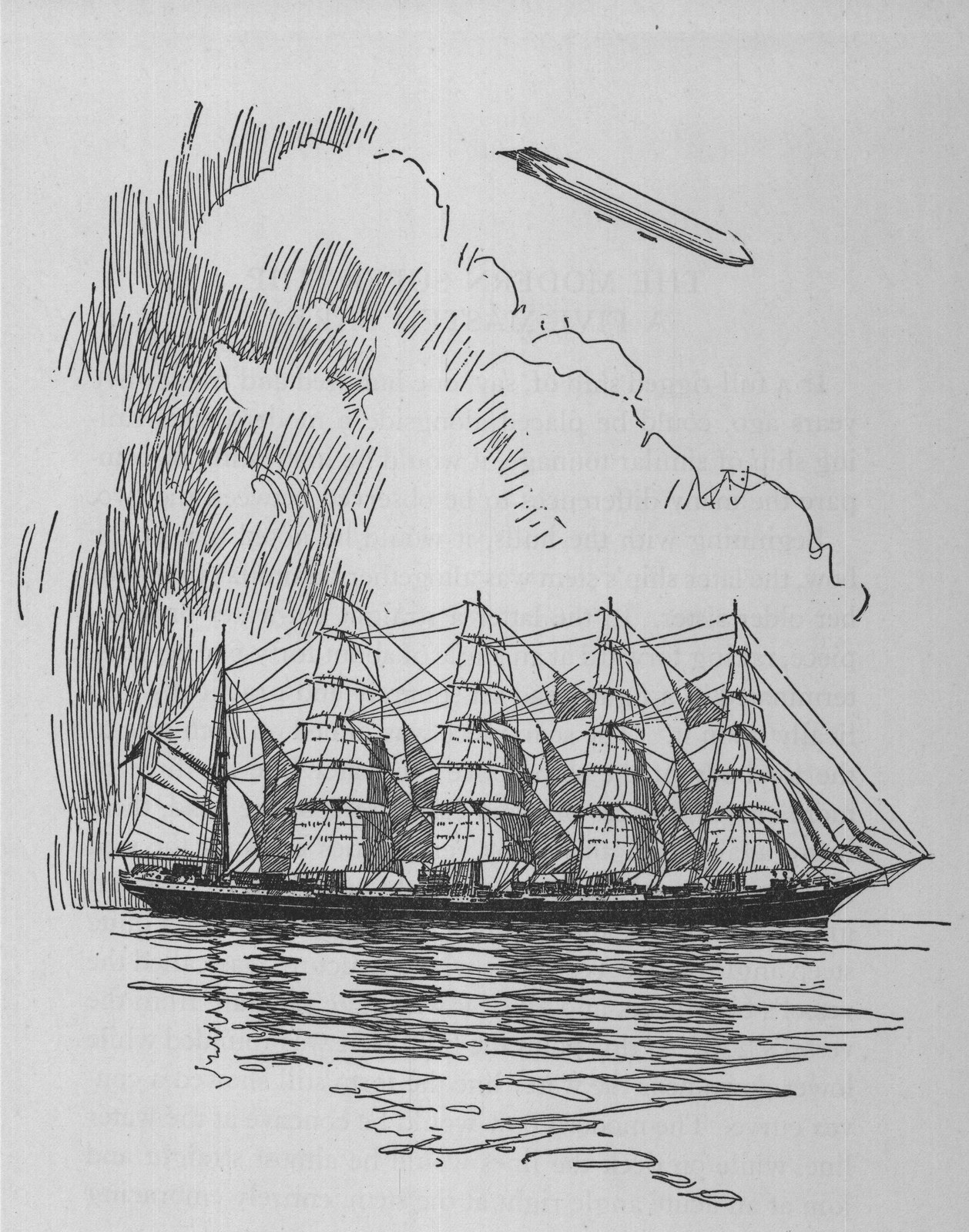
Our illustration shows the 20th Century clipper, the super ship. This remarkable sailing vessel, the Kobenhavn, was 390 feet long on deck and 420 feet over all. Her breadth was 49 feet or a ratio of only one to eight. The proportion of the hull therefore approximated that of the extremely narrow galleys of the Middle Ages. The ship's gross tonnage was 3,965 and her load displacement was 7,900 tons. She was equipped with a wireless apparatus, and her form of construction resembled the modern steam vessel in having a double bottom and many longitudinal and transverse watertight bulkheads. And yet this huge vessel was operated by a crew all told, including officers, of only sixty-five men and boys.
She was built at Leith, Scotland, in 1921 by Messrs. Ramage and Ferguson and went missing in 1930 somewhere between Capetown and Australia. Steam navigation and wireless communication have robbed the sea of much of its mystery, one of its greatest sources of romance. But who can look at a fine ship or bark with its free lifting head-sails swelling to leeward, its snugly braced yards with their symmetrical squares of billowing canvas cut into rotund patterns by the buntlines and leach lines, the taut staysails and the light lacery of the rigging outlined against a gleaming sky, the white bone at its forefoot and the shimmering water astern, without experiencing a thrill to remind one of the inherent beauty of the old-fashioned sailing ship, its glorious past and its dubious future?