Home › A Capital Ship of 1820
A Capital Ship of 1820
No BOOK about old ships, particularly none that would make a point of emphasizing the romance of ancient shipping, could justifiably omit Nelson's Victory.
Not only was Horatio, Lord Nelson one of the most romantic figures in the history of the English-speaking peoples, but the ship identified with his crowning success and death at the moment of triumph, the Victory, is the epitome of all that is inspiring and romantic in marine lore. Nelson's Victory was the fifth ship in the British Navy to bear that name. The first Victory began her career as a merchant ship under the name of the Christopher. Just when she was built is not known but apparently she was purchased for the Royal Navy in the year 1562, and renamed. The three following Victories were launched in the years 1620, 1675, and 1737 respectively.
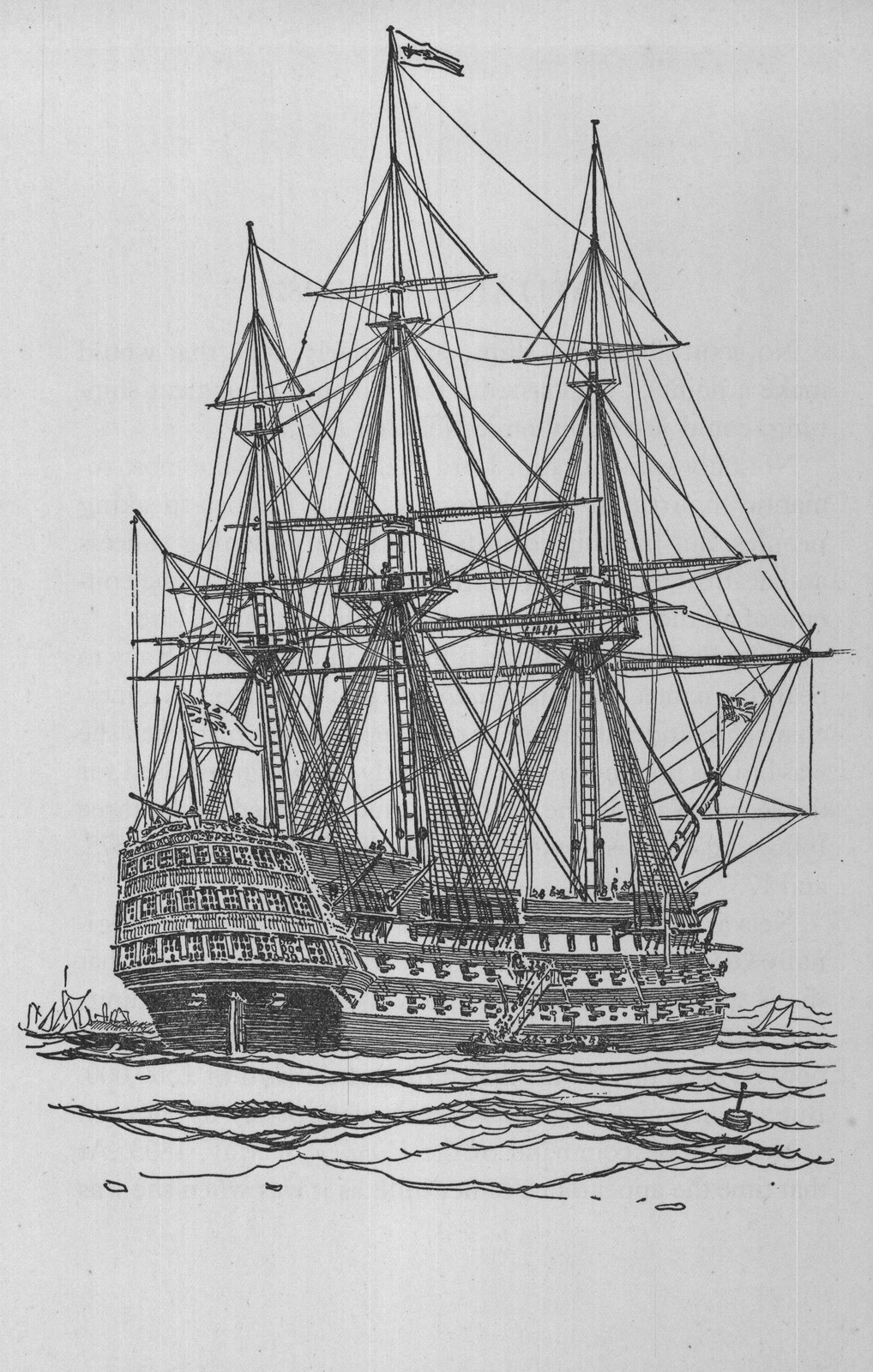
Nelson's Victory was launched in 1765. She cost originally pound63,000. Since then (for nearly everyone knows that she is still in existence) she has had numerous rebuildings and repairs, until her total cost to the British nation has now reached the astonishing figure of upward of pound500,000. But as a national asset she is worth every penny of her cost. Nelson took command of the Victory in May, 1803. At that time the appearance of her hull, as it was when she was launched, had been considerably changed during her reconstruction in 1800 after the battle of Cape St. Vincent in 1797.
As to rigging of course the earlier vertical sprit topmast had been replaced by a jib-boom, a martingale helped to support the bowsprit, trail boards gave more protection to the beak-head, the long lateen yard on the mizzenmast had disappeared, and various small modifications, rather in application than in principle, rendered the rigging more efficacious.
The rebuilding of 1814-16 again changed the appearance of the Victory's hull to that which it bears to-day and such as we show it. Efforts are now being made in England to raise money by private subscription to restore the grand old vessel to the form she bore when she fought at Trafalgar. Nelson's immortal exhortation, "England expects every man to do his duty" (with the substitution of the proper country for the word "England") might well serve as a motto for us of to-day, when nearly all nations are suffering under a decided loss of spirituality.
It is a strange commentary upon the times that the World War brought forth no one outstanding figure in any country, with perhaps a single exception, Italy, that evoked demonstrations of popularity and devotion to compare with those which were evoked by Nelson.