Home › The Bilander
The Bilander
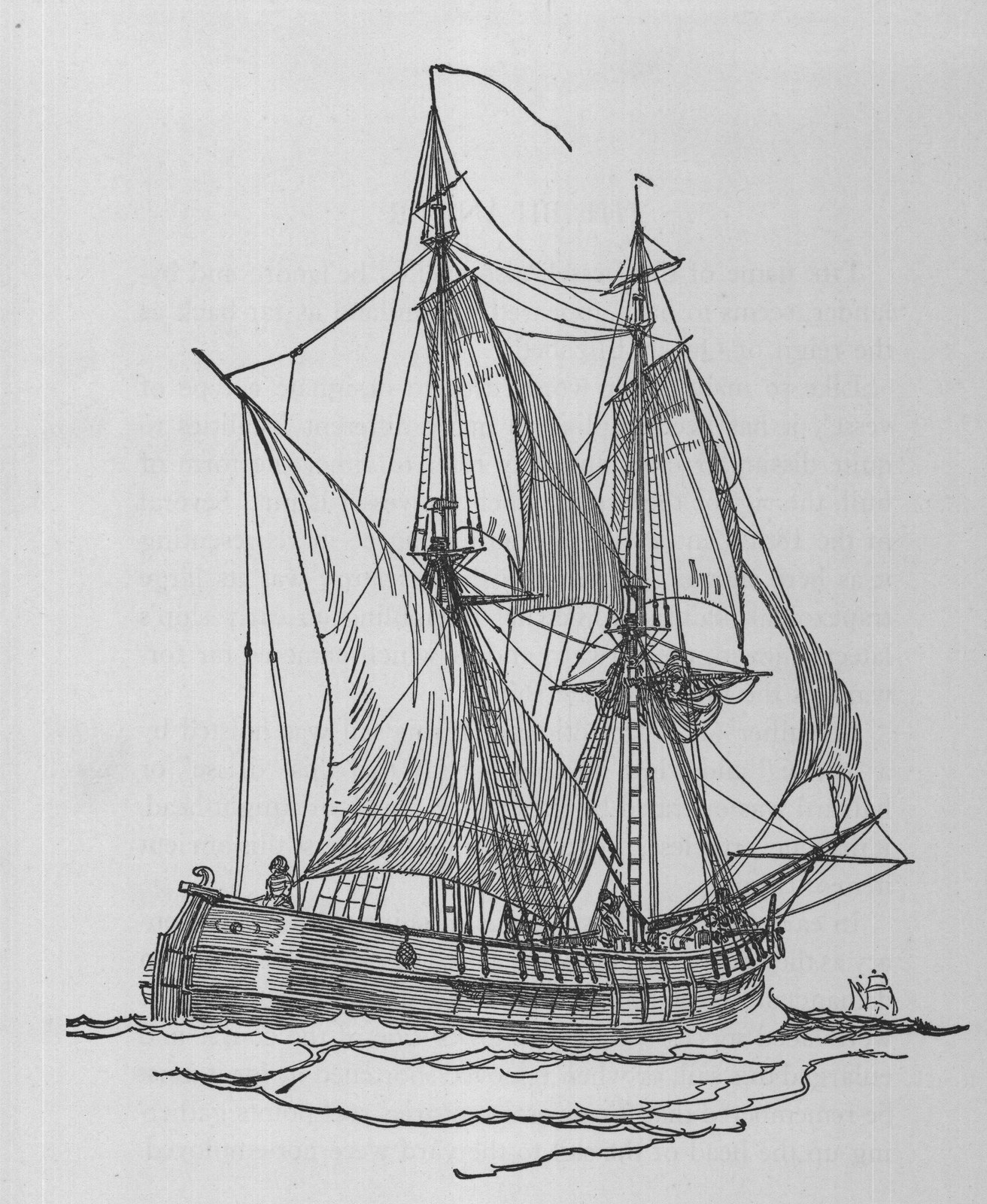
THE name of this vessel, also spelled be'landre and bylander, seems to have appeared in England as far back as the reign of Queen Elizabeth. Like so many other words used to designate a type of vessel, it has been applied in many different localities to quite dissimilar craft and may refer to either the form of hull, the rig, or the use to which the vessel is put. Several of the 18th Century marine writers agree in representing it as here shown. Its distinguishing feature was its large trapezoidal mainsail somewhat resembling an early ship's lateen mizzen, the forward end of which came as far forward as the middle of the ship.
Lescallier (1777) mentions that this sail was hoisted by a "drisse," and while he does not say that this "drisse" or halyard was operated by means of a "sep" or knight-head, it may, nevertheless, prove interesting to discuss this ancient item of rigging.
In early times the lower yards of ships were not stationary as they are to-day, but were raised or lowered as occasion demanded. Rectangular cloths called bonnet and drabler were laced successively to the lower side of the course and enlarged this sail, or when removed shortened it, for it must be remembered that for several centuries reef points gathering up the head of the sail to the yard were not employed. Lowering the yard also lowered the centre of effort of the reduced canvas and so eased the vessel in a high wind. For the purpose of changing the position of the yards, powerful machinery was needed. A stout rectangular post, securely fastened at as low a point as possible, projected a distance of four or five feet above the main deck abaft the mast. This was pierced longitudinally usually with four slots containing sheeves all rotating on the same axis. This constituted the lower portion of the tackle.
The upper portion consisted of a very large block, sometimes called a ram's head, having four sheeves below and another sheeve at right angles thereto above. The yard tye, also called the jeer, was reeved as follows: One end was fastened to the yard at the slings; it then passed through a block depending from the masthead or through a large sheeve on one side of the hounds, then through the upper cross-sheeve in the ram's head, up through the block at the masthead and down again to the yard where the end was hitched at the slings. The tackle was then united by the halyard passing successively through the said four lower sheeves of the ram's head and three of the sheeves in the "sep' or knight-head. The fourth sheeve in the knight-head was customarily employed as a lead for the top rope. The knight-head mentioned took its name from he custom of embellishing the upper portion of the "sep" with such a decoration, as was the practice also with bowsprit bollards. These still retain their romantic name, although their position and functions have changed. (See Note 7, Appendix.)