Home › An Eighteenth Century Frigate
An Eighteenth Century Frigate
While the word "frigate" is in itself not in anywise associated with the notion of decks, it is that portion of the ship's structure which immediately becomes important in any discussion of the type of vessel bearing that name. It seems improbable that the decks of the very early ships were flush, that is, that they ran from end to end of the ship without a rise or fall somewhere. If we consider the evidence furnished by the concrete examples of ancient Scandinavian ships actually before us, we see that they had short decks forward and aft at about the same level relative to the keel and a long lower one amidships. The question of the level of decks has aroused a great deal of controversy. Without expressing an opinion upon the correctness of the several contentions, it is unquestionably a fact that at a comparatively early day a new style of arrangement of decks made its appearance. This was accomplished by the installation of a continuous platform running from end to end of the ship without a break. Such a manner of construction was called "frigate fashion." Once introduced, the idea took hold rapidly. The earlier ships constructed by Peter Pett in the beginning of the 17th Century were said to be built in this wise, notably the Sovereign of the Seas of 1637. On May 3, 1696, Sir Peter Pett wrote a letter to Mr. Samuel Pepys in which he said, "Many years ago I gave Sir Christopher Wren the draught of an old-fashioned ship and another of the frigate fashion that he might see the difference of them."
The term "frigate" in its more restricted sense is quite another matter. Normally, and disregarding earlier applications of the term, the word has been used to describe one of the smaller types of warships, one having, say, from twenty-four to fifty cannon. This armament was carried on flush decks. Some of the smaller frigates were provided with oars as a supplementary means of propulsion.
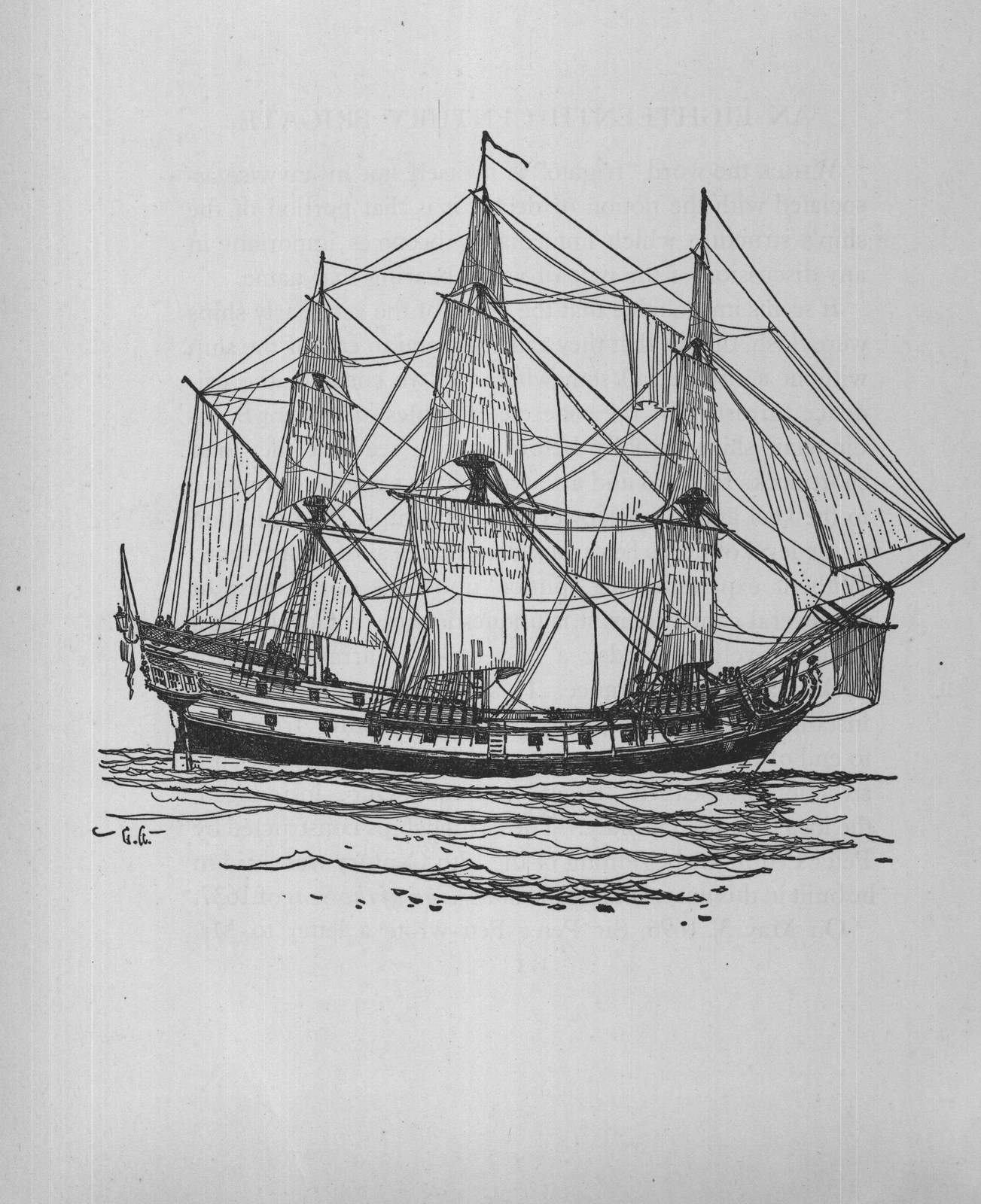
The frigate was more or less of an ocean free lance. Many of them were designed for speed and they were particularly efficient as commerce destroyers. During the latter years of the 18th Century the French led the world in designing ships, and their models were willingly followed by both English And American naval constructors.
Josiah Humphreys, in designing the first three American frigates, Constitution, Constellation, and United States, launched in 1797, followed what he called "the best French method."
The numerous single-handed combats between frigate and frigate are among the most stirring narrations in the annals of naval warfare. When steam power was introduced into naval vessels, many of the frigates were equipped with steam. With the coming of armour plate, the type disappeared, and now, with the exception of a few examples preserved for their historical interest, they have ceased to exist.