Home › The Lugger
The Lugger
Next to the galleon there is probably no old-time vessel which appears to appeal more strongly to the popular imagination than does the lugger. Nearly everyone is familiar with the quotation from the time-honoured melodrama uttered in a stage whisper, "Once aboard the pirate lugger and the girl is ours!" For the lugger has been long associated in fancy and in fact as well with piracy, smuggling, and deeds of violence.
With their lugsails flattened like boards, these craft not only out-pointed but out-sailed the lumbering revenue cutters set to the task of catching them, with as little chance as the proverbial snowball in the infernal regions. So much so that by an English statute the beam of luggers was so regulated that it was a crime to build or operate one of too narrow dimensions. And as a necessary corollary, armed luggers were introduced into the custom's service on the principle of setting a thief to catch a thief. A chart published as early as 1586 shows a two-masted vessel with what appears to be a lugsail forward equipped with vangs and a bonnet, a bowsprit, a spritsail, and a lateen mizzen sheeted to an outrigger. Lugsails are also mentioned by many of the writers of the 16th and 17th centuries.
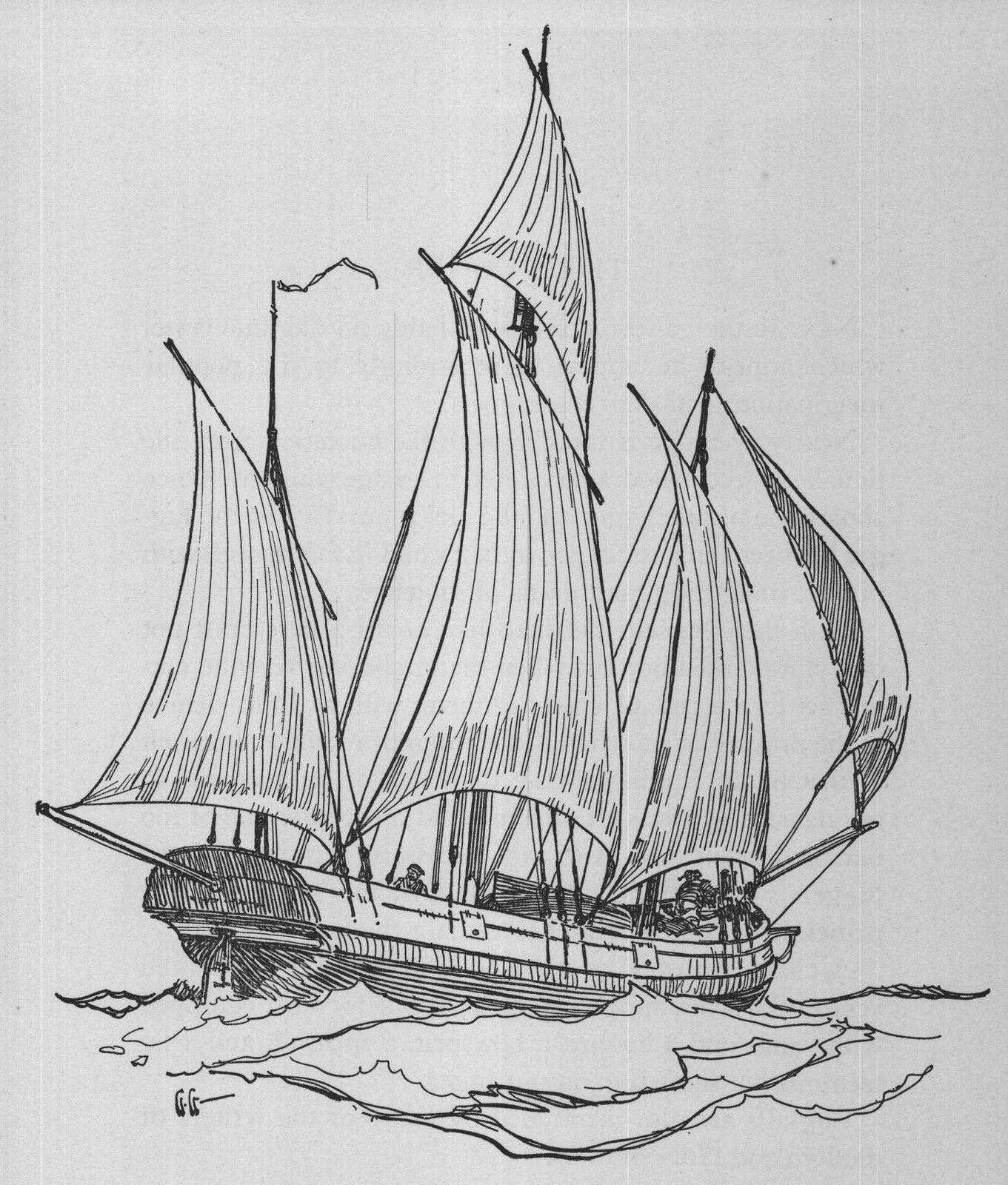
An early picture of a lugger (1794) shows a three-masted craft with lug topsails on the fore and main carried upon topmasts erected behind their respective masts.
There are two theories advanced for the origin of the lugsail, some claiming that it is a lateen sail bereft of its forward apex, while others contend that it was derived from the square sail, the yard of which, at its point of juncture with the mast, being fastened at a point approximately one third of its distance from one end instead of at the middle. As the sail was in vogue in both southern and northern waters, both claims may be correct. The luggers before the days of steam navigation were the furnishers of the fleets anchored in bad weather in the Downs and other harbours of the Channel ports. They were also great wreckers and slavers. It is believable that from their extortionate charges for these services they easily earned an unenviable reputation as pirates to which their associated trade in contraband contributed not a little.