Home › An Early Sixteenth Century Ship
An Early Sixteenth Century Ship
OF ALL the sumptuous fabrics which the imagination and ingenuity of man have devised in which to wend his way in splendour across the great deep, none has surpassed in romance and magnificence the Henri Grace a Dieu or Great Harry of the year 1514. Henry VII had in his day constructed a great ship comparing not unfavourably in size with all but the largest vessels of three hundred years later. So that the ship of Henry VIII was not large for her epoch, although she was probably of about one thousand tons burden.
That which appeals particularly to our sense of the romantic was the lavishness of her fitting-out when she was prepared to carry the King across the Channel for his meeting with Francois I at the Field of the Cloth of Gold. Launched at Erith, she was already six years old when she was taken in hand for this event. It was customary for all war vessels of this time to carry along their rails rows of shields called a pavese. In the Great Harry, these heater shields, or targets, as they were called, were displayed even around the tops. They were placed in groups of four, decorated respectively with the following devices: viz., the cross of Saint George on a silver ground, a golden fleur-de-lys on a blue ground, the Tudor rose on a green-and-white ground, and the golden portcullis on a red ground. Furthermore, the sails were on this occasion made of cloth of gold, damasked. Long forked pennants flew gaily from the mastheads, yardarms, and other parts of the vessel, the cross of Saint George predominating. At the corners of the poop were banners bearing the Tudor dragons on a green-and-white ground, and at the similar corners of the forecastle the royal arms of England were borne on golden-tipped lances. The vessel's high sides were covered with gothic windows and panels, artistically painted and gilded. Into these the wales and skids, the structural parts of the ship, gracefully blended. The stern, above the square tuck, rose in curving tiers, and the narrow after part of the poop was studded with gothic windows and bristled with cannon, if we can believe the contemporary painting of Vincente Volpe, depicting the King's departure from Dover harbour on May 31, 1520.
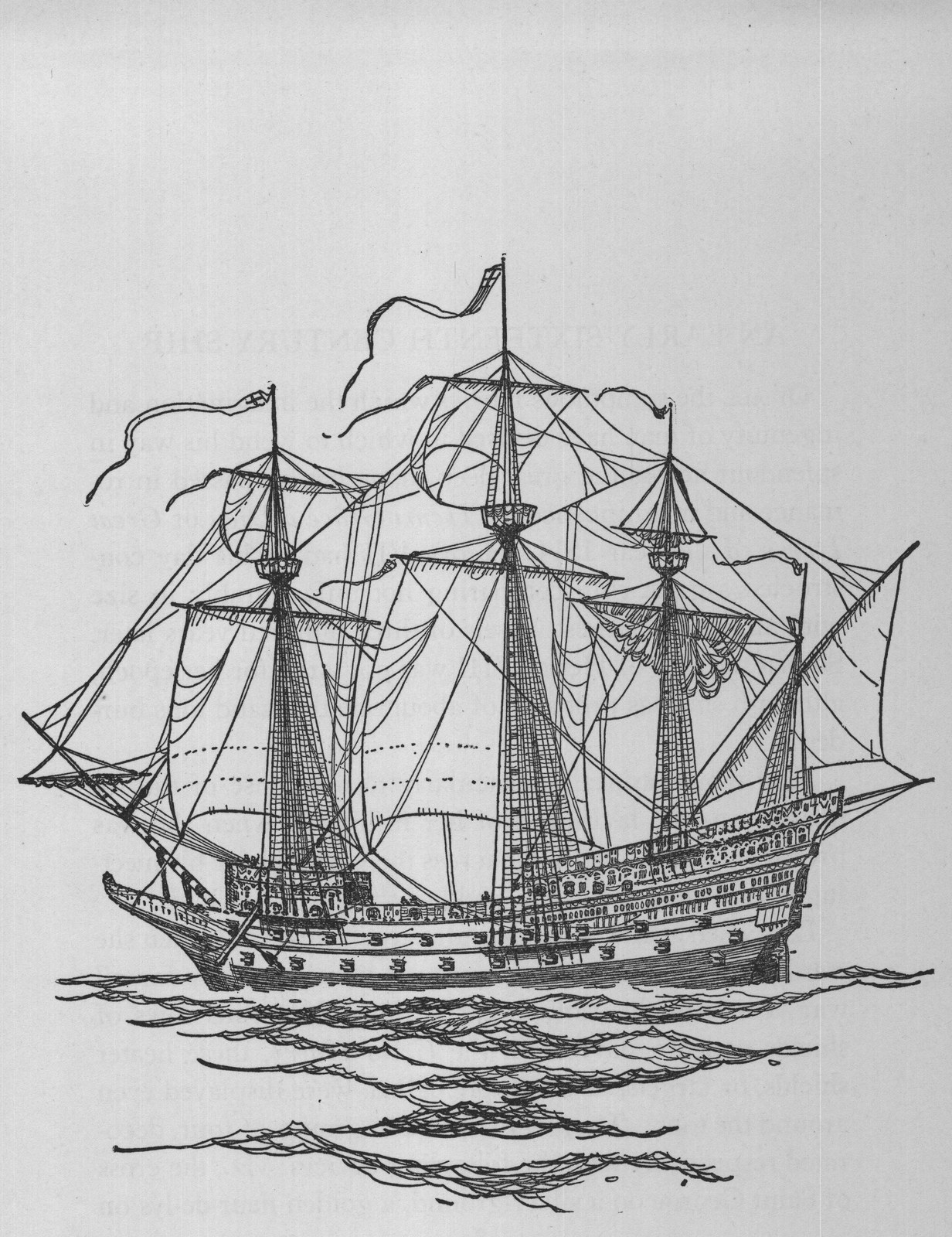
Staunch as she looked, the Great Harry probably was a bit cranky, as the King declined to return from France aboard her. Perhaps his overthrow in a friendly wrestling bout with the jovial Francis had something to do with his decision. At all events, the Great Harry must have been a thrilling and splendid sight as she stood out of the harbour, her great golden sails swelling in the soft spring breeze, her flags and banners fluttering, the royal trumpeters, an indispensable adjunct upon such an occasion, blowing forth paeans of martial music, with the lustre of the kingly presence lending an added glamour to her almost conscious magnificence.
The illustration is intended to be a rationalized version, drawn from contemporary sources without exactly copying any particular one, of such a ship as the Great Harry may have been. (See Note 3, Appendix.)