Home › An East Indiaman of 1750
An East Indiaman of 1750
"The Governor and Company of Merchants of London trading to the East Indies," as was the early official name of the Honourable East India Company. It was a creature of high privilege. Chartered in the year 1600, it maintained its lucrative and exclusive trade, sternly suppressing all competition by other British subjects-"interlopers" they were called-until its unrepublican character at last penetrated the callousness of English statesmen at the end of the 18th Century.
The Company's ships were well armed and heavily manned. Pirates both of eastern and western provenance were always to be feared, while the numerous wars in which England participated during the term of the Company's existence rendered it necessary to be well prepared for emergency. It was in the form and build of the hull that the Indiamen differed from the contemporary warships. As cargo carriers, the full underbodies, flat floors, sharp turns of the bilges and quick rises, stamped them as slower and more capacious fabrics.
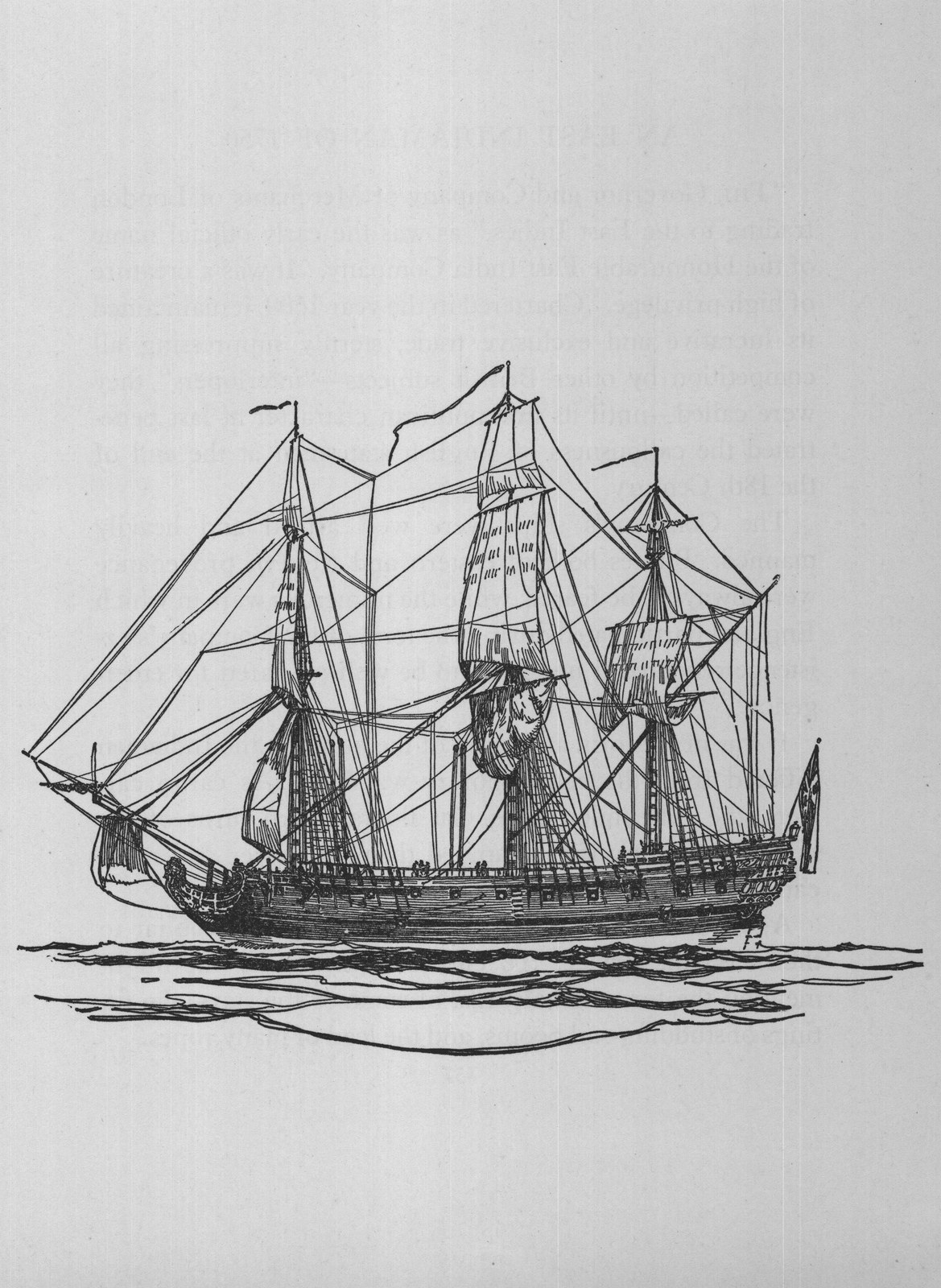
Again there were many practices in rigging peculiar to the merchant service. To cite some instances, one might mention the form of halyards, of some of the stays, the fittings of studding-sail booms, and the lead of many ropes. Studding-sails were one of the stand-bys of the Eastern trader. With fair winds and good weather, they sometimes sailed incredible distances without changing the position of a tack or sheet, although sail was always shortened at night.
The illustration shows a ship which might be easily taken at first glance for a war vessel. But if we could have a look at the arrangement of the decks, we would soon see a decided difference.
Fortunes were quickly acquired in this commerce, in which the ship's master not infrequently shared, for he was , under certain conditions, permitted to trade on his own account in a space in the ship's hold especially set aside for him. A single voyage often netted the master as much as pound10,000! Richly dowered daughters were common among the East India merchant princes, whose dollars matched and over-matched patents of nobility and decorations. If the romance of many of the marriages of money with position waned with the honeymoon, there was enough of it in the wealth of the Indies to lure new generations to the same practices.
And the long voyages to and from far-off Bombay and Calcutta, with the blue boundless ocean stretching out on all sides, the constant companionship, the occasional days and nights of terror, all were rare settings to affect young and impressionable hearts. And if this sort of romance is not the true romance of the sea, it is at all events its certain corollary and the foundation of many a happening which no one would hesitate to call romantic.