Home › The Howker
The Howker
Of the round-sterned genus and a near relation of the buss and the dogger, was the howker. This spelling is preferred to hooker, because Mr. H. S. Vaughan has pointed out, with considerable force, that the English and Irish fishing boats really receive this name because they are generally employed in fishing with hooks and lines.
So that we will confine ourselves to discussing the 17th and 18th Century craft of the name, the Houcre or Hourque of the French and the Hoecker of the Dutch, when the howker was a ship of burden ranging in size from fifty to two hundred tons.
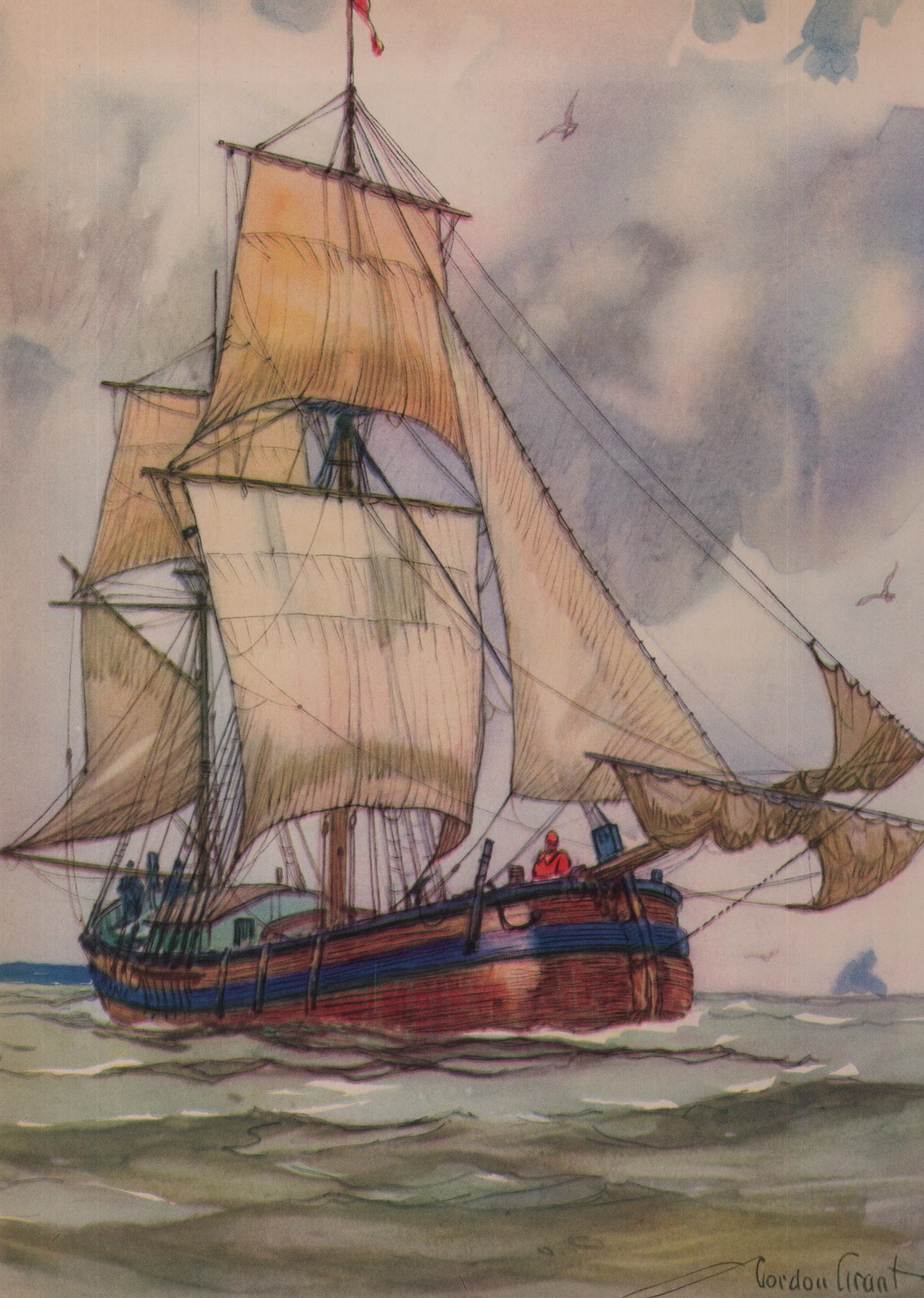
The earliest illustration of what may be a howker is to be found in the original Mariner's Mirror of 1588. In the year 1669 there were armed French vessels of this description. Van Yk (1699) gives the design of a hoecker for the East India service, and the three 18th Century writers, Aubin (1702), Lescallier (1777), and Steele (1794), all give cuts of the type. The hull had a rounded stubby bow, a curved stern, a high rudder with a tiller coming in above the stern post, double wales, and often a cabin aft under a small poop deck.
The rig varied somewhat according to period and locality, but by the beginning of the 18th Century resembled closely the ketch of the period. Lescallier's and Steele's illustrations show a pole mainmast but the mizzen topmast is a separate spar. The bowsprit was rigged to one side of the stem and could probably be hauled inboard.
After the year 1800 the term howker seems to have been applied to many one-masted vessels, probably for the reason, as pointed out by Messrs Alan Moore and R. Morton Nance in their admirable article upon this vessel in the November, 1911, issue of the Mariner's Mirror, p. 293, that the trading howker had become obsolete. They state that in its other form the word "hooker," which they employ, has a colloquial meaning as "packet." This does not agree with our New England nautical slang. "Hooker," with the sea-faring folk of the eastern coast of the United States, is a term of contempt. Many years ago, when, as a boy, the writer expressed his admiration for a certain schooner hailing from Tuckertown in Barnegat Bay, his mentor, Captain Adelbert Cramer, from whom were acquired his first instruction and interest in affairs nautical, spat vigorously to leeward, and remarked contemptuously, "That old hooker!" leaving his pupil abashed.