Home › The Hulk
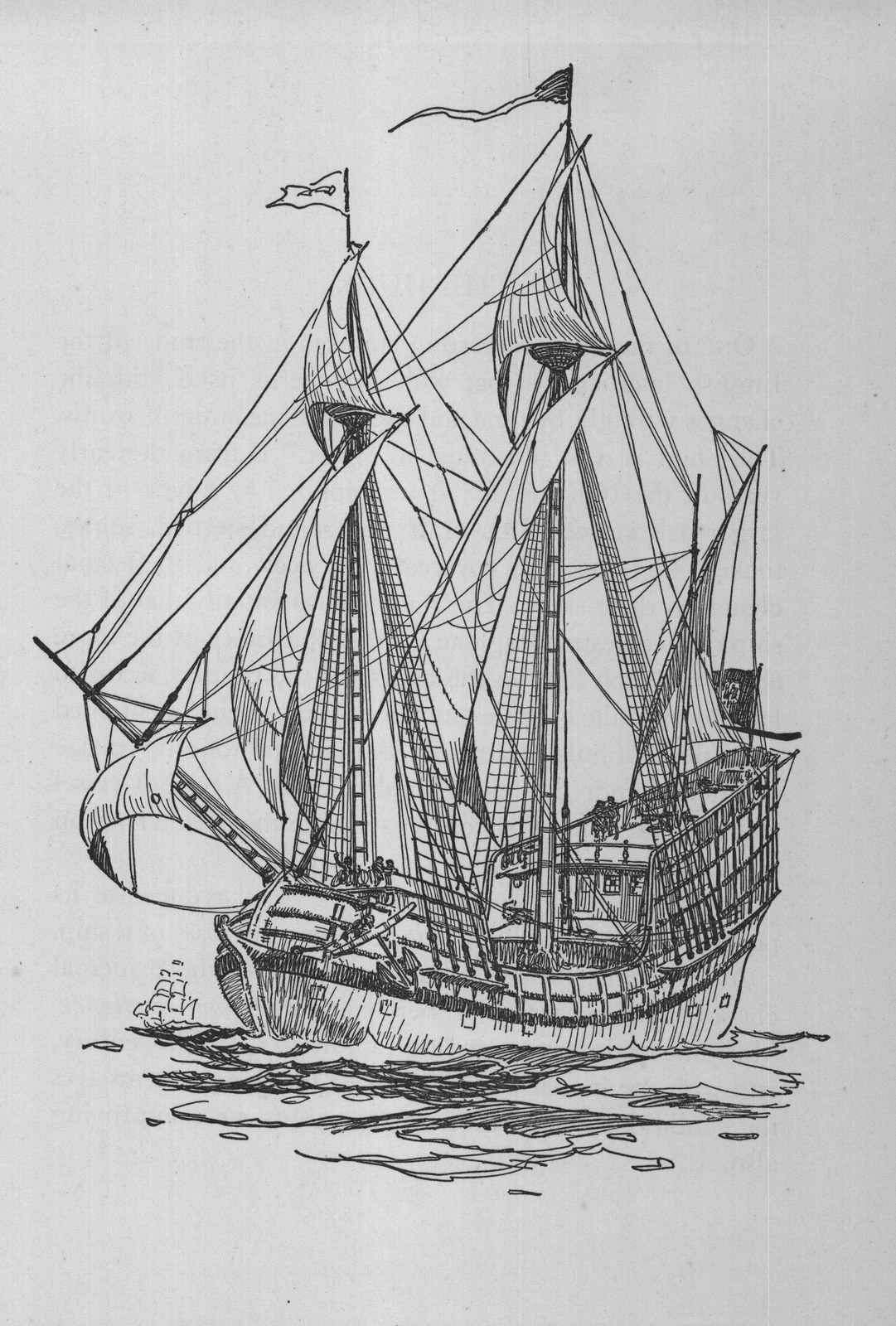
The Hulk
ONE of the most interesting subjects in the study of the English language is that which concerns itself with the changes wrought by time and use in the meaning of words. The point is well illustrated in "hulk." During the early years of the 16th Century it was applied to a type of the larger-size vessel. This craft was round sterned, square tucked, high pooped, covered with weak and ineffectual clench work or skids. The rig was substantially that of the ship of a corresponding date. The appearance of the more efficient Dutch flute in the course of the century seems to have marked the hulk's extinction. At the period mentioned great fleets of hulks are recorded, each ship ranging in size from one hundred to eight hundred tons. A type of vessel called a Marsillian is stated to have been the Mediterranean counterpart of the hulk. To-day the term "hulk" signifies a vessel reduced to its poorest, meanest condition, the remains or carcass of a ship.
At its prime, the hulk constituted one of the principal classes of cargo carriers of merchant vessels par excellence. Maritime trade was expanding rapidly in the 16th Century, and with the increase in the size of the vessels themselves the conditions and comfort of the sailors were improving also. It is interesting to learn of the sea-kit of a merchant seaman in the year 1540. This is what John Griffin, a quarter-master of the Barbara, took with him on a voyage to Brazil: a silver whistle and chain, a ship's chest, a cape of new black frysdown, a coat of black cloth with sleeves, a doublet of blue changeable camlot, a white fustian jerkin, also one of green, a white frieze coat, with sleeves, two pairs of long hose, one green the other blue, two pairs of white hose, one pair of long white breeches, two shirts of fine Hollands and five coarser ones, a black cap with a silver badge, a new black velvet night cap, another black cap, a hand gun (pistol), a sword and buckler, a dagger with a yellow haft and iron chain, a black frieze mantle, a canvas sack with pillow and pillow case. Quite a smart wardrobe! It was probably at about this time that efforts were first made in the British Navy to clothe the seamen in some sort of uniform dress, but the attempts were sporadic and evidently the uniform was anything but what it purported to be. It was not until nearly two centuries later that steps were taken to introduce regulations for the dress of all grades of the navy.