Home › The Caravel
The Caravel
THE origin of the name of this type of vessel has elicited at various times considerable divergence of opinion. But the weight of modern authority is in agreement with M. Jal in ascribing the word to the Greek K<??> (a light vessel).
One cannot do better for a brief description of this ship than to cite this author: "The vessel so named which had a real celebrity in the XV and XVI centuries, the vessel employed by the Portuguese in their voyages of discovery and by Christoper Columbus in his daring adventure to the westward, was a small structure belonging to the family of round ships but more graceful in shape than its contemporaries, the nefs, and having narrower quarters. Also it was a faster sailer, more able, and was better fitted for all enterprises demanding speed and rapid manoeuvring."
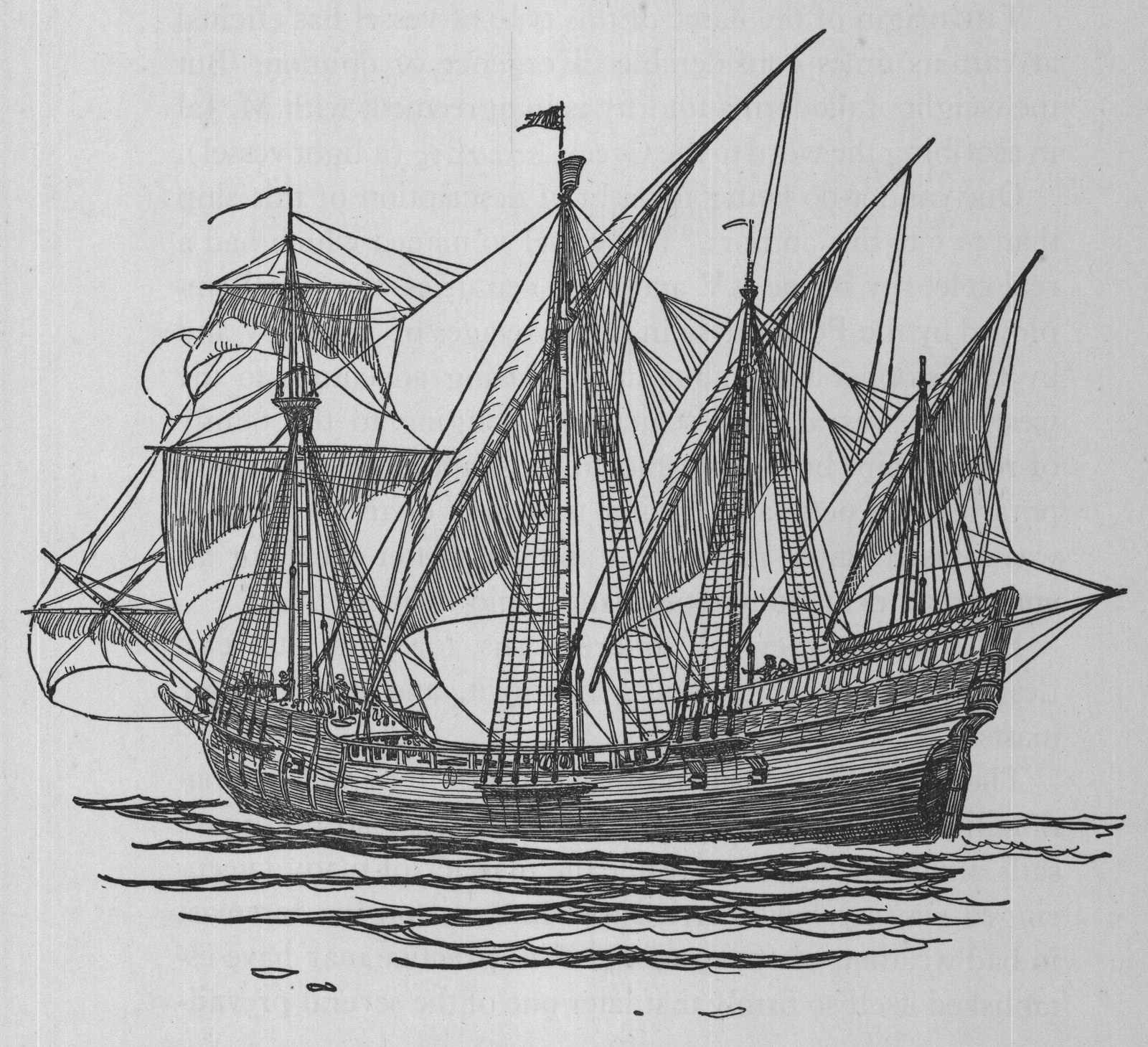
He adds that they had square sterns, fore and after castles, fairly high bulwarks, a bowsprit, and usually four masts.
The rig varied considerably according to period and nationality. The earlier caravels seem to have had no square sails although they may (after the manner of many lateen-rigged vessels) have carried a square sail on the foremast in bad weather, or for running. This practice may have established itself so firmly that later one of the several prevailing types of caravels always carried a square sail on the foremast.
This brings us to a statement of some of these variations of rig. The predominating type was a four-masted vessel with a square-rigged foremast raking well forward, having a ship's round top, and three lateen-rigged masts gradually decreasing in size. The mainmast sometimes carried a round top similar to that on the foremast, sometimes a galley form of top. Another definite type also had four masts, but the lateen and square sails were otherwise arranged. In this, the first and fourth mast carried lateen sails, while the second and third were square rigged. The exploits of the caravel were legion. Not to mention Columbus, there was the famous voyage of Bartolome and Gonzalo Nodal in 1618 in two caravels of eighty tons each, accomplishing the circumnavigation of Terra del Fuego; the expedition of the Emperor Charles V to Tunis in 1536, in which several caravels participated with all the pageantry and pomp to which the ships of that period so easily lent themselves; the voyage of Guillaume Le Testu (1509-72), and many others. Le Testu has left us some most interesting and reliable coloured representations of old ships, including five caravels, in his wonderful "Cosmographie Universelle." (See Note 4, Appendix.)