Home › An English Capital Ship of the Early Seventeenth Century
An English Capital Ship of the Early Seventeenth Century
TRAGEDY may be called one of the children of romance. And the Sovereign of the Seas is part and parcel of one of the grimmest tragedies ever enacted in the annals of any country.
When Charles I ascended the English throne in the year 1625, he seemed indeed the favourite of fortune. Endowed with a fine mind, accomplished, a gentleman to the tips of his fingers, assuming the reins of government at a time when the great strides made in the commerce of his kingdom and the budding colonies in the New World required governmental encouragement to the shipping of the realm, it was obvious that, to a man of his intellectual capacity, the navy should have been an object of especial solicitude.
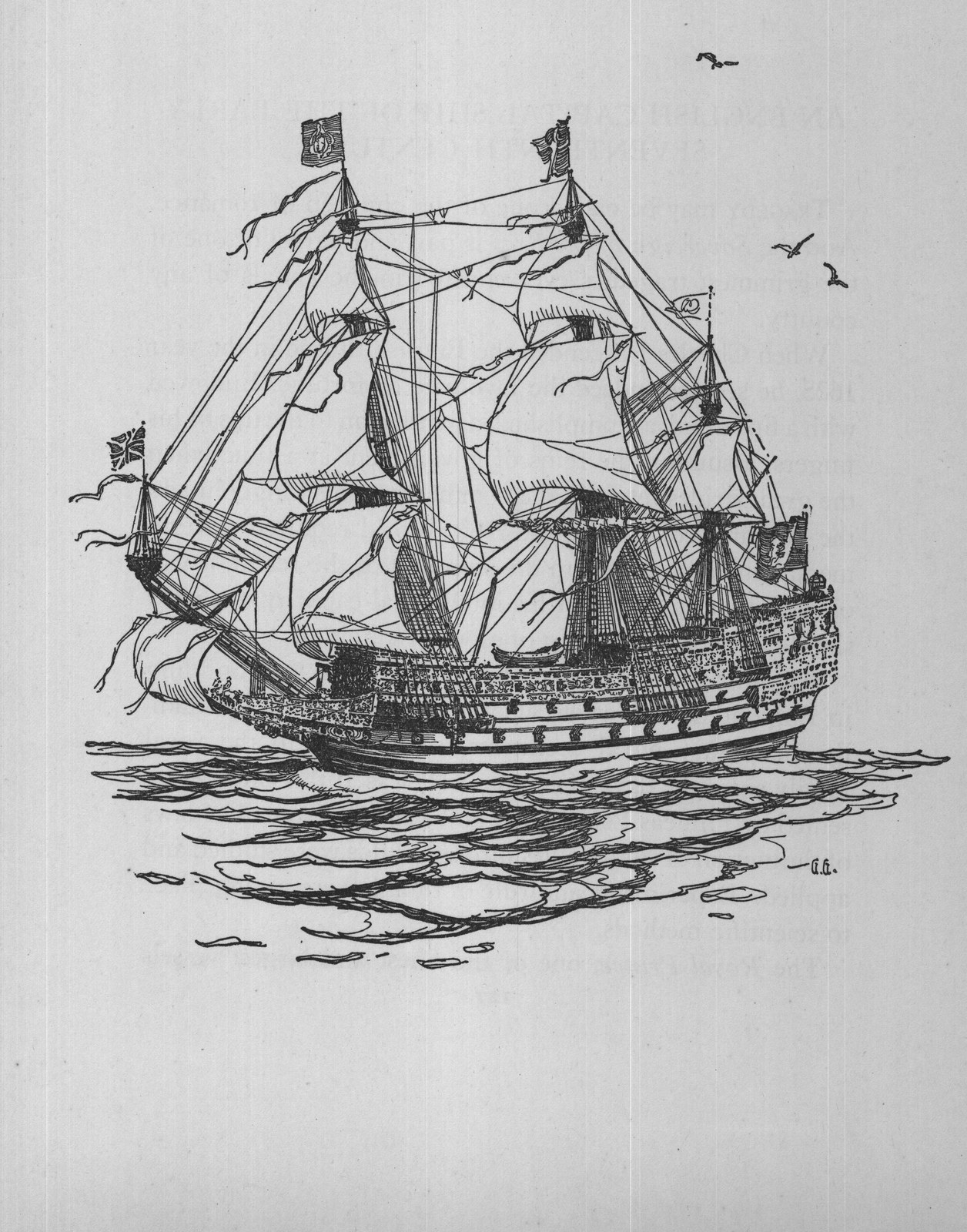
Scientific principles were being applied to ship-building in England as well as elsewhere in Europe. The Pett family, hereditary naval architects, as it were, to the royal family since the days of Henry VII, was at this time represented by Phineas Pett, father, and Peter, his son. The laws of the motion of solid bodies through fluids were studied and applied. Experiments and rule of thumb were giving place to scientific methods. The Royal Prince, one of the finest and largest vessels launched up to that time, apparently only served to urge Charles to improve upon improvement. He duly commissioned his shipwrights, including Phineas Pett, to build a larger and still finer vessel.
The result was the planning of the Sovereign of the Seas. Launched in 1637 this vessel was one of the largest seagoing ships theretofore ever constructed. Nor was her size more remarkable than were her ornamentations. Covered from stem to stern with most elaborate wood-carvings, her long beakhead crowned with a mounted effigy of King Edgar, the conqueror of Saxon England, trampling under his charger's hoofs seven fallen monarchs whose shorn beards bordered his mantle, the many badges of honour ennobling its sides, a cupid riding a lion terminating the stem-head, the curved forecastle (Pett's latest invention) displaying an elaborate allegory of the ideals of his Royal Master, the astronomical panels along the vessel's sides, the glories of Olympus with its gods and goddesses displayed on the quarter galleries, the still more splendid stern, embellished with other allegorical and biblical figures, designed to represent the ship's glorious career, the whole blazing with gold and colour, the possible but not too probable royals, the endless streamers, picturesque but hardly practical, all combined to form an effect of pomp and promise as radiant as the King's own.
But alas, the very measures which made for greatness and romance made also for ruin. Everyone knows the story of the resistance to the collection of the ship money tax, of Charles's insistence upon his divine right to override constitutional government, of the rebellion, the revolution, and of the sad procession to the block at Whitehall on January 30, 1649. The Sovereign of the Seas was no more a success in her element than her royal originator was upon the land. During the Commonwealth she was mutilated by losing, like the monarch, not her head, but by being cut down a whole deck, because she had proved to be top-heavy.
Laid up for a complete rebuilding at Chatham in 1696, she was totally destroyed by fire.