Home › The Goelette
The Goelette
IT IS sometimes difficult to differentiate between closely related types of vessels and perhaps no fine distinction need be drawn between the rig called by the French a goelette and that which we commonly designate as a schooner. However, the goelette often presents interesting variations not seen in our western fore and aft schooners.
Notwithstanding the Dutch sound of the name, Jal attributes an American origin to the word schooner and also to the rig. Perhaps he too had heard the Gloucester tale of the origin of the schooner (q. v. infra.) He says he cannot trace the vessel's construction earlier than the 18th Century, although he admits that its origin may have a greater antiquity. The derivation of the French word is interesting, coming apparently from the word gwelon (goelan), employed by the Bretons to designate the sea gull in allusion to its melancholy cry (givella=Celto-Breton, to weep). Probably the peaked sails of the two-masted goelette, especially when set wing and wing, suggested to the poetically inclined minds of the Bretons the suddenly upraised wings of the goelan in the act of making the first stroke of its pinions when rising in flight from the sea.
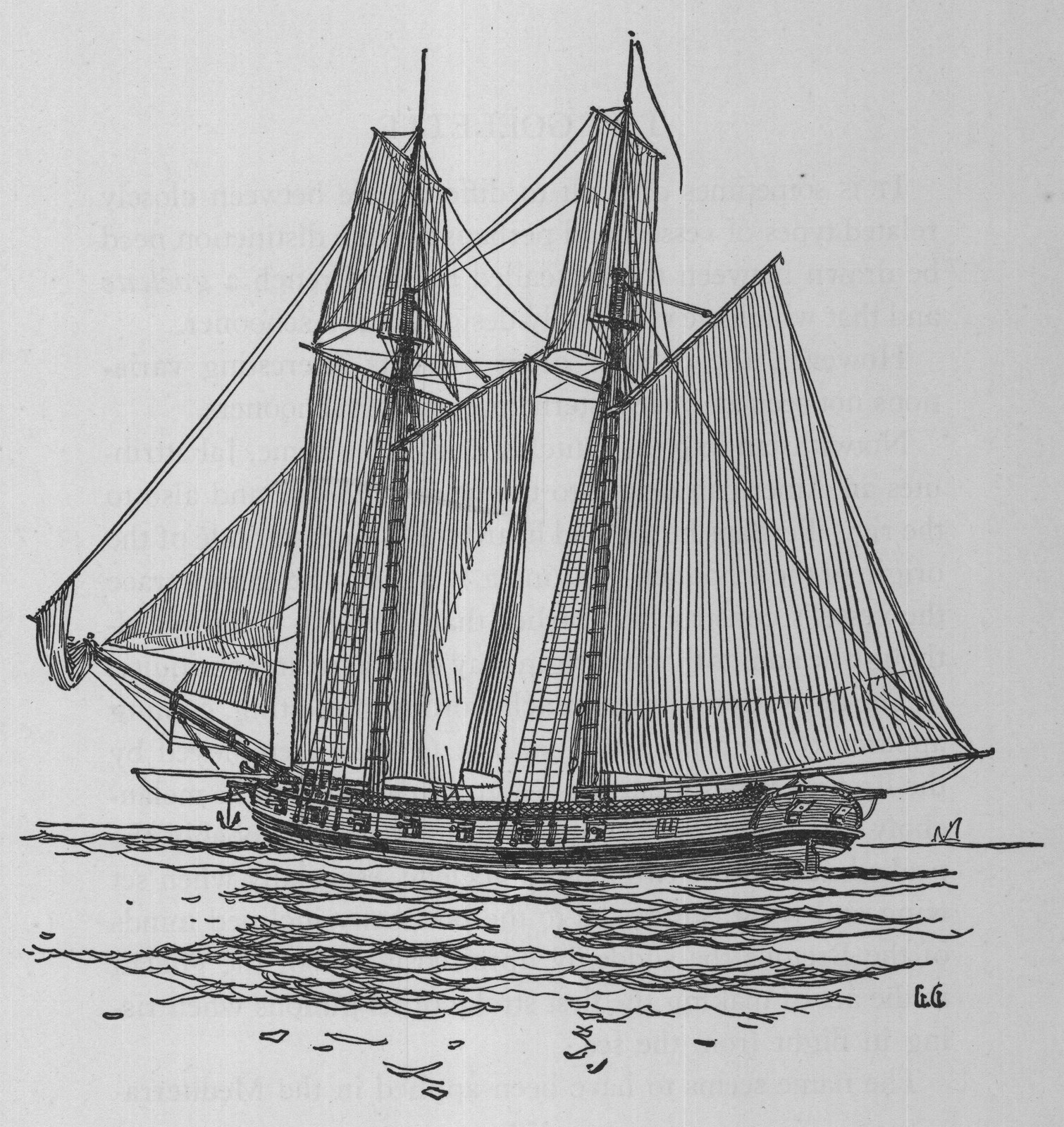
The name seems to have been applied in the Mediterranean to the schooner rig (with certain attributes peculiar to the locality) on account of its trapezoidal sails.
Jal's description fits our American schooners pretty well, at least those of his day, as he mentions that the masts have a decided rake aft. It will be remembered that it was formerly the custom so to incline the masts of nearly all our vessels.
One of the variations of the goelette rig that may be mentioned is the employment of a trysails mast before the foremast. Two square yards are rigged upon this, the lower one fixed and the upper one susceptible of being hoisted and lowered above it. Mr. H. S. Vaughan has suggested that this is a survival of a feature of the polacca rig. Such a trysail mast, with its yards, is removable and may be lowered and stowed away. The braces of the upper yard are single, the lower rove with a pendant and whip, both leading through rings attached by tricing lines to the main rigging, the hauling parts leading to the quarter.
As to the origin of the word "schooner" as signifying a vessel of the type above described, nearly everyone is familiar with the tale of the launching of the new type of vessel at Andrew Robinson's yard at Gloucester, Mass., in the year 1713, where, as the vessel left the ways, a bystander exclaimed, "See how she scoons!" Upon which Robinson is reported to have said, "A schooner let her be!" The difficulty with this yarn is that "the new type of vessel was at that date not a new type of vessel at all. Mr. Carr Laughton suggests that the Gloucester vessel was of the newer and finer design of hull which at about the period of the alleged Robinson incident came to be associated with the rig now called a schooner, and that it was to the hull and not to the rig that the word was applied.
The word "schooner" cannot be traced before 1713, nor, despite its sound, can it be assigned to a Dutch origin. (Compare the article on the goelette.) The square topsails were probably acquired by the schooner at an early date for the reason that the rig was associated with the early normal yacht hull. Square sails were largely employed upon the early yachts, for it must be borne in mind that, despite the application to day of the term "yacht" to any sort of pleasure craft, originally it had a meaning restricted to a particular type of hull and rig.