Home › The Topsail Schooner
The Topsail Schooner
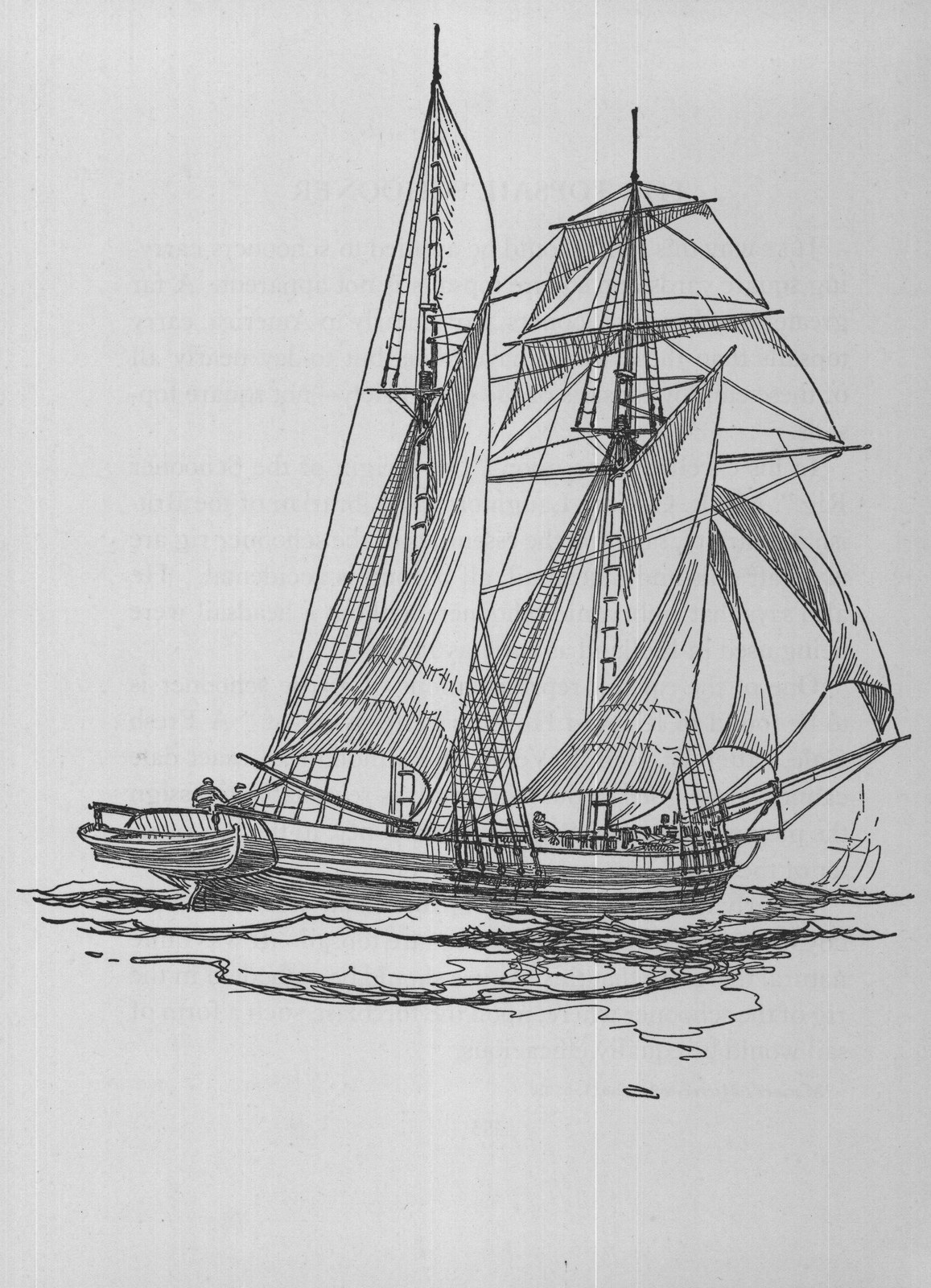
JUST why this term should be applied to schooners carrying square yards and square topsails is not apparent. A far greater number of schooners, particularly in America, carry topsails than those which have none, but to-day nearly all of these employ topsails of the gaff variety-not square topsails. In his excellent note upon "The Origin of the Schooner Rig," (Mariner's Mirror, vol. I, no. I, p.28) Mr. L. G. Carr-Laughton, the Librarian of the British Admiralty, says that the essentials of the schooner rig are two gaff sails and a headsail, all beyond is accidental. He also says that embryonic schooners without a headsail were being used in Holland as early as 1630. One of the earliest representations of a true schooner is to be found in Richard Houston's engraving of " A Fresh Gale," after W. Van de Velde, and although an exact date cannot be assigned to the painting it is reasonable to assign the picture, and consequently the schooner, to the last quarter of the 17th Century.
In early times, the popular rig for yachts was that of the hoy, whose rig often included a square topsail. It was quite natural therefore that this feature should be embodied in the rig of the schooner where, upon the foremast, such a from of sail would be equally efficacious. Mr. C. G. 't Hooft has written charmingly in the Mariner's Mirror for October, 1919, of the early English yachts, the first of which was of Dutch provenance. His article contains much historical information upon the subject, many quaint excerpts from Samuel Pepys' diary anent these pleasure craft of royalty, and considerable romance relating to the command of these little vessels by their princely skippers, with descriptions of their rich fittings and decorations and of the early days of the noble sport of yacht racing.