Home › The Galleon
The Galleon
ALMOST every untutored person who sees a model or picture of an old-time ship calls it a galleon. The reason probably is that the galleon is the type of ancient vessel most exploited in romantic literature. The galleon was primarily a war vessel. Her "great period" was during the 16th Century and early years of the 17th Century.
Less highly charged, i.e., with less decks than her companion the great or capital ship, she was more graceful of aspect and probably a better sailer. Another distinction claimed by some writers is that the decks of the galleon had three divisions or levels, while the great ship had four. One of the peculiarities of the galleon build was the form of her head. Instead of the long projecting forestage or forcastle of many of the larger ships of her time, the galleon's forecastle ended at her stem, while a long slim beak, similar to that of the galley, projected far forward. The transom of the stern was square, the poop narrow. Clench work or skids strengthened the sides, but this characteristic, while retained in Spain, Portugal, and the Spanish Netherlands seems to have passed out of fashion in English ships at an early date.
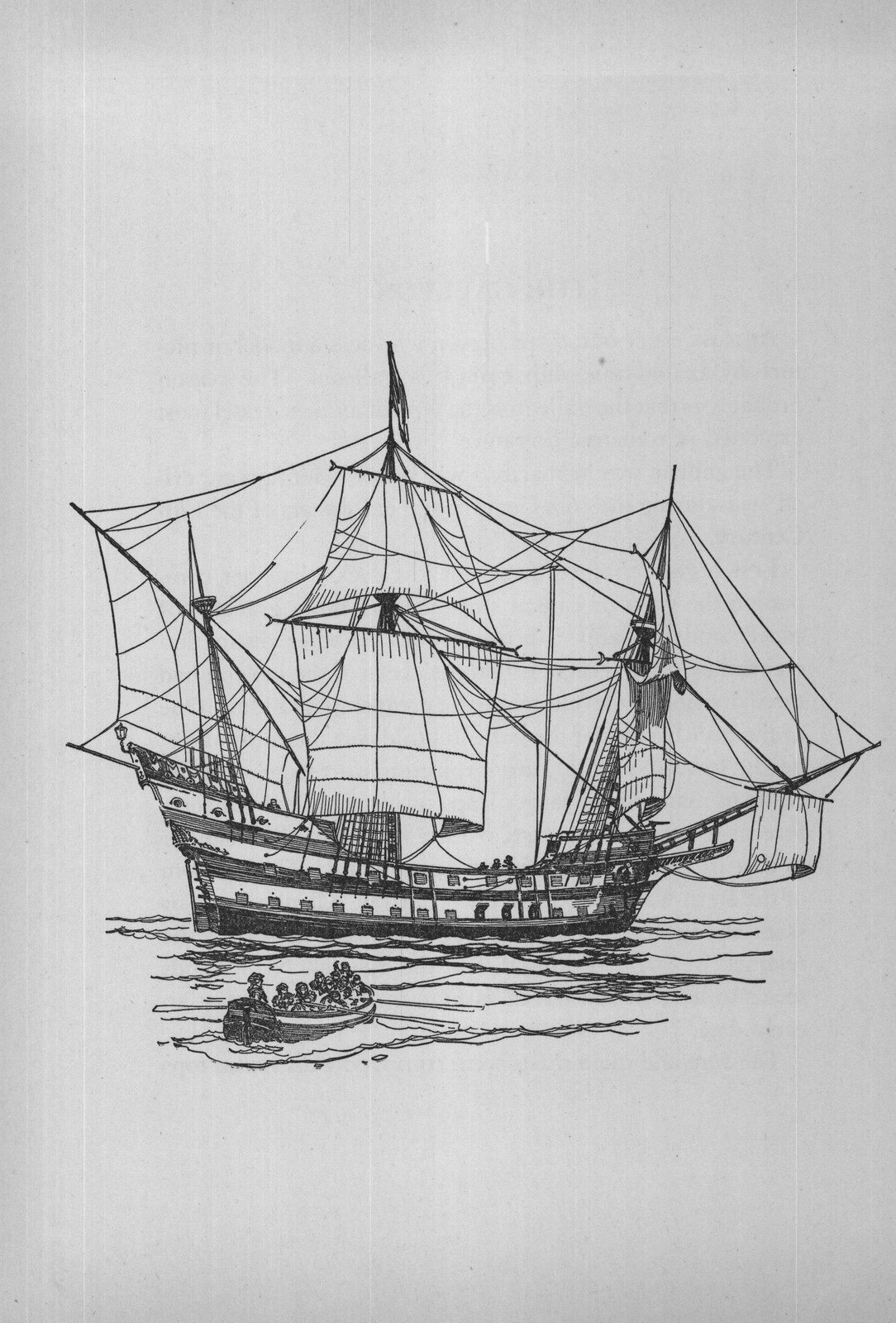
The fore and main masts were equipped with round tops and carried courses and topsails. Galleons had also one and sometimes two lateen mizzens. Generally speaking, the running rigging did not differ, except in degree, from that of a much later date. Reef points did not form a part of the equipment. The ship on which Sir Francis Drake died in 1596, the Defiance, was probably a galleon.
Full blow the trades adown the Spanish Main. With billowing courses, flowing topsail sheets, and mizzen well distended to the gale, with boiling foam and spouts of iridescent spray beneath her lengthy beak and forefoot broad, with gaudy pennants, and with ancient proudly flaunting in the breeze, the lordly galleon drives along the ocean's trackless plane. What heaps of tawny gold filched forth from heathen fanes her orlop holds! What glittering jewels raped from idol forms her iron-bound coffers fill! What lives have sped and tears and blood have drenched the treasure that she bears! In vain. Afar, uplifting from the keen horizon's blade, there looms a sail. In vain. Can heron foil gerfalcon's dazzling stroke? Full soon to her eternal doom amid the waving sea-kelp's bloom shall sift the riven frames of what was once a ship; and all the remnant of her proud Castilian crew stand cowering at the terror-laden name of Drake!