Home › The Roman Corbita or Merchantman
The Roman Corbita or Merchantman
THE steady increase in the foreign affairs of Rome, both military and civil, necessitated proportionate augmentations of both her navy and merchant marine. Increasingly large importations of all sorts of commodities demanded more and larger carriers. The great corn fleets from the granaries of the Near East and Africa maintained a continuous course across the inland sea, while the transports required to furnish supplies to her numerous armies engaged in conquest in various parts of the then known world, as well as the means of conveying the troops themselves, must have reached numerical proportions not very different from those obtaining many centuries later. The Romans imported all sorts of objects of art into Italy from conquered lands. Some of these articles were of large size and great weight. And while it is possible that specially designed barges may have been constructed to carry such ponderous objects as the obelisks brought from Egypt, yet it is not at all imporbable that many pieces of colossal statuary were transported in the larger merchant round ship. These vessels seem to have reached generous proportions. For the marine architects of a civilization which could produce so large a floating structure as the imperial pleasure boat, the remains of which have been examined and measured under the waters of Lake Nemi, would not balk at the construction of sea-going vessels of at least a thousand tons burden.
It seems remarkable that, considering the tens of thousands of vessels produced during the long period of Rome's great marine activity, not one has been wholly preserved for us by some chance such as that which saved the Gokstad ship from decay and that so few graphic representations of these ship from decay and that so few graphic representations of these ships remain to us out of the great number of more or less perfect monuments of Roman greatness. A number of ancient coins and medals show us vessels, but in these, as in more modern cases, the artist was limited by the scope of his field, and such representations are always conventionalized. Other representations are scarcely more satisfactory.
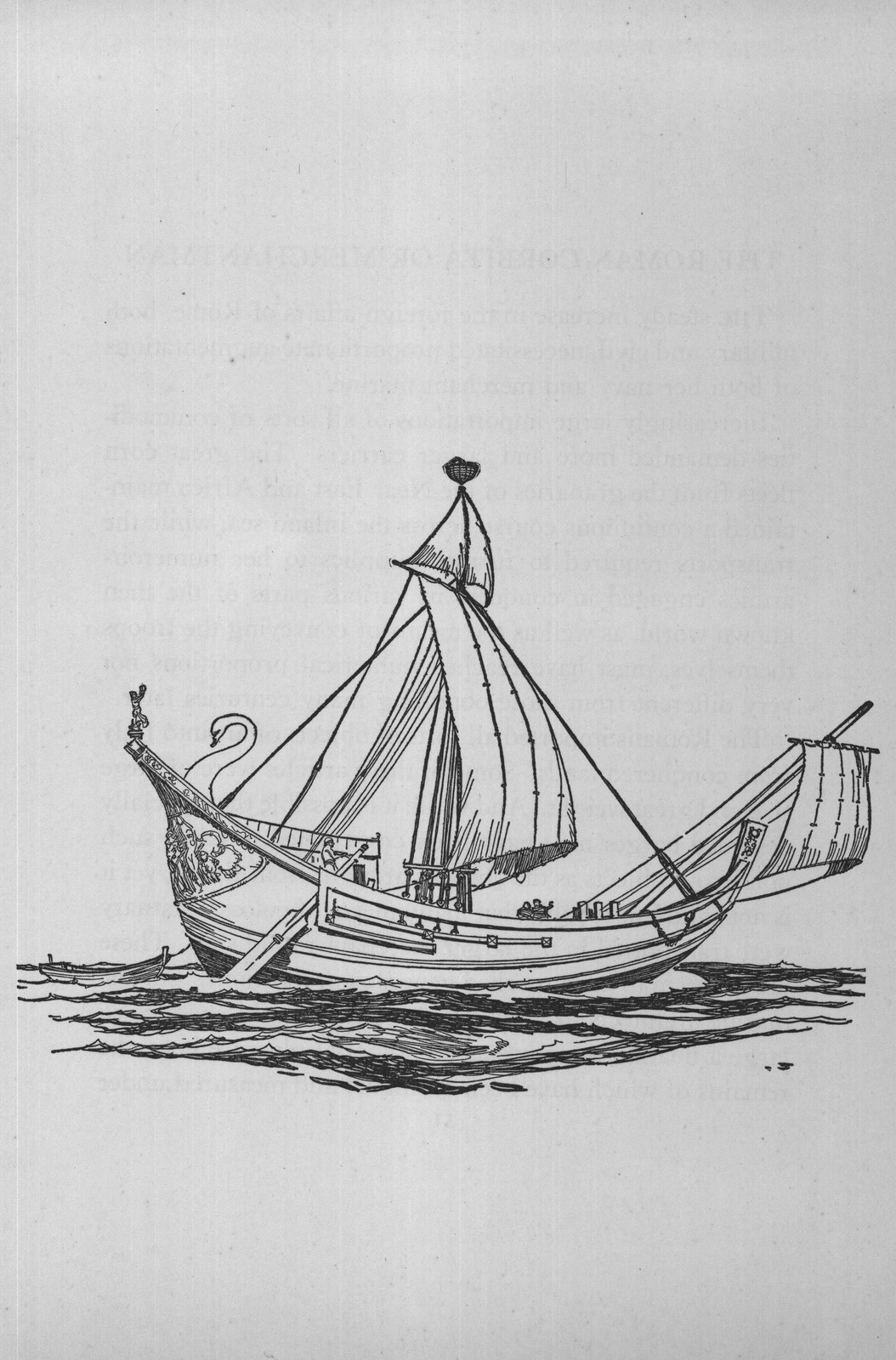
The accompanying illustration shows a rationalized version of a Roman merchant ship adapted from a monument discovered at Ostium, the great ancient seaport of Rome. The original sculpture, if reliable (and it is believed to be so), shows most of the exterior details of hull and rigging of a merchant ship of that period. These merchant vessels of the larger sort were called corbitae, from corbis, a basket, thus named because they carried such a receptacle at their mastheads in order to indicate their occupation as carriers of both passengers and merchandise. It is said that these Roman merchantmen were of heavy construction and were noted for their slow sailing. The sheer of the ship was considerable, and the rotundity of the fabric served as a pattern for the round ships of a thousand years later. The high swelling stern was admirably adapted to minimize the effect of following seas--a constant source of menace to ships proceeding principally before the wind. The form of the wales probably is predicted upon and indicative of some features of internal construction, but as to this we cannot be certain. No exception can be taken to the form of shrouds set up by deadeyes and lanyards, nor to the manner of tightening the prominent stays. The curious topsail composed of triangular halves has survived to our own day and generation. Attention may likewise be directed to the form of brails, the ropes passing through rings sewed upon the sail in rows perpendicular to the yard. This device effectively confined the folds of the sails. Although if the canvas was heavy a sail so brailed must have been bulky and somewhat difficult to furl properly.
The bowsprit was then no innovation, but its use seems to have been practically disregarded, if not forgotten, during the Dark Ages. Taken altogether it may be safely assumed that this vessel was wholly adequate to the demands made upon it and that its minor appliances and internal arrangements of which we are unfortunately totally ignorant were the result of an evolution, as sure and as practical as that of our modern vessels. The form of this old ship is the embodiment of grace, and its ornamentation lends to it a dignity compatible with that of the then Mistress of the World. Among the late discoveries at Ostia is a fresco showing a Roman merchant vessel in the process of lading.
Five personages in all appear upon the ship's deck, while two more carry sacks, presumably of grain, up a gang plank. The central and most important figure is labelled Arascantus, probably the owner. Standing aft on the raised deck of the cabin and holding the tiller of one of the rudders (for two are shown) is another man, labelled Farnaces, Magister, evidently the captain. In form, this painting of a ship resembles closely our illustration. A bare mast appears without rigging or sail.
Little by little more facts are continually coming to light showing the development of the vessels of early times and gradually filling the gaps in the order of their evolution. Let us hope that in the not too distant future the line will be complete.