Home › An Elizabethan Ship of 1588
An Elizabethan Ship of 1588
PROBABLY no episode in historic times is more replete with romance than that connected with the attempt of Philip II of Spain to invade England in the year 1588 by means of his so-called Invincible Armada.
The vessels of which the Armada consisted were galleons, pataches, galleasses, zabias, galleys, and hulks, totalling, according to Hakluyt, one hundred and fifty sail including twenty caravels equipped with oars. A number of them were of considerable size. We have, in these pages, given examples of several of these types of vessels. There were sixty-four galleons of a huge "bignesse." The galleasses are stated to have been so large that they contained chambers of state, chapels, turrets, pulpits, and many features of great houses! The English ships were not so large, but they were more seaworthy, hardier sailers, and also more numerous. The Ark Royal, a vessel of about eight hundred tons, was the English flagship. Another was the Dreadnaught, among the first of its name, in our time, a word to be applied to a class of the most formidable ships of war. The fleet opposed to the Armada consisted of one hundred and ninety-seven vessels, galleons, galleasses, galleys, pinnaces, and caravels, the smallest being but thirty tons. Only thirty-four of this number were royal vessels of war, the balance being merchant craft, fishermen, and coasters.
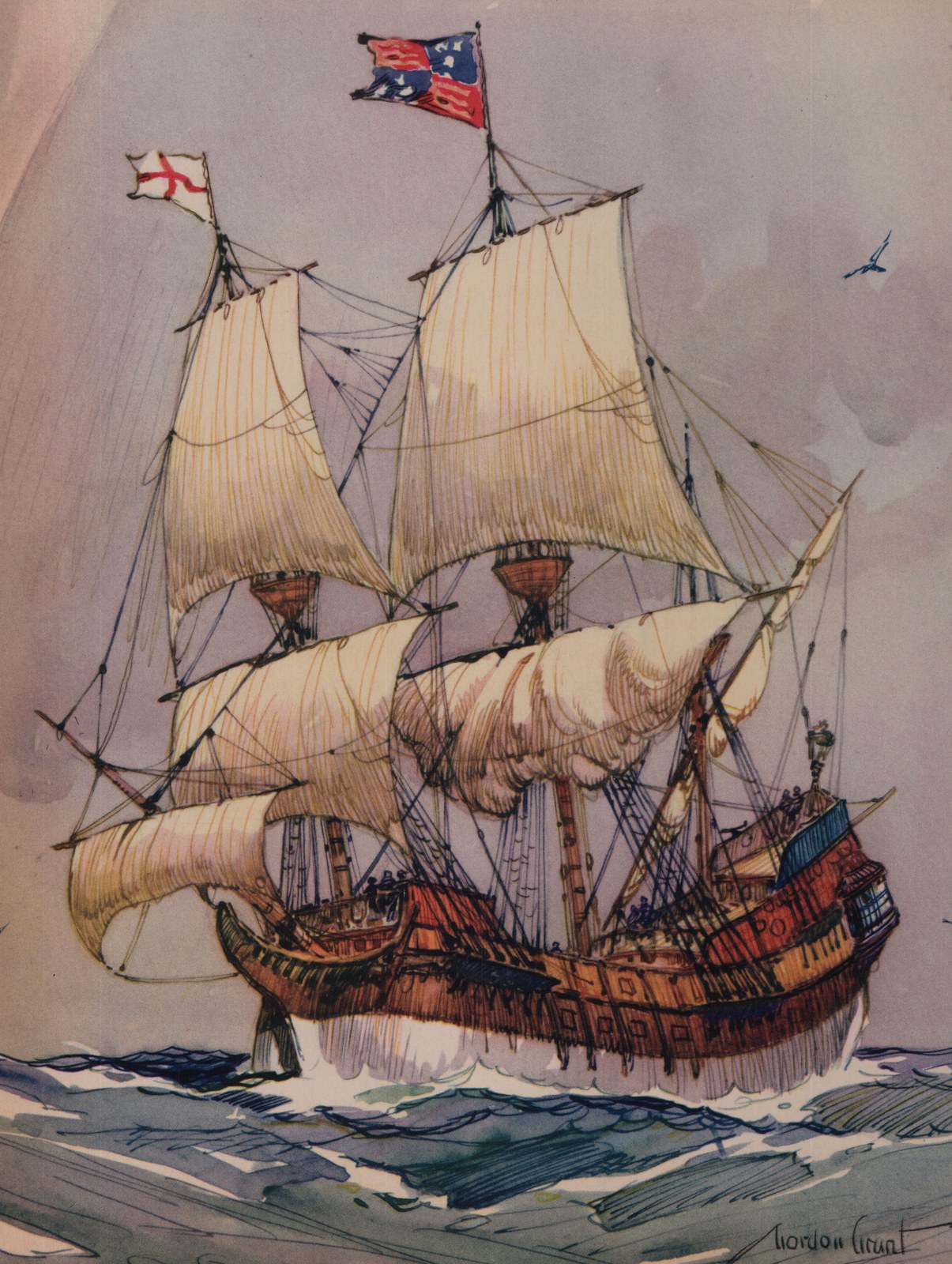
Lord Howard of Effingham, high admiral of the English fleet, caused the victory to be commemorated in a series of ten tapestries. These, designed by Hendrick Vroom, an eminent Dutch marine artist, and woven by Francis Speiring, were known as the Tapestry Hanging in the House of Lords. Unfortunately, they were destroyed by fire in 1834. But they had been reproduced in engravings made in 1739 by John Pine, so that we have authoritative representations of these ships as it is inconceivable that Lord Howard would have accepted Vroom's designs if they had not correctly shown the vessels composing his own fleet.
They show several of the Spanish ships propelled by oars. The vessels of the larger size thus propelled are probably meant to depict galleasses. If these were fifty-gun ships, carrying on the average one hundred and twenty-five mariners, two hundred soldiers, and three hundred galley slaves as rowers, they must have been vessels of considerable size. But the pictures show them with a freeboard, too high to be conveniently rowed, and with fore and after castles also too high for vessels of this type from what we know of their build from other and more reliable sources. Moreover, the rig is contrary to what we know to have been the rig of the Mediterranean galleasses of the period. So we feel that Vroom did not make out a very strong case in this particular. But perhaps he wished to flatter his patron, the victor in the conflict, and probably the good high admiral "fell for it," as is the saying to-day.
And what endless romances are interwoven with the aftermath of the Armada and its destruction. The Spanish ships cast away in the Orkney Islands and along the Scottish and Irish coasts in their mad dash to escape from their implacable enemies, the romances of the intermarriages between the shipwrecked Spanish mariners and the women of Scotland and Ireland. Even to-day new romances come to light, such as the finding of a bronze breech-loading Spanish cannon fully charged, a part of the armament of the Florencia, a vessel of nine hundred tons, blown up in August, 1588, in Tobermary Bay, Isle of Mull, after her flight from the Channel. The invention of Robert Louis Stevenson, in such tales as "The Merry Men," conjures up in the imagination the wild doings and far-reaching effects of this great defeat and victory.