Home › The Flute
The Flute
DURING the 17th Century the flute was the high chieftainess of the round-sterned tribe. As a carrier, she seems to have replaced the hulk among the traders of northern and western countries.
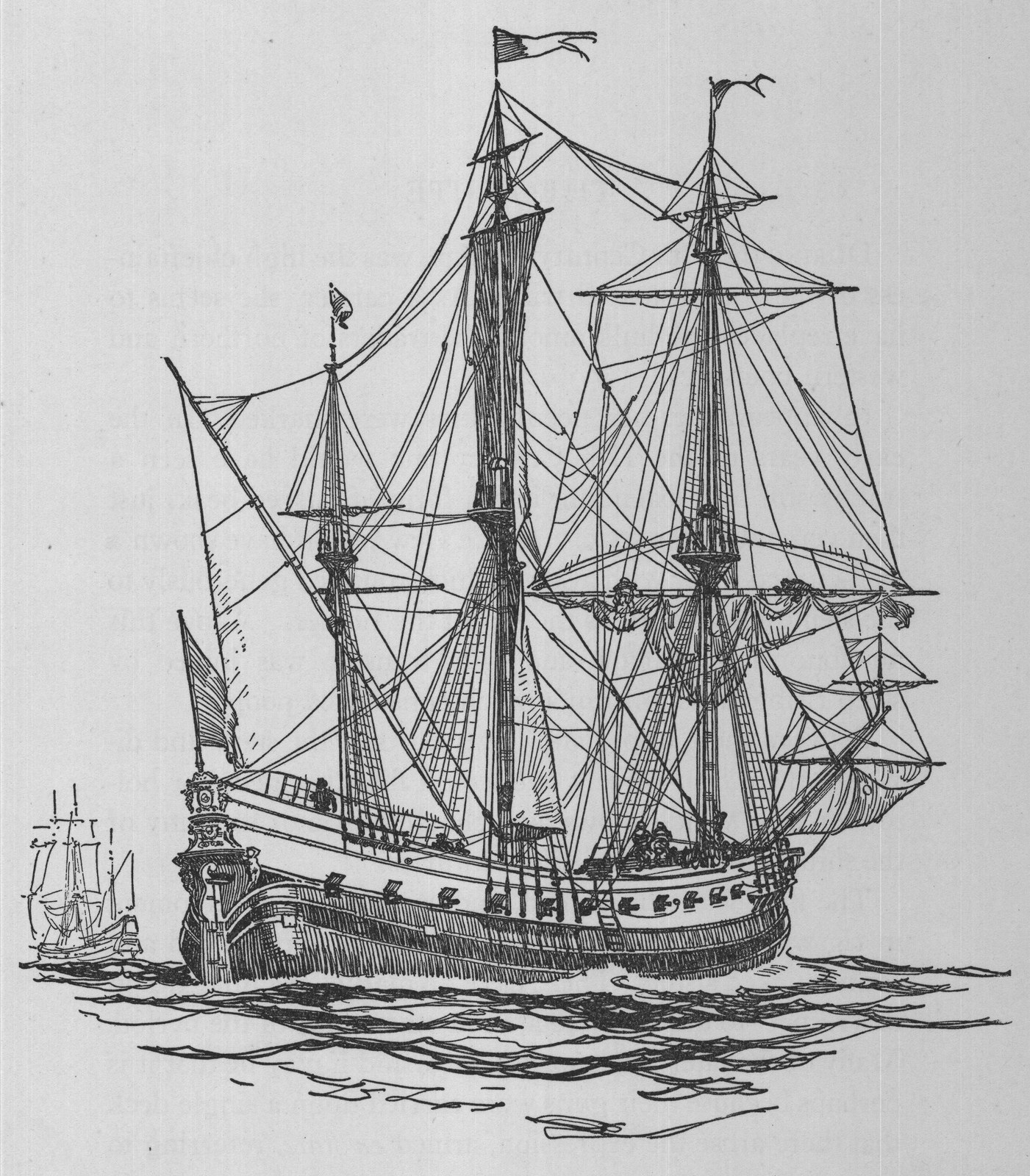
In appearance, her peculiarities were marked. In the early years of the 17th Century one would have seen a stubby stiff bow extending into a form of curved beak, just then very much the style. A side view would have shown a well-curved sheer with a stern which rounded generously to the stem post as high as the top of the rudder. Above this an abnormally narrow and lofty transom was joined by steep rising sides to form a much constricted poop. Between these upper and lower parts of the stern and dividing them transversely one would find that peculiar hollow or cove which shows as a characteristic of so many of the ships of the 14th and 15th centuries. The flute was ship rigged, and as such her development in rig was upon similar terms with her square-tucked and round-tucked sisters. There were no marked peculiarities in this respect to differentiate it from other ships of the period. Many of the later flutes were armed, and it may be that it is perhaps because their guns were carried upon a single deck that there arose the expression, armed en flute, referring to a ship with guns upon its upper deck only, the lower decks being used for the stowage of goods, horses, troops, etc.; in other words, an armed transport. There seems, however, no particular reason why the flute should have been selected to furnish this term to fit such a combination. Any other shiprigged vessel carrying guns upon a single deck would have served as well. It is a problem that will have to be left to the etymologists.
The flute seems to have been a popular form of hull, as many contemporary representations of her appear in the prints and paintings of nearly all the countries of western Europe. Mr. Nance tells us that it was in such ships as this that the tar, timber, and other articles which Holland could not produce for her own ships would be brought from the north in exchange for manufactures and goods imported in her bottoms from far-distant regions. It was a favourite form in Holland, a land of round-sterned vessels, and it is more than probable that many flutes crossed to America and performed important roles in the development of the Dutch colonies in the new world. So far as is known to the author, no particular vessel of those whose names are recorded has been identified as a flute. Perhaps records still exist that would furnish this information if occasion demanded.