Home › A Late Seventeenth Century French Ship of the First Rate
A Late Seventeenth Century French Ship of the First Rate
WHILE a considerable advance in size had been made during the latter part of the 17th Century in the French ships, owing to the intelligence and energy of Colbert and Louvois, the able ministers of Louis XIV, in England and in Holland the tonnage of the larger vessels of war was not materially greater than at the beginning of the century.
The Sovereign of the Seas, until her destruction in 1696, one of the largest vessels of the British Navy, measured about one thousand six hundred tons. The Duke, launched in 1685, measured one thousand five hundred and forty-six tons; the Royal William, launched in 1692, had a tonnage of one thousand three hundred and forty. These were all firstrate ships. The last named ship was never a success. She was cranky and carried her guns badly. Sir Cloudsley Shovel, one of the most brilliant officials of the time, complained bitterly of the poor construction and equipment of the English vessels. Not so the larger French ships of this period. The Soleil Royal, one hundred and eight guns, was of one thousand nine hundred and forty tons; the Royal Louis measured about one thousand eight hundred tons. Moreover, the French ships had better lines, were roomier, and carried their guns to more advantage. Artistically also at this time they were far superior to their contemporaries.
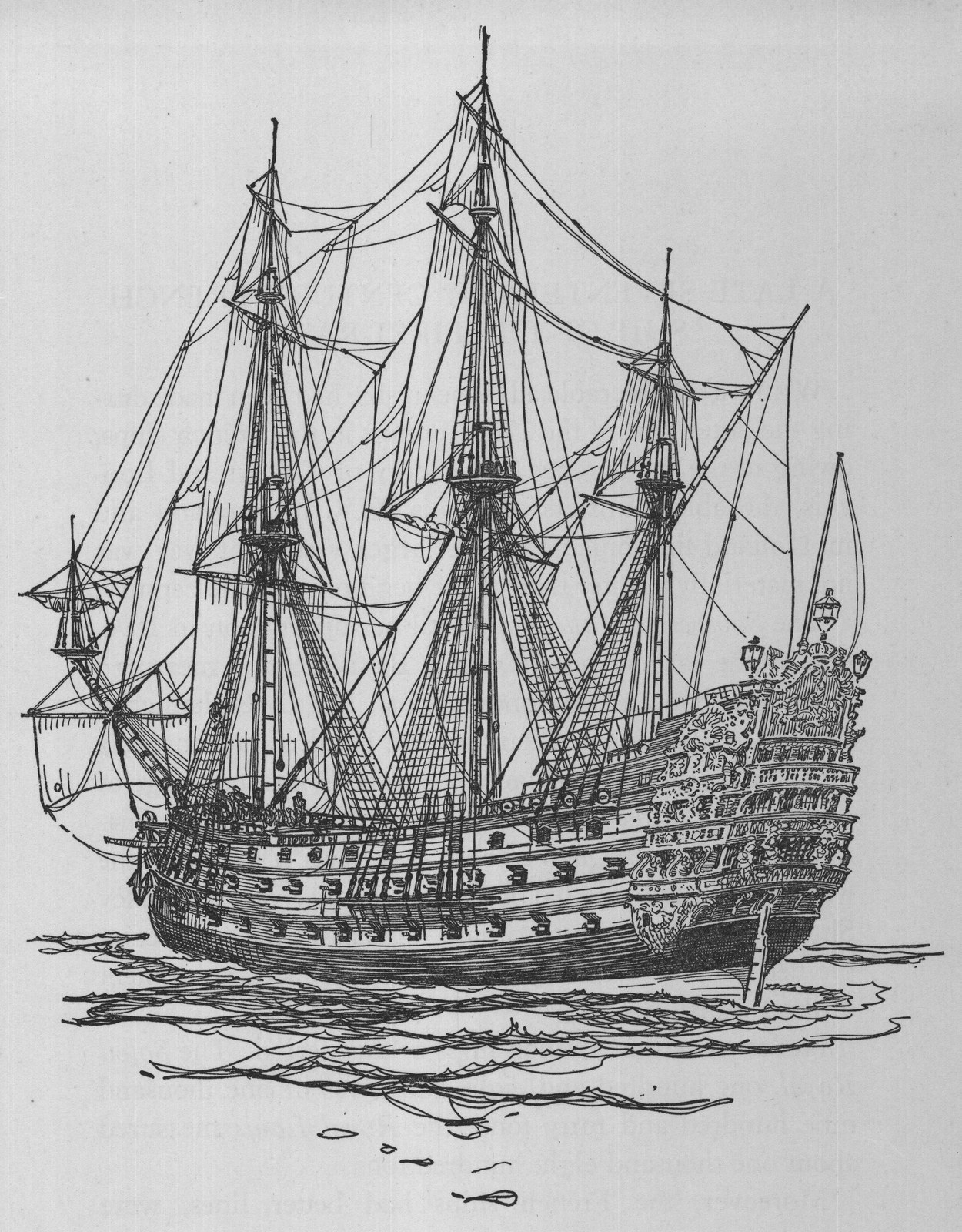
Such great sculptors as Nicolas Lavray and Pierre Puget laboured to extend the glory and magnificence of Le Grand Monarque by lavishing the richness of their imagination upon the embellishment of the ships of Le Roi Soleil, while a no less famous person than the King's own painter, Le Burn, designed the ornament for the Soleil Royal.
Many of Puget's original designs for ship decorations are preserved in the Musee du Louvre as well as several superb pieces of wood carving executed (for a like purpose) by his own hand.
His designs for the great ship's lanterns carried at the stern are particularly graceful. We show in the appendix several forms as employed in different countries at about this period. These beacons gleaming across the waves at night lighted up the richly gilded ornament on the sterns of the great fabrics as they moved majestically beneath the silent stars or under cloud-swept, tempestuous skies, the harbingers of romance and the playthings of royal ambition.