Home › The Dutch Galliot
The Dutch Galliot
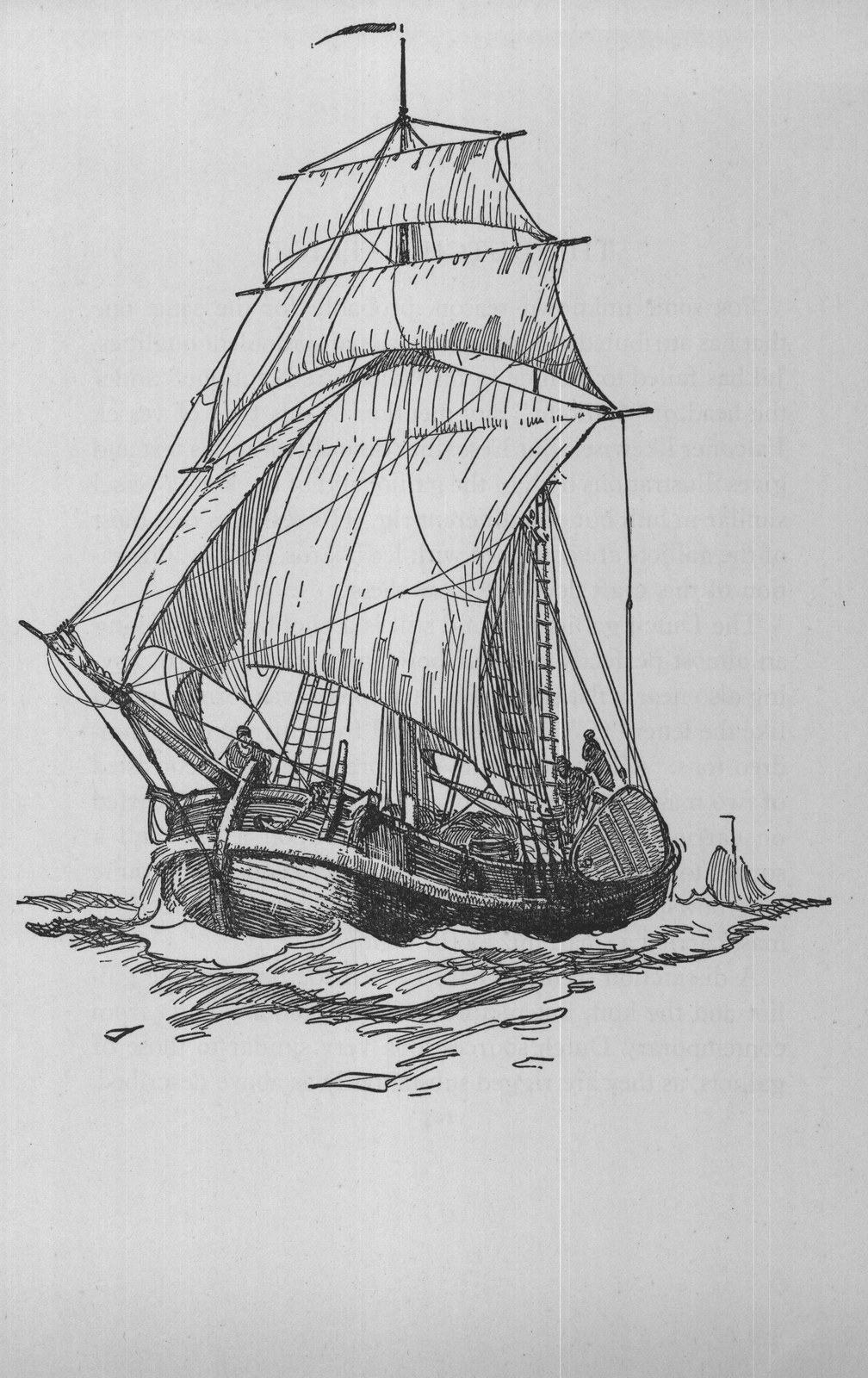
For some unknown reason, probably for the same one that has attributed to Homer occasional somnolent qualities, Jal has failed to include in his "Glossaire Nautique" under the head of "Galiotte," any mention of this type of vessel. Falconer likewise. But Lescallier describes it in his text and gives illustrations both of the galliot and of the koff, a vessel similar in hull but of a different rig. His text says that most of the galliots are equipped with lee boards, but his illustration of this craft does not show them. The Dutch galliot was and still is a chubby craft having an almost perfectly circular bow and a similar stern, having also nearly flat sides. The stem piece was formed much like the letter "C." In size it varied from fifty to three hundred tons. A hundred years or more ago its rig consisted of two masts, the foremost of which with a topmast scarfed on carried a trapezoidal sail hoisted upon a gaff and a square topsail. There were several jibs extended on a quite long bowsprit having little steeve or inclination. The aftermast carried a small mizzen or dandy.
A distinction seems to have been made between the galliot and the koff, but pictures of 18th Century koffs from contemporary Dutch sources look very similar to those of galliots, as they are rigged substantially as above described.
Again, it has been authoritatively stated that koffs are both ketch rigged and schooner rigged. The illustration of the koff given in Lescallier alongside of the galliot is a sort of schooner rig supplemented by a small mast right aft with an out-rigger but with no sail thereon. This view shows lee boards. But the Dutch authority states that "the true koff has no lee boards; when she has, she is a koff-tjalk. Now the tjalk is still another sort of Dutch vessel. So we seem to be getting into deeper water than is to be found almost anywhere along the Dutch coast and so had better abandon a further discussion of the subject by concluding with a quotation of Mr. L. G. Carr-Laughton's surmise upon the matter. He says: "It seems probable therefore that the name denoted not the rig but the form of the hull or the employment of the vessel." This latter clause interjects a new element into the already too complicated discussion. Therefore we commend any one who feels so inclined to pursue the subject further in the language of the land of origin of these vessels, and if he is successful in mastering the intricacies of its naval terminology and in extricating us from the hole into which we have fallen, he is certainly entitled to high praise as being able to "beat the Dutch."