Home › An Early Fifteenth Century Merchant Ship
An Early Fifteenth Century Merchant Ship
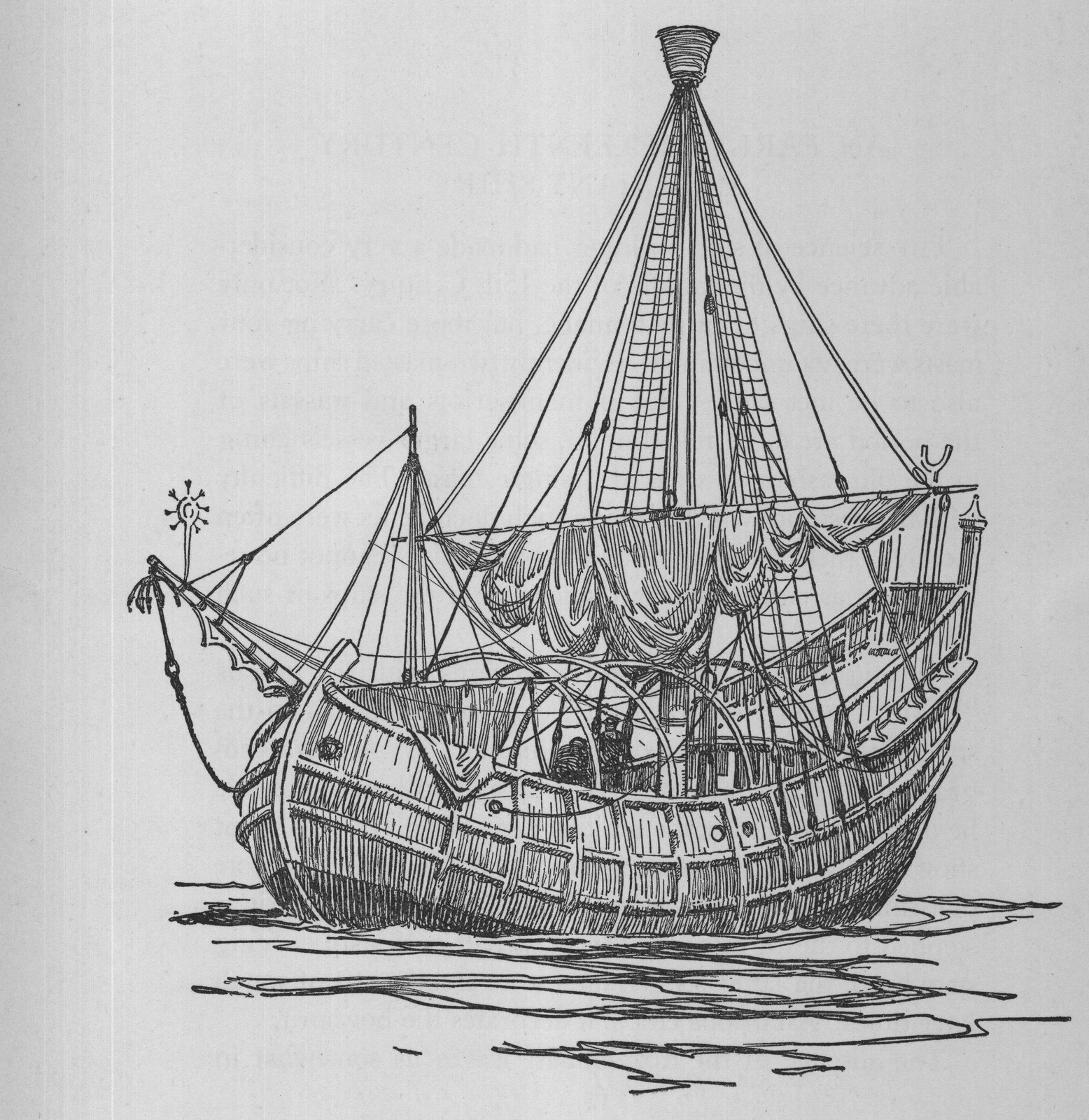
THE science of ship-building had made a very considerable advance by the middle of the 15th Century. Not only were there ships of large tonnage, but those carrying four masts were not uncommon. Evidently two-masted ships were also to be met with. But if manuscripts and missals of the period are to be relied upon, some larger vessels clung to the old-fashioned style of a single mast. The difficulty with this testimony is that many such documents were often merely copies of earlier illuminations, and so cannot be relied upon as contemporary renderings of the ships of such later date. An engraver of this period who signs with the initials "I. M." (Israel von Mekenen), working somewhat in the style of the famous artist signing himself "W. A.," who engraved both the details of the rigging and hulls of the vessels he depicted with most meticulous care, has given us a print showing such a two-masted ship. It is interesting to note that this vessel has no forecastle and that the bowsprit is stepped to the right of the foremast and curiously curving stem-head, the latter style traceable in small craft of much later times. A curious emblem decorates the bowsprit.
The absence of the mizzenmast leaves us somewhat in doubt as to the function of the crotch at the taffrail unless it may be assumed that the main mast can be lowered and supported thereby. Across the deck in the waist are curved awning supports suggesting that a deck cargo liable to be affected by the elements may have been carried. The poop deck, graced by substantial lanterns, is built upon stanchions, a characteristic of the period. It is practically impossible to assign a name to this oldtime vessel, but she is certainly not a ship of war. Perhaps she was a passenger ship, but if so, she does not look very comfortable. In fact, sea travel at this period was not the height of luxury. Hammocks had not yet been introduced and the voyager in such a ship as this would have been compelled to sleep on a truss of straw in a cabin hardly large enough for a dog. These ships were perpetually wet, and the odour of the bilge could hardly be compared to Coty's perfumes. But let us hasten to overlook these aspects of the voyage and to think only of the brave adventures of the traveller and the fine yarns his sea experiences would enable him to recount to his family and friends when once he had recovered from his mal-de-mer and got rid of his sea legs.