Home › The Buss
The Buss
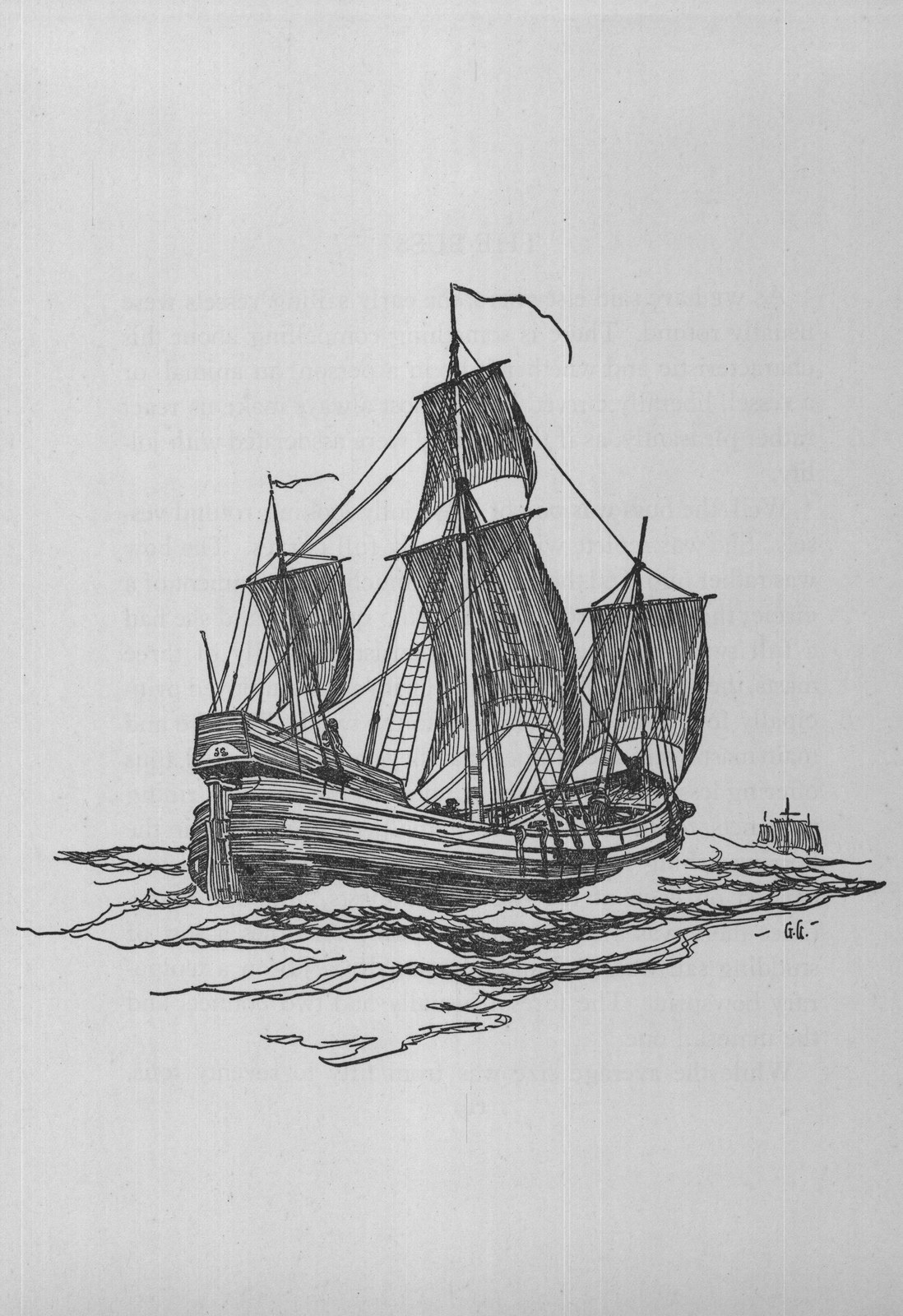
AS WE have said elsewhere, the early sailing vessels were usually rotund. There is something compelling about this characteristic and whether it be in a person, an animal, or a vessel, liberally curved lines almost always make us react rather pleasantly, as if that quality were associated with jollity. Well, the buss was one of those jolly-looking rotund vessels. She was replete with pleasantly full curves. The bow was rather high and the stern piece much like a segment of a circle; the poop narrow, with bulging quarters, and she had a full sweeping steer. Her rig consisted usually of three masts, the after one short and fitted with a sail employed principally for riding with her head to the wind. The fore and main masts were so equipped that they could be lowered, thus offering less resistance to the wind when the boat was riding to its nets, for these vessels were employed principally in the herring-fishing industry. Usually a single square sail was carried on each of the two larger masts, although sometimes there was a square main topsail. At times a sort of studding sail was used and occasionally a jib on a temporary bowsprit. The foresail usually had two bonnets and the mainsail one. While the average size was from fifty to seventy tons, busses were sometimes said to be as large as two hundred tons. The length, on the average, was fifty feet on the keel with a beam of about sixteen feet. In England during the 17th Century the maximum cost of such a vessel is said to have been about pound260. It has been said that the City of Amsterdam was built upon herrings; now, as the busses were principally employed in former times by the Dutch fishermen, in catching these same herrings and carrying them ashore, why may it not be also claimed that the buss is really the underpinning of that city? And what could be more appropriate for a Dutch dam than to have a floating foundation?