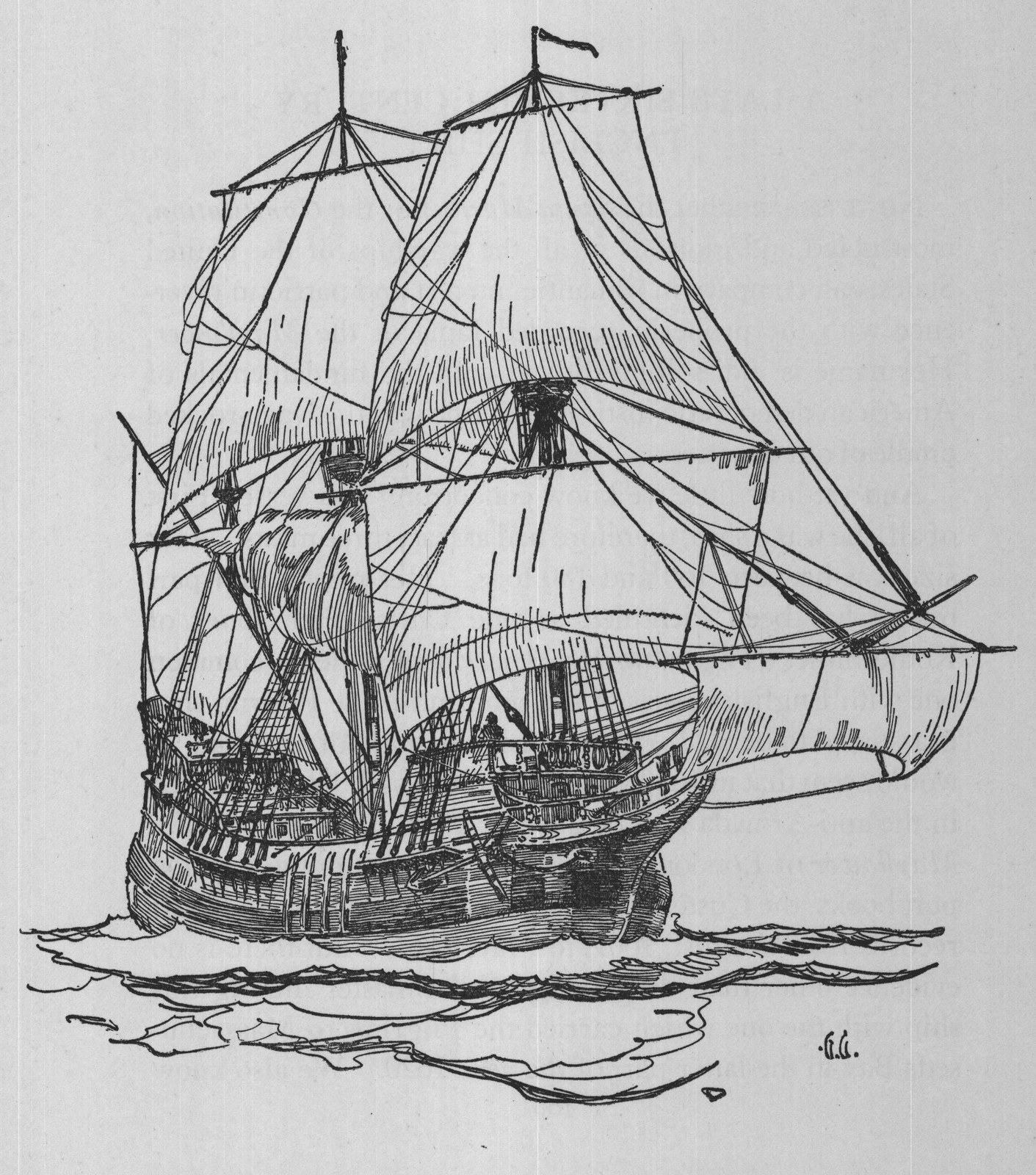
Home › A Late Sixteenth Century English Ship
A Late Sixteenth Century English Ship
NO VESSEL, neither the Santa Maria, nor the Constitution, most noted and glorious of all the warships of the United States, can compare in romantic interest and patriotic reverence with the properly accorded fame of the Mayflower. Her name is indissolubly linked with the fundamentals of American democratic institutions. She was the wave-rocked cradle of our liberties. And yet how little we know concerning this vessel. First of all, she was a ship, therefore had at least three masts. Her size was between 160 and 180 tons. Her master and part owner has been identified as one Christopher Jones of Rotherhithe. The name Mayflower was rather a common one with English vessels of her time and if the Pilgrim ship is assumed to be a Mayflower designated as "of London," it would seem that in 1620 she was an old vessel that had served in the anti-Armada fleet of the year 1588. The record of a Mayflower of London has been traced through the London port books, the Customs accounts, and the Admiralty Court records from August, 1609, to May, 1624. But there is no evidence other than the identity of the master linking this ship with the one which carried the Pilgrims to Massachusetts Bay in the latter part of the year 1620. We also know that on this trip one of the main beams amidships "bowed and cracked"; that by means of a "great iron screw" the said beam was raised again into its place and made secure by placing a post under it. We know that the Mayflower returned from Plymouth, Massachusetts, to England in April-May, 1621. The London port records give after this date only one entry of the ship of which Christopher Jones was master, dated October 31, 1621, when she was unloading bay salt at London from Rochelle, France. Christopher Jones died early in the year 1622 and thereafter the identity of the Pilgrim ship, in so far as the London Port records go, is lost. She was in ruinis at Rotherhithe in May, 1624, when, in a proceeding in the High Court of Admiralty, she was valued with her tackle and furniture at pound128. This epitomizes the facts and strong probabilities relating to the history of our Mayflower.
As to her appearance, all must be left to conjecture. We are pretty well acquainted with the general design of hull and the particulars of the rigging of ships of the late 16th and early 17th centuries. But as to detail of structure, ornament, and interior distribution relating to the Mayflower, we are completely in the dark. So our illustration is fanciful to that extent. We are indebted to Mr. R. G. Marsden for the facts based upon documentary evidence concerning the history of the Mayflower of London, both before and after her voyage to Plymouth. Mr. J. W. Horrocks, in a masterly article in vol. VIII (pp. 2, 81, 140, 237, and 354) of the Mariner's Mirror arrays the facts and draws a number of fair assumptions from them, at the same time winnowing the wheat from the chaff of bushels of suppositions, most of them ridiculous, and breaking down several theories that not all the screw-presses and posts of a fleet of Mayflowers as large as the Armada itself could support.