Home › The Clipper Ship of 1850
The Clipper Ship of 1850
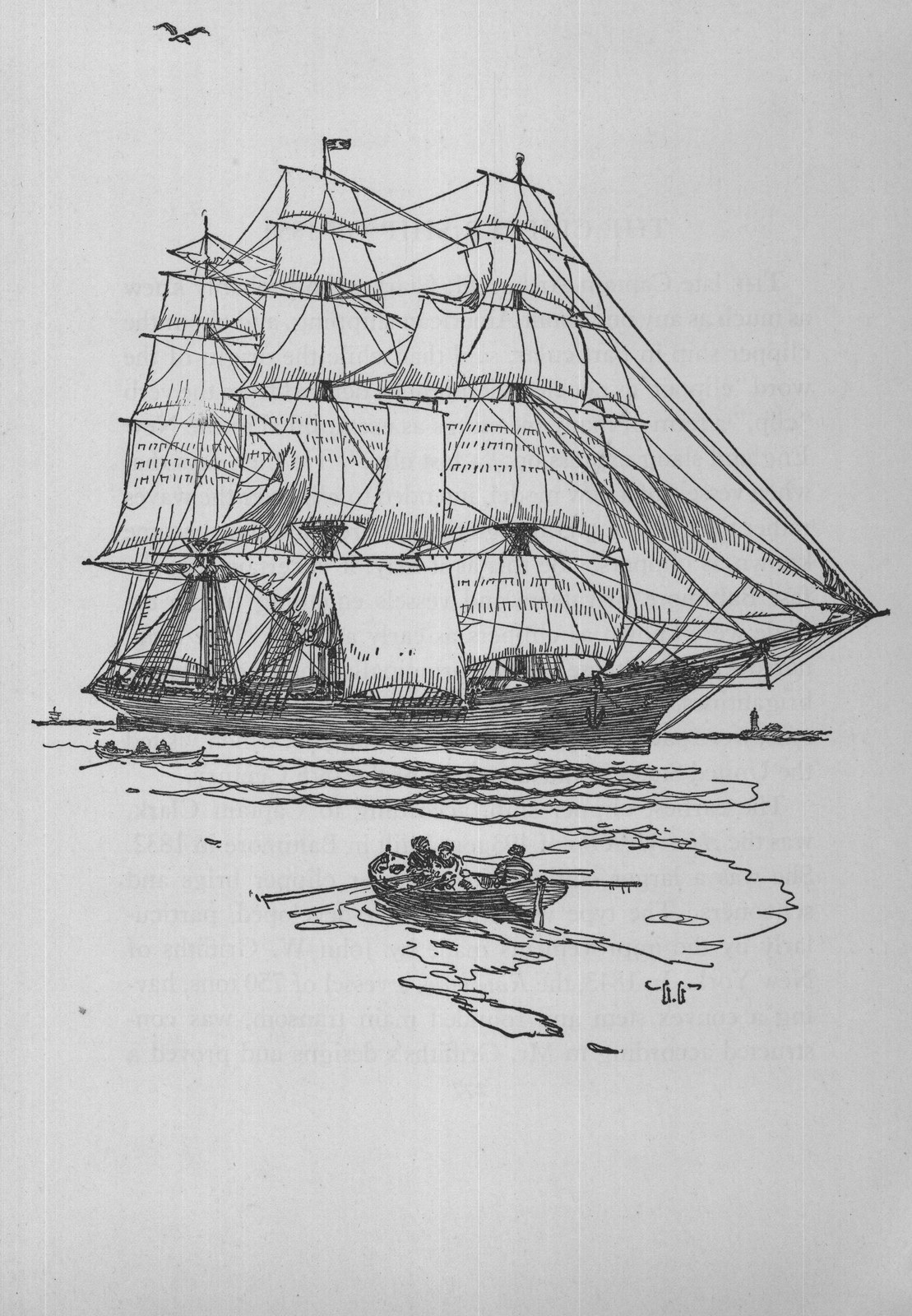
THE late Captain Arthur H. Clark, who probably knew as much as any one about American shipping, and about the clipper ship in particular, said that while the origin of the word "clipper" is not clear, it might be derived from the verb "clip," a term of many meanings as exemplified in the New England slang expression, "a fast clip." He then says that when vessels of a new model, intended to clip over the waves rather than to plough through them, were built, they became known as clippers. Be this as it may, it is certain that the fast Baltimore privateers and vessels engaging in the tea trade were known as clippers as early as 1810. The long, narrow hulls of these vessels, principally small craft, brigs, brigantines, and schooners, rarely exceeding two hundred tons, were patterned after the French luggers, which visited the United States in the latter part of the 18th Century. The earliest clipper ship, according to Captain Clark, was the Ann McKim of 493 tons built in Baltimore in 1832. She was a larger edition of the earlier clipper brigs and schooners. The type was still further developed, particularly by the improvements made by John W. Griffiths of New York. In 1843, the Rainbow, a vessel of 750 tons, having a convex stem and rounded main transom, was constructed according to Mr. Griffiths's designs and proved a great success. Thereafter, large numbers of similar vessels were constructed, both in England and in the United States, the size gradually increasing until the average tonnage was well over one thousand, while such great ships as the Sovereign of the Seas of 2,421 tons and the Great Republic of 4,357 tons marked the zenith of the development of sailing craft. These superb vessels, stoutly constructed, splendidly rigged, well manned, and ably officered, sailed every sea, carrying on through thick and thin, establishing records for speed almost equalling the steamships of to-day. The Flying Cloud sailed 374 miles in twenty-four hours! This was on her famous trip from New York to San Francisco in eight-nine days and twenty hours in the year 1851.
Those were the declining days of the romance of the sea. The sun of the sailing ship was setting. Already the gold and the crimson were mantling the skies-the gold of California and the crimson of the coming Civil War. But the glory of that sunset was the brighter by reason of the perfection to which the ingenuity of man had brought that most romantic of his handservants, the ship.