Home › The Carrack
The Carrack
THE word employed to designate the larger ships of an indeterminate period, which certainly embraced the 14th, 15th, and part of the 16th centuries, and probably a considerable period of time prior to the earlier date mentioned above, was carrack. Appearing in various forms such as carraca, carraque, and kraeck, the term is of doubtful origin. Jal rejects its derivation from K<??>. Mr. Nance says that the word is of Mediterranean origin, but does not state the source.
During the period above mentioned it was essentially a vessel designed to carry large burdens, but often employed also for purposes of war, and was undoubtedly an integral part of the shipping of all European maritime nations, although, as to some countries, it may not be possible to identify it by name with any particular individual ship.
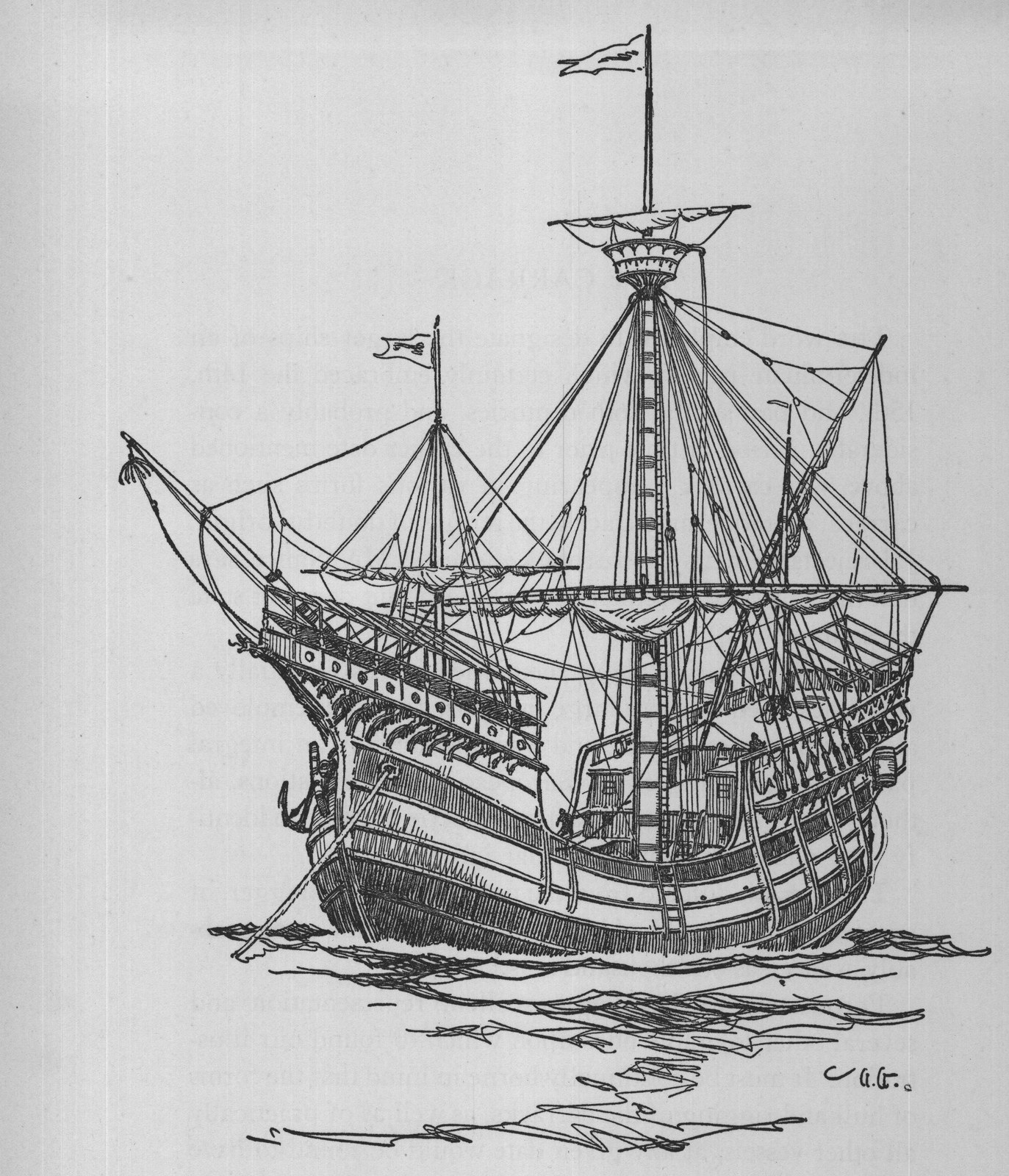
The carrack differed from the nef in that it was bigger, of greater draught, and had higher top-sides. Some were probably as large as one thousand tons. Fortunately we have one excellent representation and several other tolerable ones upon which to found our illustration. It must be continually borne in mind that the forms of hull and rigging of the carracks, as well as of practically all other vessels, at any given date would be found to have differed somewhat in each different locality and that changes were constantly taking place from time to time in such forms in each of such places. So that the best we can do is to say that our illustration shows a Northern carrack taken from a print of the engraver who signed himself with a mark that looks somewhat like the letters W. A. The date may be placed about the middle of the 15th Century. The print referred to, which has the sovereign merit of giving the name of the vessel represented, while offering all one could reasonably expect from an artist of this period, is not by any means perfect. It is only by supplying its defects from other sources that one can arrive at a reasonable representation of the whole.
It will be seen that the carrack usually had four large wales. Skids strengthened the sides. In the carracks of Southern waters it was customary to permit the ends of the deck beams to project beyond the planking of the vessel's sides. These ships usually had three, sometimes four, masts, the mainmast being much larger than the other two. A diminutive main-topmast appeared at quite an early date, but this spar was often little more than a flag-staff.
One of the most recent "finds" showing representations of carracks is an illustration to a French translation of Boccaccio's "La Teseide." It is in the Vienna National Library. Usually such miniature illustrations of contemporary 15th Century books and manuscripts, owing to their small scale and conventional handlings, are of little value in furnishing reliable information as to the shipping of this period.
The picture above referred to is a happy exception. It offers many points of confirmation to other drawings, prints, and paintings. Mr. Nance has given an interesting review of the subject of carracks, and particularly of the sources from which the information concerning them is drawn, in the Mariner's Mirror, vol. IX, no.5, May, 1923.
He there describes the Boccaccio drawing and compares it with other representations of carracks, giving references to earlier articles upon the same subject, in that magazine. The search for information upon these matters is one of the latter-day romances of the old ship. It is a fascinating study in which the opportunity for original work is unlimited.