Home › Late Fifteenth Century Ship › Late Fifteenth Century Ship
Late Fifteenth Century Ship
LIKE nearly all other branches of archaeological research, the branch dealing with the ship has, within the last fifteen years, made very definite advances. Much that the indefatigable efforts of M. Jal were not able to discover is gradually coming to light. While interesting, the task of the modern searchers after the facts of mediaeval and renaissance naval architecture is arduous. It demands the examination of numberless time-stained parchments, of crumbling papers, of ancient volumes stowed in out-of-the-way corners of libraries, and of musty records in remote naval and marine repositories. But the searchers are constantly adding to the store of information upon the subject. The highest praise is not too much to bestow upon the painstaking specialists contributing to the pages of the Mariner's Mirror, the periodical published by the British Society for Nautical Research.
It is unfortunate that the well-meaning Spanish gentleman who prepared the plans and designs for the Columbus fleet sent to the United States for the Chicago Celebration in the year 1892 could not have had the benefit of the effort of these English scientists. It is safe to say that if he had, the alleged replica of the Santa Maria, the principal result of his earnest if misdirected efforts, would not have borne the form she does-for she is still in existence, disseminating to this day a deplorable amount of misinformation; while models fashioned after her, based upon the same erroneous data, are legion and may be seen even in such repositories as the Science Museum at South Kensington in London and the Smithsonian Institution at Washington, D.C. It is also curious that one of the Italian Government's literary contributions to the Columbian celebration, a superbly printed treatise on the subject of naval architecture in the time of Christopher Columbus, its pages filled with illustrations giving much of the information if not the complete appearance of a ship of the latter part of the 15th Century, should have adopted the said rendering of the Nao Santa Maria, as the final estimate of the evidence so presented.
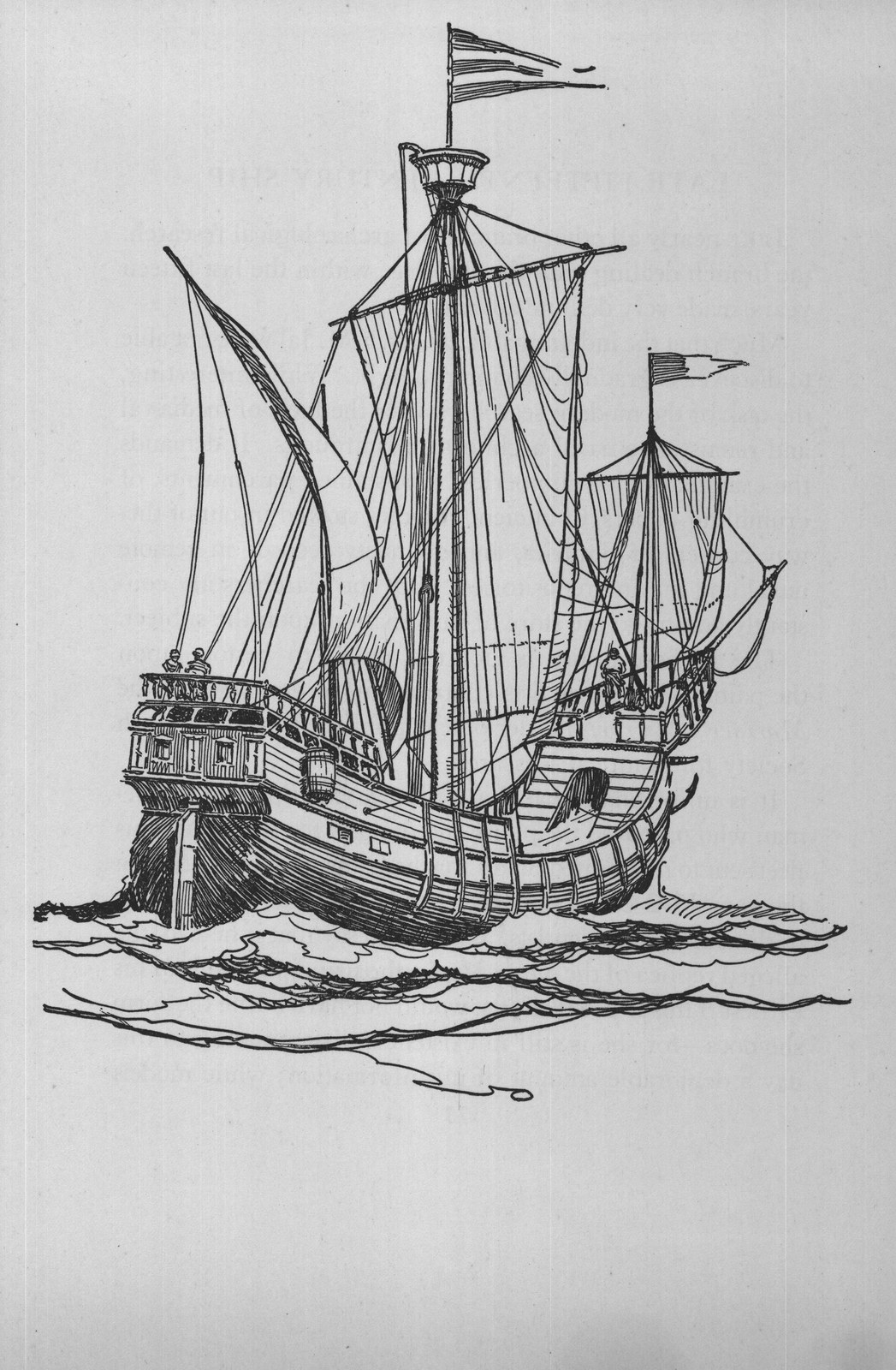
The round ship of that date was round and no mistake. As Mr. R. Norton Nance humorously says of the carracks of that time, "The compass seems to have decided the form, not only of the stem, but also of the mid-ship sections." The curves of the sheer are almost equally generous. Prominent wales and skids formed part of the exterior structure.
In addition to rotundity, giving that certain appearance of bulk that all generously curved bodies possess, the next conspicuous feature was the great size and height of the mainmast. It is the apotheosis of the mast-tree of the once single-masted vessel, assisted now in a very small way, not supplemented, by two, sometimes by three, young sprouts of masts, small saplings still, but destined in time to grow into formidable rivals but never quite compeers. The square mainsail, too, was still out of all proportion to the other sails, probably embracing twice the area of the balance of the ship's canvas put together.