Home › An Eighteenth Century Seventy-Four Gun Ship
An Eighteenth Century Seventy-Four Gun Ship
The ship of seventy-four guns may be said to have been, during the "great period" of wooden sailing ships, the man-of-war par excellence. It was the most popular sized ship among the great European naval powers as is evidenced by the fact at the end of the 18th Century there were more seventy-fours both in the English and in the French Navy than ships of any other class. The word class is here intended to mean any particular type of approximately a like tonnage having the same number of guns. Thus the frigates, while collectively more numerous, varied considerably in size and in the number of guns carried. Mr. John Masefield has said that a modern sailor, accustomed to the keen iron ships of the present day, would have called such a ship a "sea-wagon," qualified or otherwise, before spitting and passing by. But when the great sails were set, and the hull began to move through the water, the cumbrous fabric took on attributes of beauty and nobility. There has been perhaps no such beautiful thing on earth, the work of man's hands, as an old seventy-four under sail.
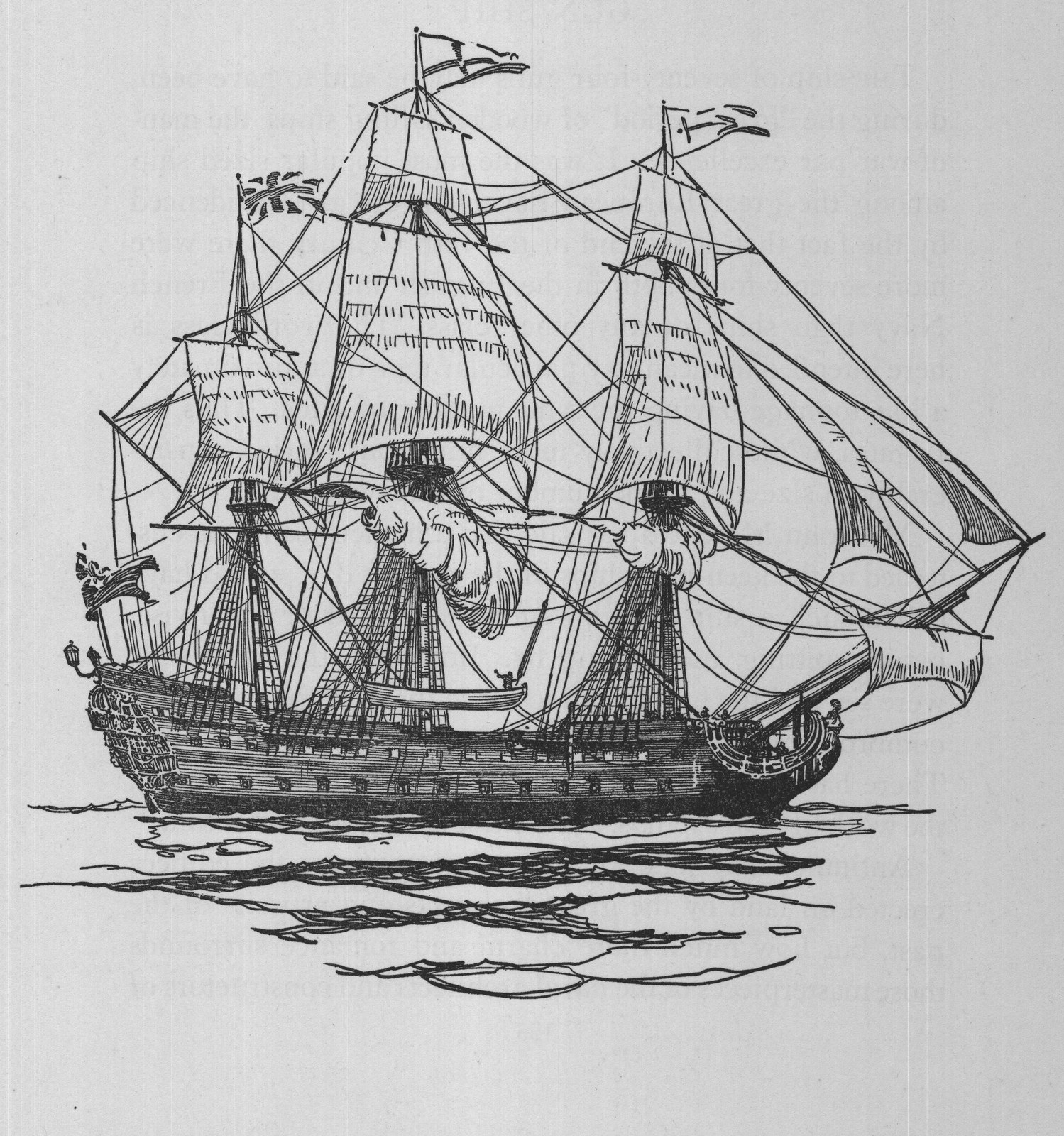
Antiquity may lend charm and romance to the edifices erected on land by the great architects and artisans of the past, but how much more charm and romance surrounds those masterpieces of the naval architects and constructors of bygone days, those creations, destined to struggle against the destructive forces of winds and waves, of fire, or treacherous shoals and uncharted rocks, those structures whose very lack of permanence in substance has been the means of strengthening the memory of their beauty in the mind of man! The French seventy-fours were not substantially different from their peers (or should we say peeresses?) in other navies. There was, however, one feature quite distinctive, the form of the stern transom. At this period, the outline of their sterns above the lowest member was almost a perfect ellipse. Otherwise, at a distance it would have taken a practised eye to discern such differences of rig as existed. These fine distinctions are as intangible and yet as manifest to the trained eye as are the differences to be noted in old porcelain and glass by that of the connoisseur. If you had asked an old sailor how he recognized such and such a vessel as being of this or that nationality, he would probably have answered "by the cut of her jib." This subtle differentiation would have left most folks not much wiser than before. Most of the larger French ships of the end of the 18th Century had built-in waists; that is, wide permanent structures joining the forecastle and the quarter deck. In the English ships there were sometimes light removable gangways serving as a means of communication on the same plane between these two parts of the vessel, but in many others a person passing between these stations would have been compelled to descend one ladder and to ascend another. The illustration shows a French seventy-four, the Terrible, captured by the British about the year 1747.