Home › A Frigate of 1820
A Frigate of 1820
WHEN we come to compare the frigate of the first quarter of the 19th Century with earlier examples of the same type, we find that, while there has been some development in the rigging, not much change has occurred in the hull during the period of about thirty years.
Trail boards, that is, solid construction, enclosed the old-fashioned open beak-head, thus providing additional protection to the forecastle bulkhead. The open space, formerly to be found between the bulwarks of the foredeck and afterdeck, that is, opposite what might be called the waist, if frigates can truly be said to have waists (the example of the fashionable young women of to-day may be noted) was solidly built up with a permanent structure except for a single narrow opening on each side for access to the deck. Boat davits had appeared at the quarters.
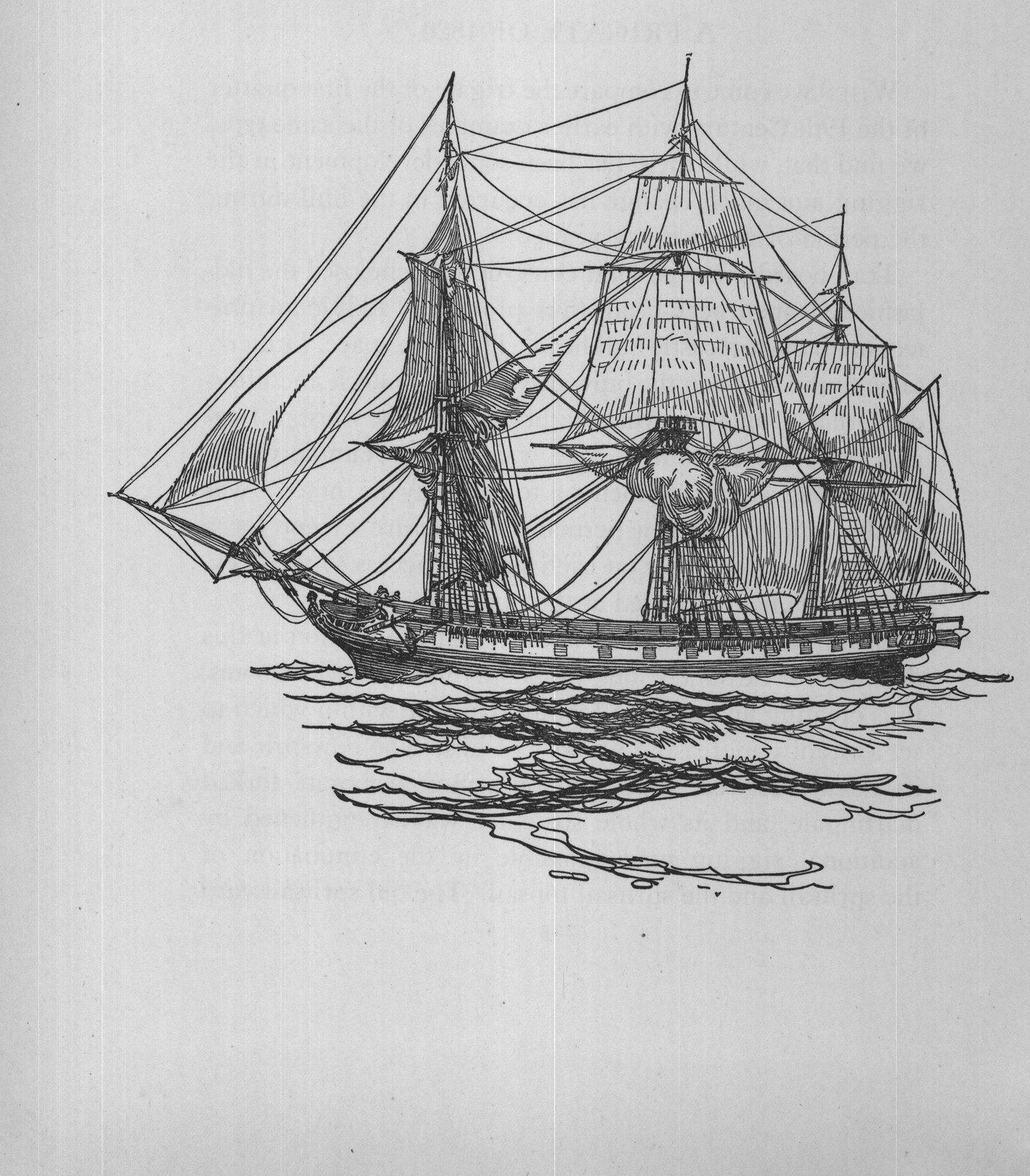
In the rigging it may be noticed that the fashion at this date was for extremely long jib-booms and flying jib-booms, thus creating an immense forward triangle within which to set a steadily increasing number of jibs. The bowsprit and its extensions were supported by a most elaborate forked martingale, and its whole structure was strengthened by additional rigging made possible by the elimination of the spritsail and the spritsail topsail. The old spritsail yard was still retained as a means of further strengthening the bowsprit in the horizontal plane.
Royals were a part of the regular equipment and not occasional sails, set temporarily upon a long-poled topgallant mast. Extra crosstrees and shrouds added further security for the royals upon the royal mast, while an additional pole set abaft this spar furnished a convenient medium for setting sky sails. Altogether, the light weather sail spread had increased, still further heightening the dignity of these beautiful fabrics, approaching, at this period, the zenith of their grace and majesty.
The frigates were the eyes of the fleets of which they formed part, the scout-cruisers of their day. Also they were of the greatest service as commerce destroyers, running down (we came near saying "to earth") the proverbially timid merchant ship if not strongly convoyed. What stories are more thrilling with adventurous romance than those of the frigates of this period whose exploits are so near our own times that none of the essence or flavour of the tales escapes us!
It is worth noting that in France, the custom had been to give to the frigates names of a feminine gender, such as La Victoire, La Gloire, etc., while to larger ships, names of the opposite sex were usually applied. We will leave it to our readers of the fair sex to determine whether this was due to the saucier and more jaunty appearance of the frigates when compared with the cumbersome but perhaps more majestic impression created by the craft of greater tonnage.