Home › A Greek Galley
A Greek Galley
500 B.C.
NEARLY everyone will admit that among the sculptured productions of antiquity none are more satisfying in beauty, in sentiment, and in romantic interest than those from Greece.
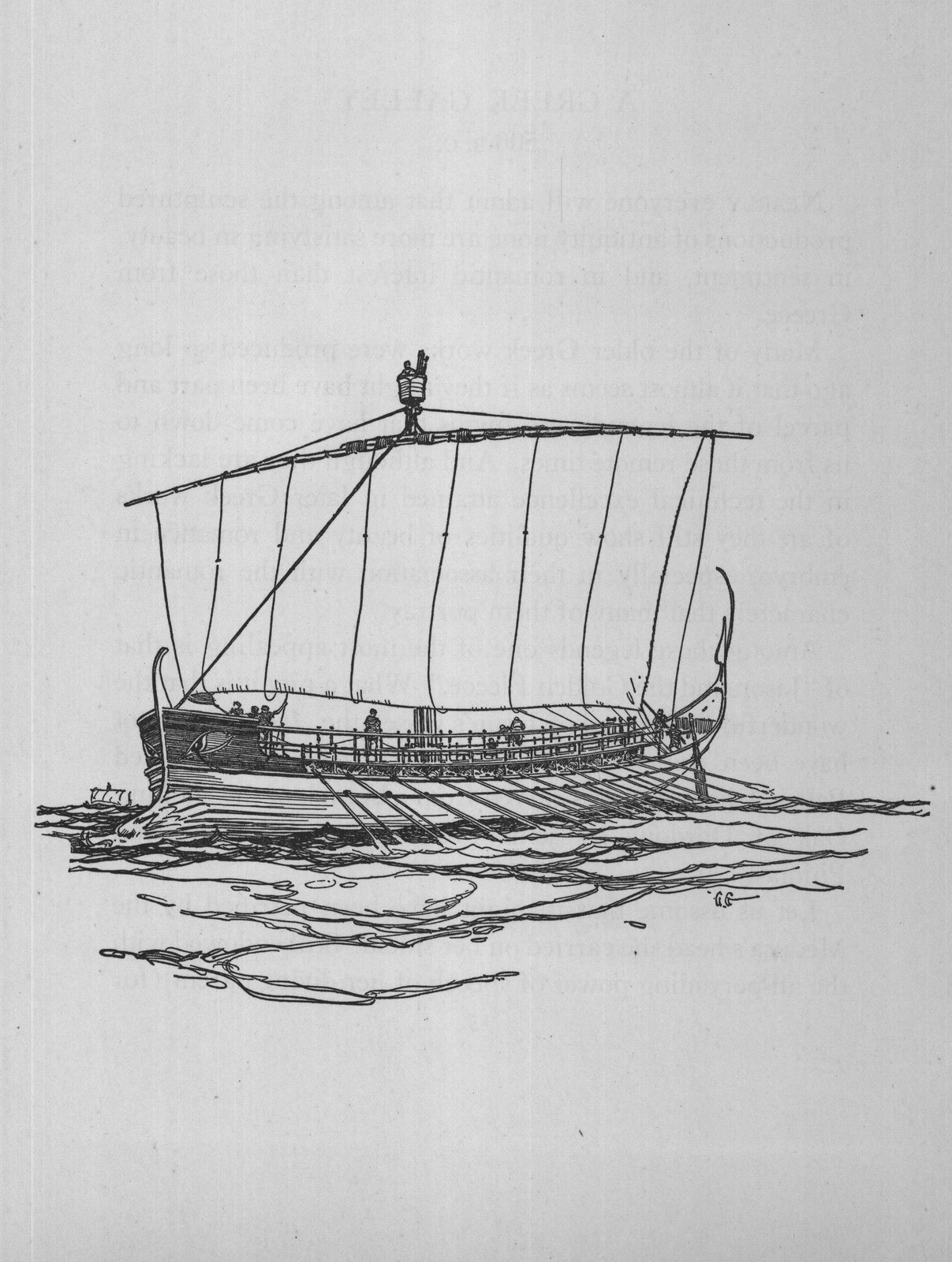
Many of the older Greek works were produced so long ago that it almost seems as if they might have been part and parcel of the legends and myths that have come down to us from those remote times. And although they are lacking in the technical excellence attained in later Greek works of art they still show qualities of beauty and romance in embryo, especially in their association with the romantic characters that many of them portray. Among those legends one of the most appealing is that of "Jason and the Golden Fleece." What a pity it is that the wonderful figurehead of Jason's vessel, the Argo, could not have been preserved. You will recall that it represented Pallas Athene and was carved from a branch of the Talking Oak of Dordona by some precursor of Praxiteles and Phidias.
Let us assume that it might have been petrified by the Medusa's head she carried on her shield. Still endowed with the all-pervading power of speech of her divine parent (for all things are possible to the gods, and what is more common than a speaking likeness, be it on canvas or in stone?) the goddess might have told us poor mortals of an age far removed from those golden days, and of the vessel over whose destinies she ruled.
Instead of being compelled to rely on ancient vase paintings, distorted by the conventions of the decorator's art, on minute seals, and on descriptions composed by authors untutored in the technique of naval affairs, she might have described to us at first hand the form of the Argo, her rig, the details of her construction, her decorations, and given us other information, now sadly lacking.
We can form some idea of the size of the Argo, because you will remember Jason summoned fifty Greek heroes to man her oars.
Assuming one hero (and they were all mighty men) to an oar, a length, according to other credible standards of comparison of about one hundred and twenty-five feet might be inferred: not so bad, for, oh, so many centuries B.C!
And then she might have told us something about Medea and Jason (for even goddesses are not above gossip) and how she had to chaperon them on the voyage back to Colchis. Perhaps she was a little jealous of Medea; and so would any one be who did not have an enchantress for either wife or sweetheart.