Home › A New Bedford Whaling Bark
A New Bedford Whaling Bark
"SHE blo-o-ws! An' sparm at that!" comes from the crow's nest high up on the foremast. "Where away?" " 'Bout three p'ints off the port bow." Instantly the vessel's deck teems with activity. The "Old Man," as the captain is usually called, bustles up through the after companion hatch. The bark has been out of luck so far this voyage, and this is the first school sighted. The tumult increases, but it is an orderly tumult, where every man knows and does exactly what is required of him. Boats must be hoisted out, the vessel's course altered, yards braced; sheets, tacks, and bowlines handled; sail spread or shortened as occasion demands; stages rigged, fires lighted, a multiplicity of acts performed.
Meanwhile, the boats have got off, and, urged along by sturdy muscles, approach the quarry. And it is exactly in this respect-the rapidity and facility with which the boats could be put overboard-that the whalers contributed a most useful appliance to marine science. In olden times the hoisting in and out of a boat was a comparatively complicated and tedious operation. It was performed by means of several tackles. In taking a boat on board, first the yard tackles. In taking a boat on board, first the yard tackles hanging from pendants at the arms of the fore and main yards lifted the boat from the water high enough to clear the rail; then by means of other tackles and guys, the boat was directed over its chocks, to which it was lowered and secured.
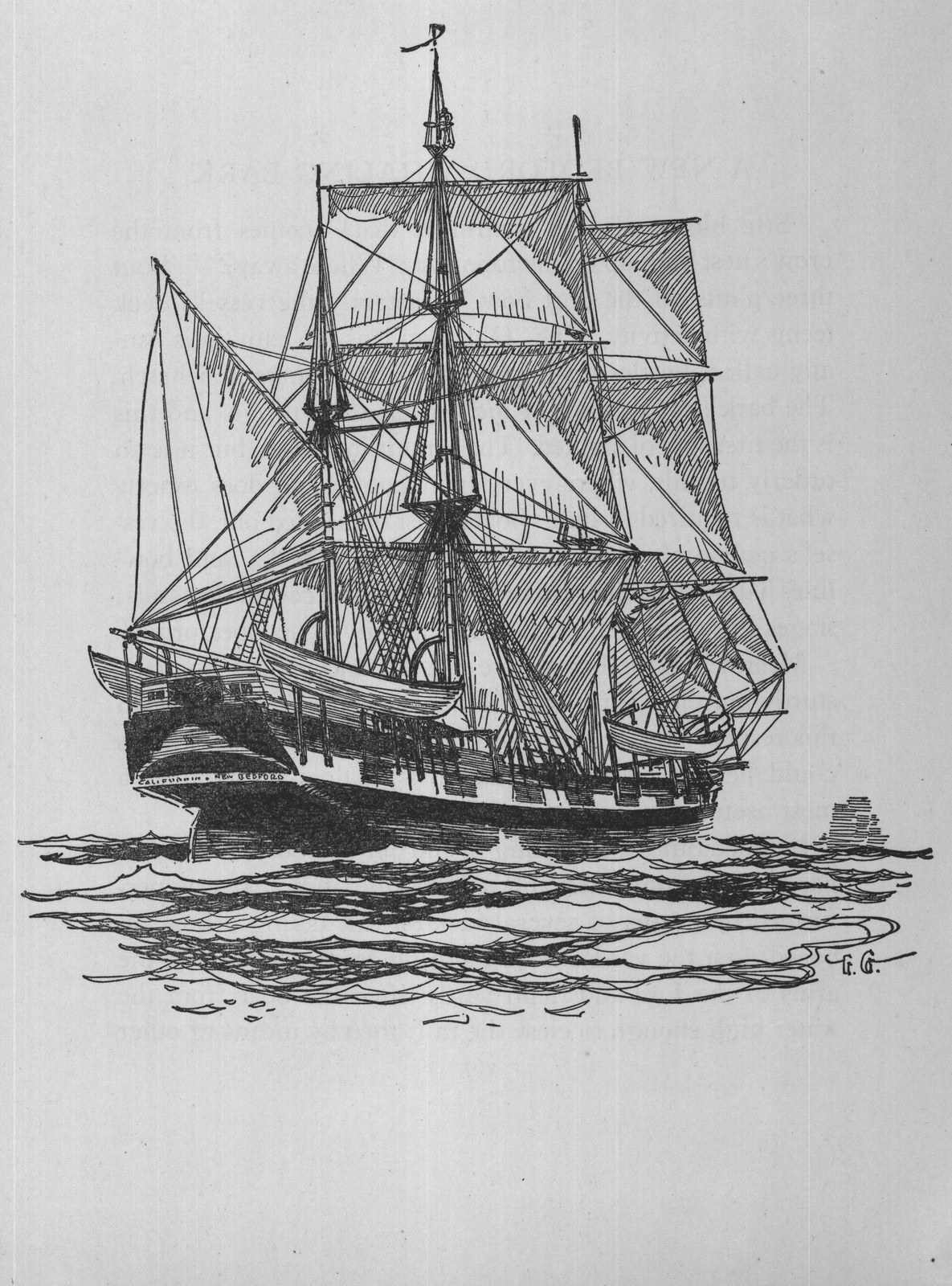
About the end of the 18th Century the earliest form of boat davit made its appearance. It consisted of a long stout beam extending across the extreme end of the hull on both sides of the stern for a considerable distance beyond the vessel's sides. Forward of this and right aft of the mizzen shrouds a stout, removable, vertical stanchion was fitted. To the top of this and from the end of the cross beam, tackles were rigged and these lifted the boat diagonally to the line of the ship's keel, thus easily clearing the spread of the quarter gallery. In this position the boat was readily secured and was in position for immediate lowering.
It was a simple and obvious progression from this to the conventional outboard davit. The end of the above-mentioned cross beam also furnished a convenient point to which to attach the after block of main braces, and it was for this purpose that this cross beam continued to be used long after its original purpose as a part of the quarter davit had disappeared. Another peculiarity of the whaling vessels of the United States is their two narrow raised deck houses astern. The convenience of these is obvious. The bark rig was a favourite one with the whaler as it afforded an opportunity to keep all the main braces aloft and thus out of the way of the continually handled boats, while the fore and aft mizzen had conspicuous advantages when it came to lying-to.
Apparently the rig was evolved about the end of the 18th or the beginning of the 19th Century. Darcy Lever (1808) mentions that it was customary for vessels in the Baltic trade to substitute a flagstaff for the mizzen topmast, its top yards and gear, and to omit also the cross-jack yard, retaining only the driver, a fore and aft sail, on the mizzenmast. This would leave the vessel substantially bark-rigged. Subsequent development substituted a more elaborate spar for the flagstaff, one capable of carrying a gaff topsail, and the type was complete.
There is plenty of romance in whaling, when seen from a landsman's eyes, but there could not have been much romance in the minds of men who pursued this calling. The chase, harpooning, and lancing of the huge quarry had its wild thrills, but the following acts of the drama, the stripping and hoisting in of the blubber and the trying out of the oil, were certainly fetid and repulsive anticlimaxes.
Although fortunes were rapidly acquired in the pursuit of the whale, particularly prior to the year 1860, after that date, the owners of the whaling ships often suffered severe reverses. The Civil War played havoc among the whalers of the northern ports. Many ships were captured by the cruisers of the Confederacy. Of these not a few were herded into Southern harbours and there deliberately sunk to improve the defenses of those havens. Again in the winter of the year 1871, thirty-two whaling vessels were nipped in the Arctic ice and totally destroyed, the crews numbering more than 1,200 men barely escaping with their lives. This blow fell most heavily upon the city of New Bedford, Massachusetts.
The discovery of and enormous increase in the production of petroleum sounded the death knell of the whaling industry. And while the whale is still pursued, the harpoon gun, the bomb and steam whalers have superseded the handrowed boat, hand harpoon, and lance, and have also robbed the trade of such romance as it formerly had. These modern appliances have also almost exterminated the whale, and the day is not far off, unless a comprehensive international policy of conservation is agreed upon, adopted, and firmly enforced, when the cetaceans will become as scarce as the old-time whaling ships.