Home › An Egyptian Galley
An Egyptian Galley
1600 B.C.
THE Nile region has always been a land of romance. Its antiquity and mystery fired the imagination of the Greeks and Romans. Successive later generations have acknowledged its thrall. The systematic scientific research of modern times with its discovery of the key to the riddle of the hieroglyphic writings has lifted the veil and permitted us to catch glimpses of the wonderful civilization and accomplishment of those far days, but has dispelled none of their romance.
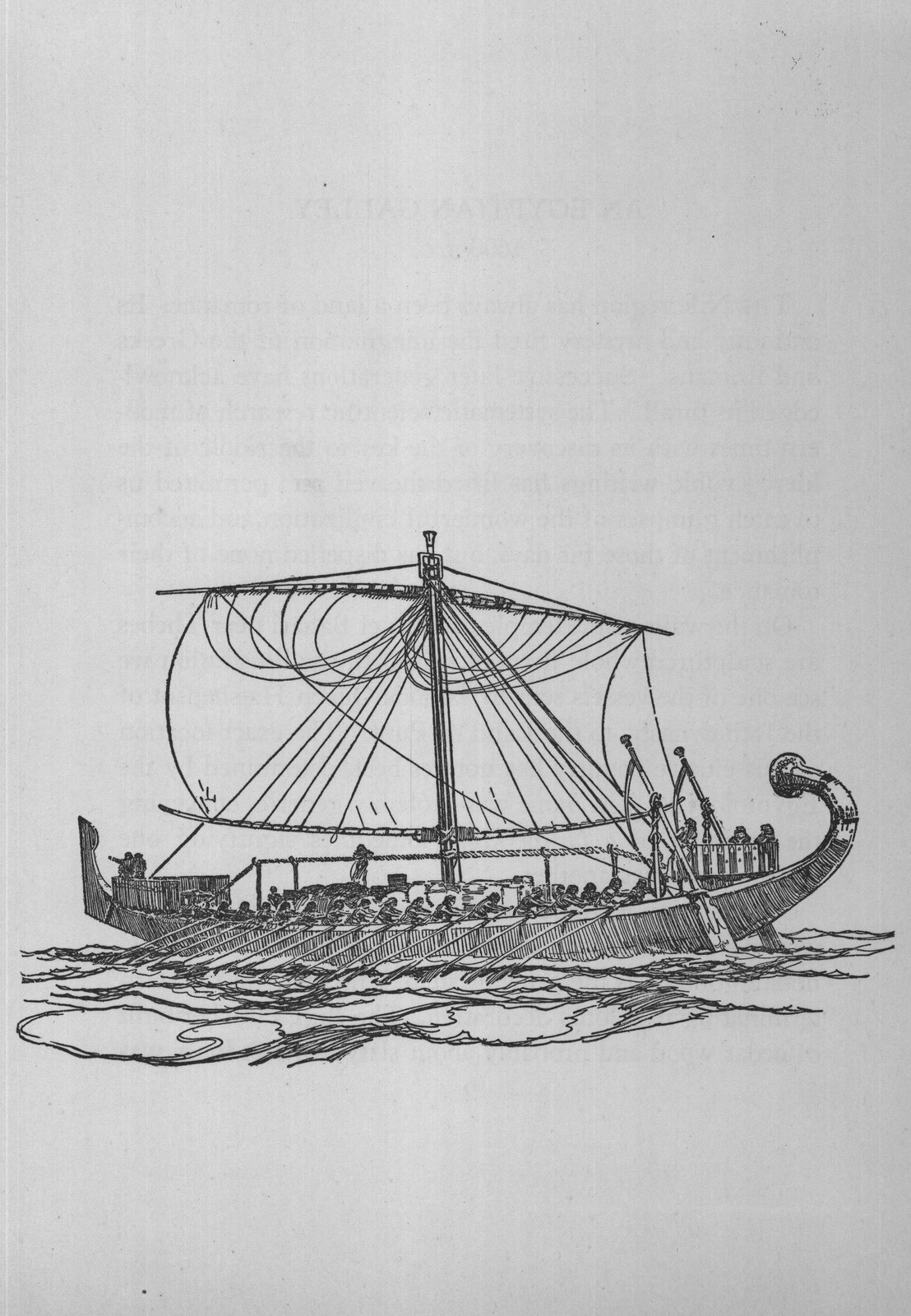
On the walls of the temple of Deir el Bahari near Thebes are sculptured whole fleets of ships. In the illustration we see one of the vessels sent by famous Queen Hatshepsut of the 18th dynasty, to the Land of Punt. The exact location of this elusive country has not yet been determined by the Egyptologists. The name was probably generic, conveying the meaning of a far-off land, sometimes signifying one place, sometimes another.
Nothing can be more graphic than these temple pictures with their accompanying text. Note how similar to the Venetian gondola is the prow or stem, how graceful the stern terminating in a lotus decoration. The ship, clincher-built of cedar wood and probably about sixty-five feet long, was strengthened by a hog truss formed of wooden crotches supporting an immensely strong cable. This effectively prevented the hull from sagging or straining in a sea-way, particularly when heavily laden, because these vessels evidently were cargo carriers. The mast was probably provided with a tabernacle, so that when the yard was down, it could be lowered to offer less resistance to a contrary wind. The upper yard was fashioned of two arms or antennae lashed together, a method persisting in certain Mediterranean types of sailing vessels until to-day. The lower yard acted as an extension for the tacks of the sail and was useful in holding down the foot. Parrels1 (See Note I, Appendix.) confined the yards to the mast. The upper yard had its braces, and the ropes attached to the outer end of the lower yard acted as sheets. Lifts sustained both yards; when hoisted the upper yard was suspended from two, and when lowered, several sub-parts held it up, similar to the lower yard. These upper yard lifts show in the drawing in graceful curves. At the masthead an arrangement of cleats and battens furnish the means of leading the halyards, running and standing lifts for both yards.
Halyards hoisted and sustained the yard at the masthead and probably served also as backstays. In furling sail, the upper yard was let down. No forestays are shown in these relief delineations but they were certainly in use, as they appear in the Mehenkwetre models now in the Cairo Museum and Metropolitan Museum of Art at New York.
The rudder is shown on the starboard side. Perhaps there were two rudders, a very common practice. Largely employed in the shallow waters of the Nile, it was of prime importance that the rudder should be adjustable to the depth of the water. The rudder post was quite long, sufficiently so to enable the tiller to be rigged vertically downward. The lower part of the post was confined to the counter by a stout rope through holes pierced in the gunwales and the upper part held by a similarly arranged loose lashing to a socket or crotch at the top of a stout post, while still farther up the tiller entered it and was rotated vertically. Ropes were made fast just above the blade or loom of the rudder and belayed inboard. By this means the whole rudder could be lowered or raised as occasion demanded. These details appear fully in the Mehenkwetre models. In experiments recently made by Mr. H. E. Winlock, of the Metropolitan Museum of Art, who was one of the discoverers of these models, every rope connected with this rudder rigging was found to have its purpose, the strains nicely calculated and so arranged that practically all tension was taken from the rudder post when the boat was under way. The form of these boats with their long overhang fore and aft was admirably adapted for landing in shoal water, necessitated by the river navigation in which they were principally engaged.
The success of the Punt expedition proves how capable were the naval architects who planned these vessels of more than thirty centuries ago, how skilful were the workmen who constructed and the mariners who manned them. Upon the return of the ships to Thebes, laden with precious woods, incense, resin, gold, silver, and ivory, furs, live animals, and slaves, as temple-wall writings tell us, it is not to be wondered that all the people chanted hymns of praise to the power and magnificence of their heaven-born queen and to the supreme majesty of Amon-Ra, Lord High God of the terrestrial thrones!