Home › The Monuments of Rameses The › The Monuments of Rameses The: Sha-em-Jom
The Monuments of Rameses The: Sha-em-Jom
Then, as the good king Priam was made to feel in later years, he had to admit that a lengthy lineage is not always a guarantee of good fortune and stability; that old age is rarely a blessing, and that those whom the gods love, die young.* The prince Sha-em-Jom, so popular among his contemporaries, and of whom Egypt, during the troubled reign of his brother Menephtah doubly felt the loss, has left tokens of remembrance on a * Homer's Iliad, ch. 21. and Menander's Fragments. great number of monuments, particularly at Memphis, of which he was governor or viceroy. The lapidary inscriptions show him to us presiding in this character from the thirtieth year of his father's reign over the grand panegyrics which were celebrated every four years in honor of the god Phtah. The French savant M. Mariette, to whom we are indebted for an interpretation of these inscriptions, has found a great number of others dedicated to the same prince, in the recesses of the Serapeum of Memphis, that strange necropolis peopled with statues of Apis or sacred bulls whose epitaphs have enabled that indefatigable reader of inscriptions to regulate, by genuine figures, the hypothetical dates of a quite important portion of Egyptian chronology, and to bring the undeniable testimony of these humble four-footed creatures to bear in proving or disproving the existence of royal dynasties and monarchs claiming to be the children of gods.
According to all appearances, Sha-em-Jom was buried in the Serapeum, where, after the lapse of thirty-three centuries, M. Mariette thinks that he has discovered his mummified remains. We can do no better than to transcribe in this place the exact language of the report on the subject which that celebrated expert has addressed to his European brethren: "Three of the five Apis that died during the reign of Rameses II. were buried in chambers No. 2, 3 and 4 of the small subterranean excavations.
The other two had been deposited in one hollow chamber, the wall of which bears the date of the year 55 of the great king. One died when the prince Menephtah, who at a later period was to succeed his father Rameses II., had taken the place of Sha-em-Jom in the government of Memphis, and from the position of the mummy, I do not think A mummy in its bandages. that it is to this Apis that the date written on the wall refers. Consequently, the other died in the year 55, and this observation is interesting if, as may be the case, the mummy of which I have recovered the remains, instead of being that of Apis was that of prince Sha-em-Jom himself. This new point would be worth extended explanation.
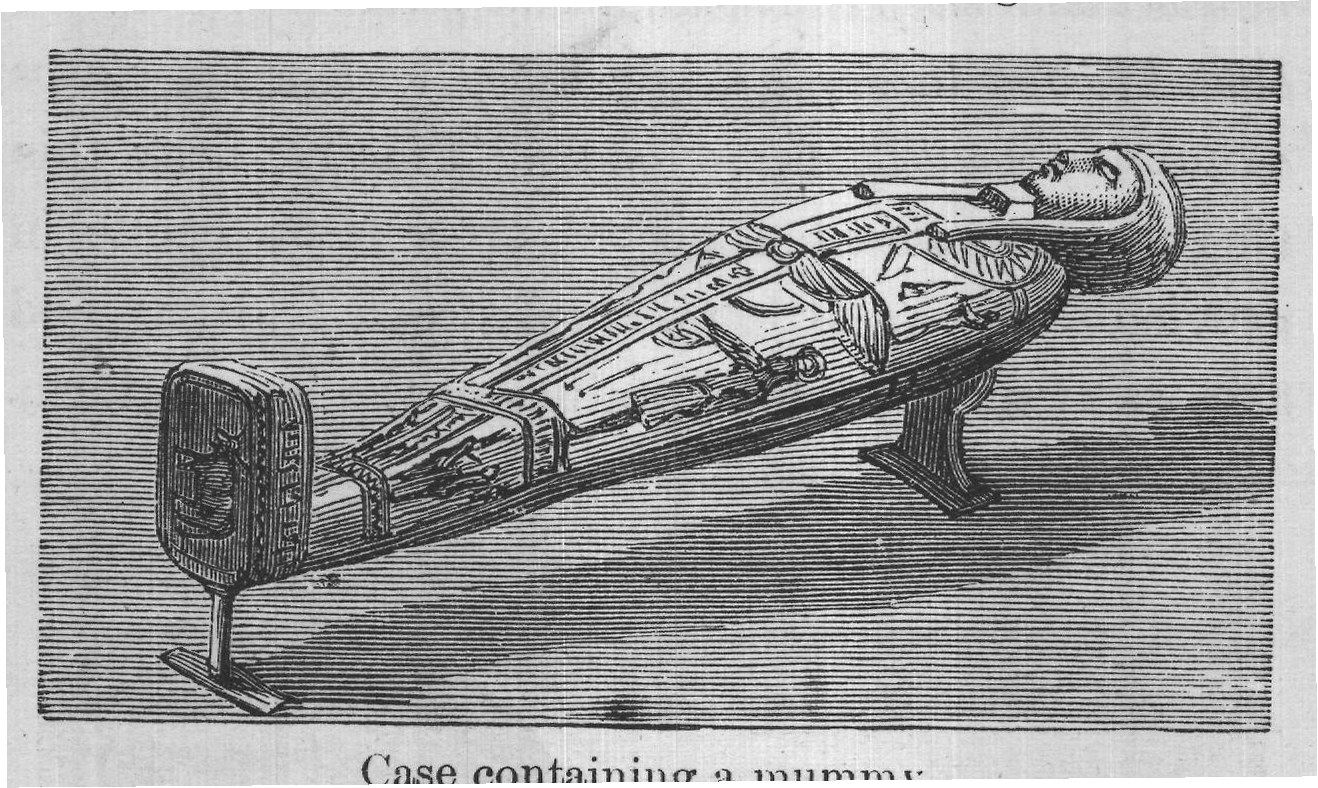
Let the reader imagine a mummy in the human form destroyed in all its lower parts from the breast downward. A thick mask of gold now at Case containing a mummy.
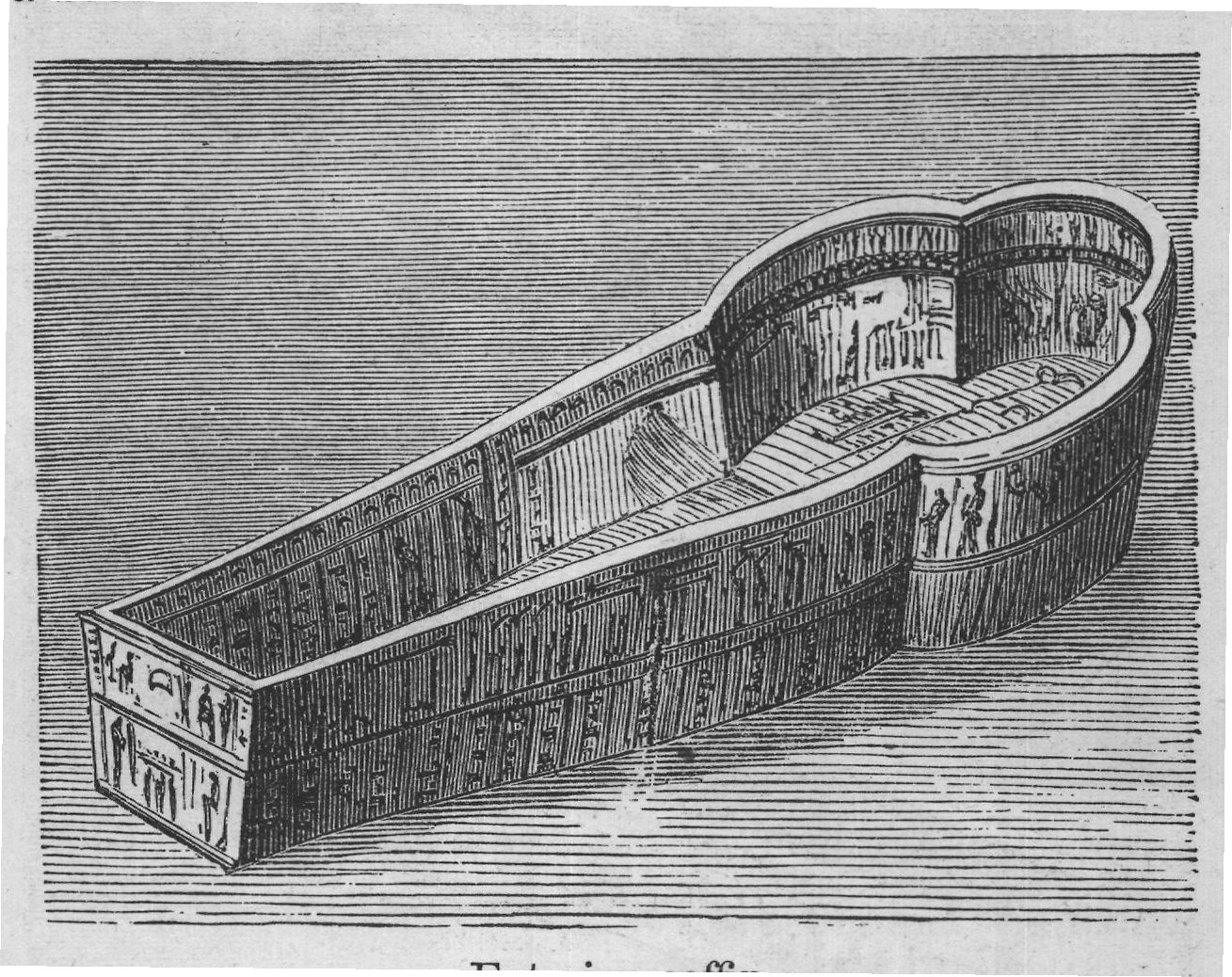
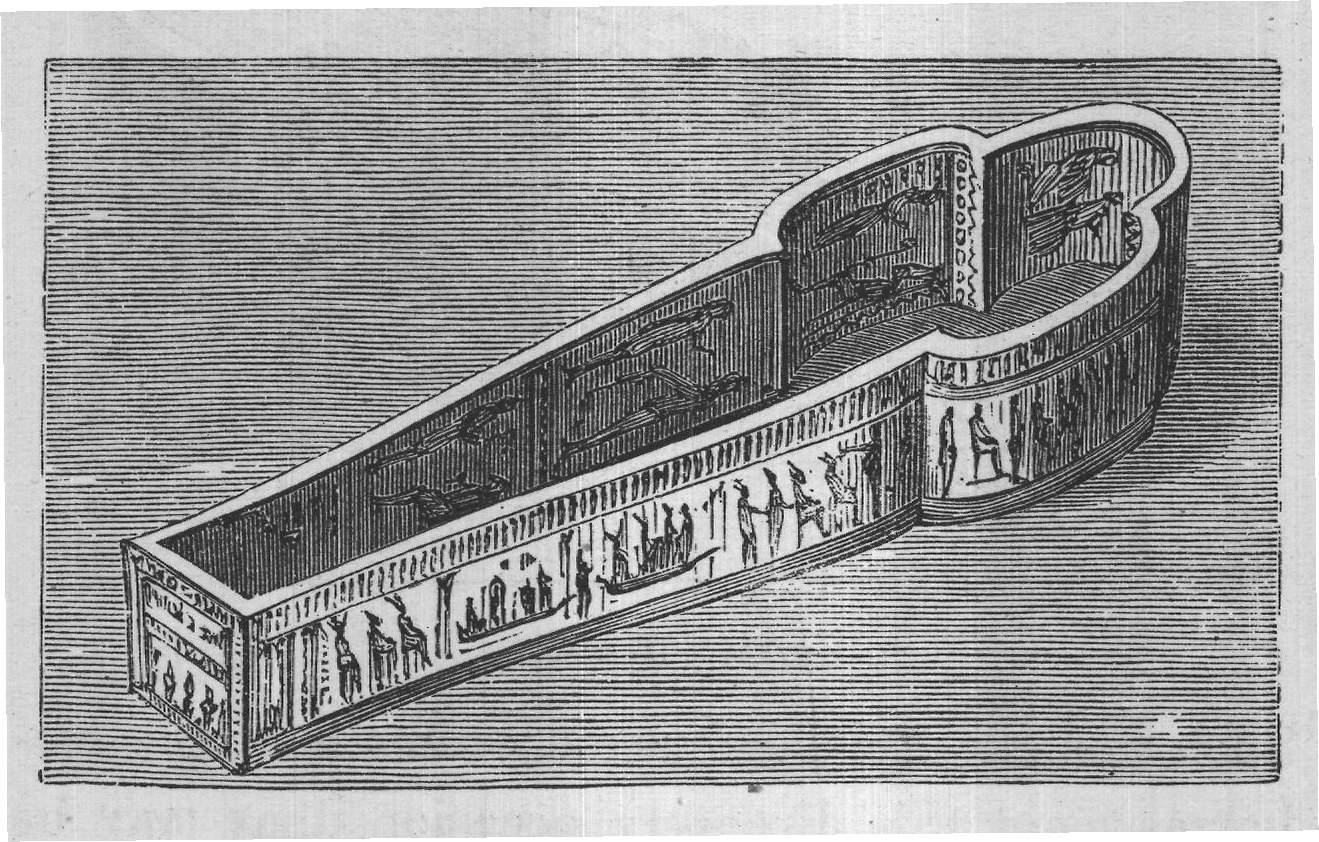
Interior coffin to contain the case. the Louvre covered its face. Around the neck were two chains, also of gold, to one of which were suspended three amulets. As for the interior, it presented nothing but a mass of odoriferous bitumen mingled with shapeless bones, in the midst of which were buried two or three pieces of jewelry with golden clasps containing small plates of glass. Finally, near this singular monument, I picked up a large beetle in greyish steatite, a little pillar of green feldspar and a score of small funereal statues of the human form. Exterior coffin.
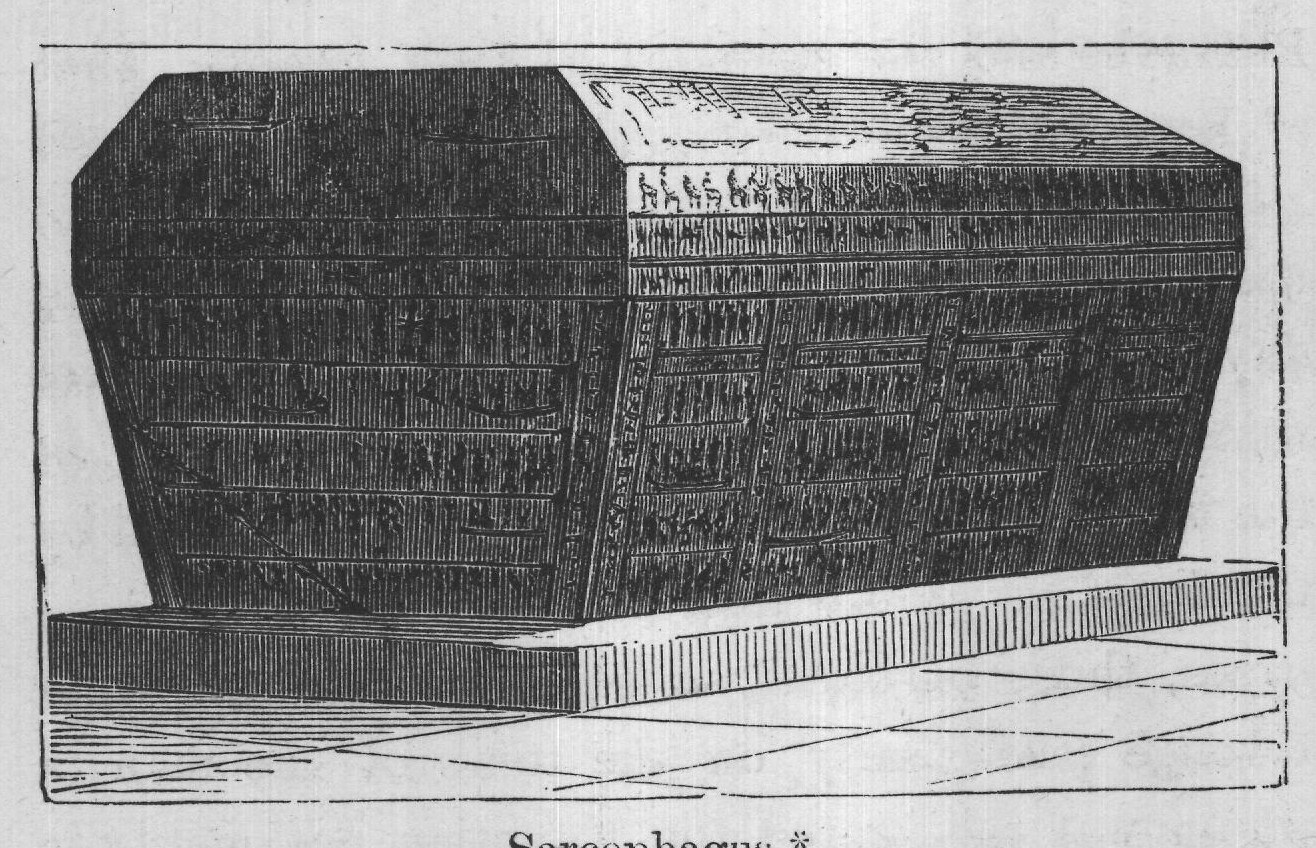
Such was our Apis, and some estimate of the embarrassment this discovery occasioned us may be had when it is furthermore known that while all the monuments found above the mummy indicate the title and name of Sha-em-Jom only, all those on the contrary that were discovered in the neighborhood mention the name and usual qualifications of Osorapis. Is this an Apis? or is it the mummy of Sha-em-Jom, who, dying in the 55th year of his father's reign, made it a point to be buried in the finest of the tombs that adorned the cemetery of the city of which he was the governor, therein fol- Sarcophagus. * lowing the example of the other grandees of Egypt, who had themselves buried at Abydos near the tomb of Osiris?"
To sum up, was this funereal windfall, this decayed magma, the remains of the beloved son of Rameses, of the selected heir of his vast empire, or * These sarcophagi in porphyry, in basalt or in alabaster, formed the fourth and last outside covering of mummies of high rank. simply those of a bull fattened in a sacerdotal stall? Is there not in the doubt itself, a keen satire on renown and death, as bitter as any that history has ever gathered in the tomb?
We have elsewhere remarked the relations that exist between the duration of the reigns of the Pharaohs and the splendor of their tombs. That of Rameses should, consequently, have surpassed all the rest in magnificence. It was the third to the right in the valley of tombs. At the present day nothing remains of it but a mass of shapeless ruins. All the funereal abodes of the holy mountain of the West having been violated and overturned by the Persians at the time of the invasion of Cambyses, those barbarian conquerors wreaked their revenge particularly on the tomb of the man in whom was incarnated the Egyptian nationality in its struggles against the men of the North, justly regarded by these barbarians as their ancestors. However, long before this period of warlike vengeance, the priestly reaction which had put an end to the dynasty of Rameses and his successors ; which had identified the patron deity of this martial family with Typhon, the genius of evil; which had pursued the images of Sethos even to where they were found on the scroll-box of the great king, -had this reaction really respected his memory and his coffin! - XVIII.
WHATEVER may have been the causes of the revolution that wrested from the descendants of Rameses the sceptre of Egypt and transferred it to the family of the priest Peor, it cannot be considered as a reassertion of human dignity, outraged by the unbounded haughtiness of the Pharaohs of the eighteenth, nineteenth and twentieth dynasties.
A mere shifting from one set of hands to another of privileges and vices, it momentarily profited the priestly order only to the detriment of the vital forces of the nation whose decline and downfall it hastened. A people can never with impunity bo taught to contemn what once they worshipped.
Under the anathema which fell upon her military spirit and warlike energy, Egypt sank back upon herself like her granite sphinxes crouching near the entrance of her temples. Thenceforth, concentrating in the adoration of natural phenomena, an activity which had no other outlet, she strove to connect with the subtleties of nascent metaphysi cal science, the rude conceptions of her original mythology, and made everything else subservient to this vain toil; men and things, principles and facts, art, industry and intelligence alike. With her everything passed into the condition of a symbol, and every symbol became stone, until, petrified herself like the objects of her idolatry, she did not notice the billows of the human race that were flooding up around her. Even then, upon that soil struck with a paralysis which lingers there still, one grand memory alone survived and covered this corpse of a nation with the name of Rameses as with a protecting ægis.
One day Darius, entering Memphis as its master, penetrated to the temple of Phtah and gave orders that his own statue should be placed in front of those of the native kings, and even of the colossal figure of Rameses Mei-Amoun. But, upon hearing this order of the victorious monarch, the prophet of the temple opposed it in these terms: "Thou hast not done, oh king, all that Rameses did, since the latter not only subdued as many nations as thou, but he also conquered the Scythians whom thy Persians could not overcome. It is not just, therefore, that thine image should be placed above that of Rameses, since thou hast not surpassed him by thy deeds."