Home › The Monuments of Rameses The › The Monuments of Rameses The: Appendix
The Monuments of Rameses The: Appendix
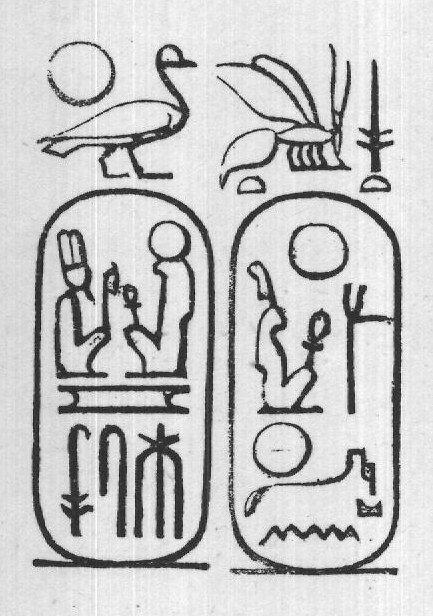
At the words of this aged priest, inspired with a patriotic remembrance as though by the breath of his god, Darius, the undisputed sovereign of twenty satrapies whose chiefs had kings for vassals, bowed his head in silence and abandoned his ha aghty design. 일 Royal cartouche of Kameses Mei-Amouu ODA APPENDIX.
APPENDIX.
I.
THE CUSHITES, (page 15.) ... THE Coptic idiom, a remnant of the old Egyptian tongue, is incontestably one of the most curious although one of the most meagre fragments of the languages of antiquity. An original kinship with the Semitic idioms has been discovered for it; since the Semitic dialects have penetrated the old Cushite foundation of human tongues. ....
Although the Coptic is the antipodes of the Sanscrit, a thousand reasons seem to conspire to make us look in the bn of the Indus for the seat of primitive civilization transported to the valley of the Nile at an epoch preceding the time when Southern Asia was wrested from the Cushites by the Aryan and Semitic races. If we find in the popular forms of worship of India the contrast between which and the religious notions of the Vedas is so marked, a strong resemblance to the creeds of Egypt, is there any reason to feel surprised when we discover some words in Coptic that have an equivalent in the Sanscrit? There is one thing that must never be lost sight of, in any inquiry relative to those distant times. It is absurd to say: this is of Indian and that of Egyptian origin, for the influences that shaped them have followed the tide of migration.
Thus, even while admitting the influence of the Arian and APPENDIX.
Semitic creeds upon the forms of Egyptian worship, we cannot avoid recognizing in certain portions of the Vedas a character common to the religion of Egypt. The cause of these coincidences must be sought in the primitive extension of the race of Cush and of Shem in the regions lying in the immediate vicinity of the Aryan tribes. tribes. (Baron Eckstein, Researches concerning Primitive Humanity.) THE TEMPLE OF DENDERAH, (p. 29.) THE great celebrity conferred on this monument since the French expedition of 1798, is associated with an archæological error respecting the date of a planisphere carved on the ceiling of the temple, and with the fantastic speculations of Dupuis and his school on this pretended relic of antiquity. Nevertheless, the ruins of Tentyris, of which the wretched village of Denderah retains the name with its Arabic modification, have in themselves a real interest, principally owing to the state of preservation in which the temple is found. But, if this temple be one of the best preserved in Egypt, it is also one of the most recent. Commenced under the last Ptolemies it was not completed until some time in Nero's reign. The most ancient names that figure on the hieroglyphic inscriptions are those of Cleopatra and of her son Ptolemy Cæsarion; the latest is that of Nero. A Greek inscription legible upon the upper part of the portico, on the overhanging of the cornice, is in the name of Tiberius and dated in the 21st year of his sovereignty.
The emperors Caligula and Claudius also contributed to the embellishments of the edifice. Near the hieroglyphic inscription in which are read the names of Cleopatra and of the son she bore to Cæsar, on the external part of the rear APPENDIX. wall of the temple, there is carved a portrait of that famous Queen; it does but little credit to the chisel of the artist. The 'whole sculptural work, moreover, betrays a period of decadence in the art. The hieroglyphics, like the ornaments, are of inferior execution, as we find them on many other monuments of the same periods. But architecture maintained itself better in the midst of this wasting away of art. Here, for instance, the general effect, notwithstanding the bad taste and the heaviness of detail, lacks neither grandeur nor majesty, and the temple, even in its present condition, still produces a vivid impression on the traveller. The portico or pronaos, a work of Tiberius, is supported by 24 columns in four rows of six columns each. An intercolumnary wall, breast high, extending between the pillars, closes the lower part of the first row. The ceiling, which is in complete preservation, is ornamented with the celebrated zodiac which has been the subject of so many dissertations and hypotheses. To the portico succeed three halls of unequal size, the first adorned with columns, and the two others with adjoining side rooms. On the ceiling of one of these chambers was secured a planisphere which is now in Paris. The naos or sanctuary which terminates this range of halls is isolated by a circular passage from the six rooms that surround it. The total length of the temple is 81 and its width 34 yards. That of the portico, which overshoots the body of the temple in such manner as to give the whole structure the form of a T, is 43 yards in length by 98 of interior height. The temple was preceded by its dromos, extending a length of 110 paces to an isolated pylon which bears the names of Domitian and of Trajan.
This temple was dedicated to the goddess Hathor, from whom the city, to all appearance, had taken its name (Than-- athor-the habitation of Hathor.) In the inscriptions distributed in various parts of the temple, the goddess bears, among other titles, that of the Queen of Tenathyr, a word from which, in the fullness of time, was derived Tentyris. In its turn the latter degenerated to Denderah.
APPENDIX.
M. de Rougé, in one of his lectures at the college of France, in the course of 1865, communicated to his audience a letter from M. Mariette, announcing the discovery that the latter had just made, beneath the temple of Denderah, of a subterranean chapel, the construction of which the indefatigable explorer thought that he could trace back to Cheops, (Chuffu,) the founder of the Great Pyramid.
Whatever may be the credit to assign or the reservations to be made in reference to this opinion, one thing is certain, to wit, that the discovery, in itself, does not in any degree affect the relatively modern dates of the upper temple and of its zodiac. The utmost it could do would be to give fresh credit to the hypothesis (rather quickly abandoned by the savants of our day) according to which the first religious monuments of Egypt were subterranean temples.
III.