Home › The Monuments of Rameses The › The Monuments of Rameses The: Ammon
The Monuments of Rameses The: Ammon
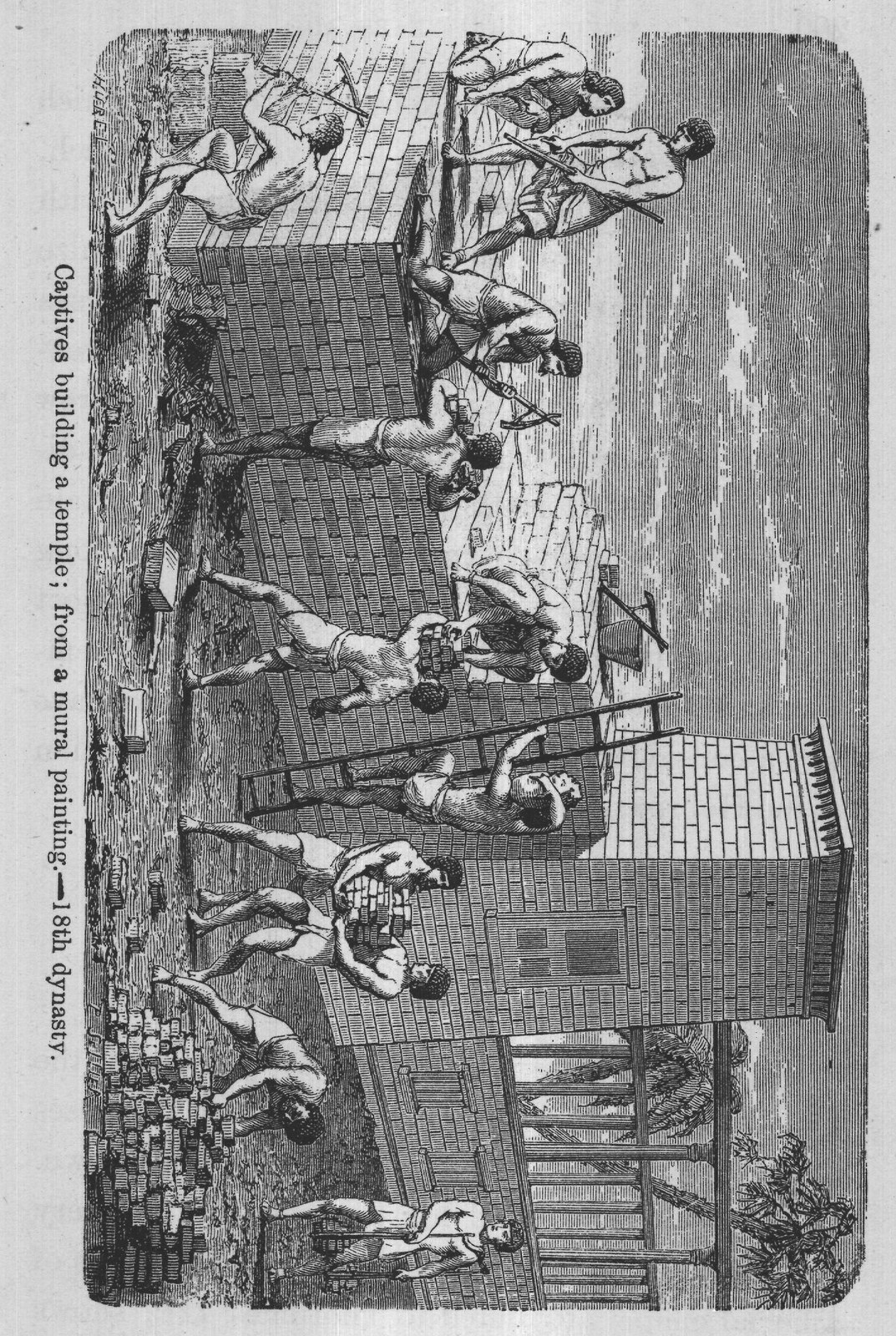
HUREL 新 Captives building a temple; from a mural painting.-18th dynasty. us prisoners of war employed in kneading clay, moulding bricks and building the walls of a temple to Ammon under the surveillance of Egyptian superintendents or overseers armed with heavy staves. The inscription informs us that these prisoners at hard labor, " are captives taken by His Holiness to work upon the temple of his father Ammon." When copied by the engraver's art, does not this scene look like an illustration of the folowing passage in Exodus: ch. i. v. xiii. and xiv. "And the Egyptians made the children of Israel to serve with rigor:" "And they made their lives bitter with hard bondage, in mortar, and in brick, and in all manner of service in the field: all their service, wherein they made them serve, was with rigor."
History can bring to the support of the Biblical text still more formal testimony than the preceding. There are legible upon the back of a hieratic papyrus which, unfortunately, has been very much mutilated, but which may be referred to the nineteenth dynasty, these characteristic lines: "That for twelve years, these men, entrusted with the making of bricks, be kept and closely watched in the workshops, so as to see that they deliver exactly the number of bricks that they are ordered to make, without rest or cessation!" (A papyrus of the Anastasi Collection No. 3, page 2 This working-up of the captive and the slave pushed to its farthest limits, i.e. mutilation and death, was the law of nations of a historic age, which did not cease even with the most civilized countries until after the advent and triumph of Christianity : that law of nations, of which, long after the time of Rameses, the Assyrian monarchs, the Dorian Republics of Greece and the Roman patriciate, were to make many another ferocious application, and which, even while we write, still entangles, with its long-surviving roots, the eastern half of modern Europe, and all the countries yet under the yoke of the late-comers of wandering barbarism.
XI.
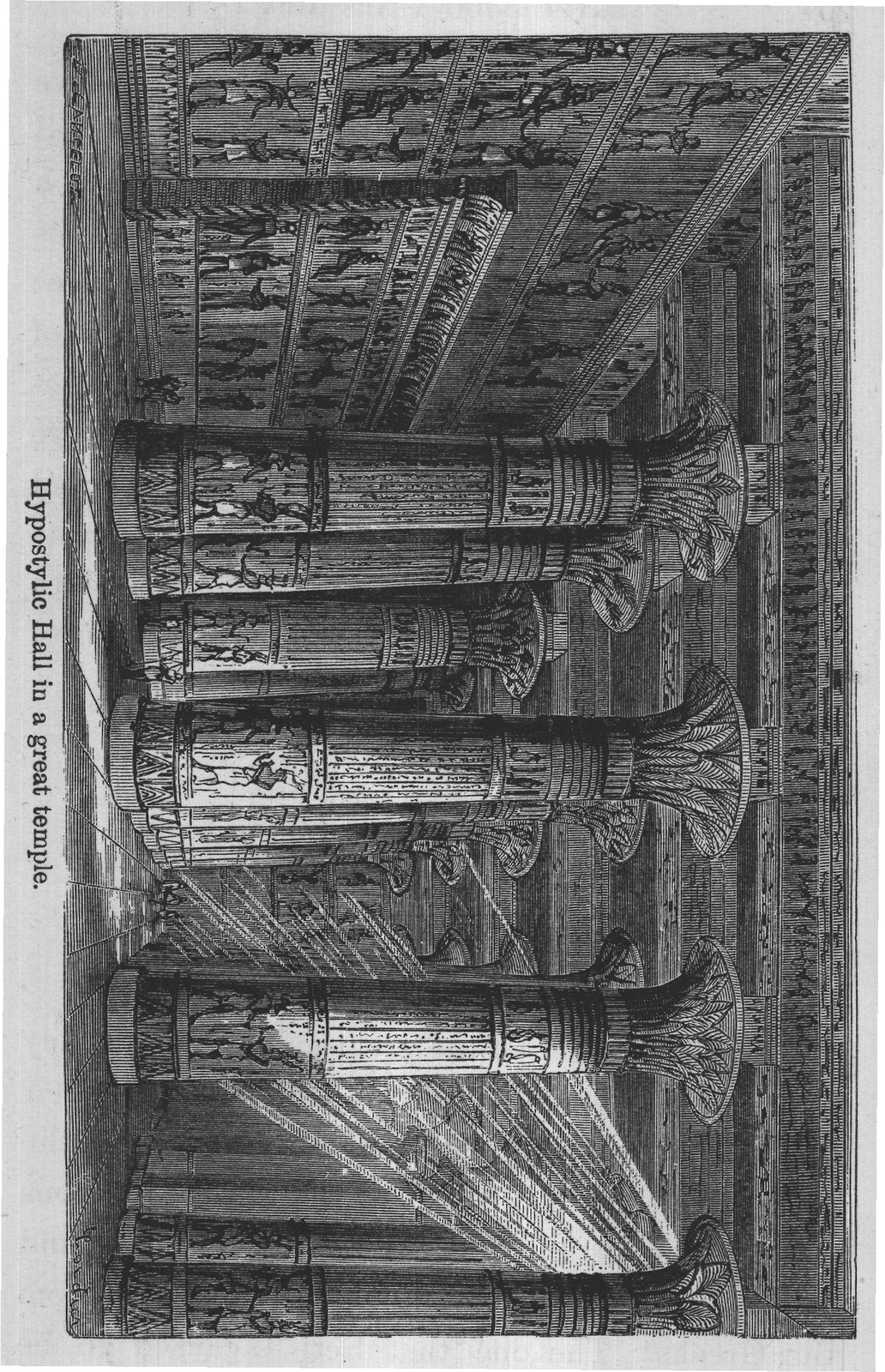
AT Thebes, as in all the great cities of the valley of the Nile, the sacred edifices enclosed within their limits between the pronaos and the sanctuary of the gods, a spacious hall which, owing to the numerous columns supporting its massive ceiling of carved and tinted granite, received the title of hypostyle from the Greeks. The one that Seti I. caused to be built in the temple of Karnak is celebrated among Hypostylic Hall in a great temple. them all for its dimensions-one hundred yards by fifty-and its hundred and thirty-four columns still standing, a dozen of which sustain the central part of the ceiling, at the height of seventy feet from the soil, upon capitals of twenty yards in circumference. The dimensions of these halls, even in the absence of other indications, would bear witness to the purpose for which they were destined. In the shadow of these groves of columns, where apertures curiously cut in the upper part of the cornice or windows hewn through the solid granite allowed only a subdued heat to penetrate, and just enough light to illuminate the reliefs and the tintings of the great mural scenes, the monarch, seated on a magnificent throne, between the mementoes of his ancestors and the images of his gods, presided at the meetings of the priesthood and high dignitaries of the empire; gave audience to the ambassadors of foreign nations and to deputations from vassal nomes and provinces ; adjudged, as a tribunal of last appeal, the disputes of cities or of individuals ; listened to the complaints of his subjects or the outcry of their need; in.fine, held the great days of the royal sway.
The scribes, a very busily employed race of functionaries, whose learned body replenished its ranks from the colleges of the priesthood, took down, on the spot, the minutes of these sessions of absolute power. Subsequently, when the importance of the subject demanded it, the series of all the orders and of all the administrative measures thereunto appertaining was recapitulated on a monumental stele, destined to remind the population therein interested of the vigilance and solicitude of the prince. And, in sooth, these stones of testimony which have survived until our own time, are not the least instructive of the monuments that will put modern science in a condition to reconstruct the genuine history of the Egyptian period, of which, more faithfully than the others, perhaps, they represent the real aspect, the characteristic traits and the inner private life. It is with this view that we do not feel as though we could omit from this study on Rameses and his time, a few passages from a document of this description dating from the commencement of the reign of that prince. We borrow them from the interpretations jointly agreed upon by the English orientalist Birch, and our learned compatriot M. Lenormand. ....
XII. "When he had subdued the land of Ethiopia, trodden the Libyans beneath his sandals, and rooted his sceptre among them; after terror had overwhelmed Wentnowr and the Akars, the living and life-bestowing god, the representative of Seth and Ammon, the king sun, the guardian of truth approved by Phrah, the director and defender of the land of Kemi, the child of the gods, the beloved one of Ammon, Rameses, the eternal life-giver, descended at Memphis to accomplish toward the divine triad of that city ceremonies of thanksgiving. "On the twenty-fourth day of the month paoni, in the third year of his reign, as he was seated on his throne of the purest gold, and, with his head adorned with two ostrich plumes emblematic of justice, was causing the names of the regions from which gold was obtained to be registered in his presence, and was giving orders that the roads leading to them and unprovided with water should be supplied with fountains, there was mentioned, among others, the country of Okau where gold abounded, but the route to which was utterly destitute of springs. His Majesty was informed of the distress of the workmen employed in the extraction and preparatory washing of the precious metal, many of whom had perished of thirst on the way with the asses they drove thither. In fine, the condition of things was such that it could not continue without leading to the abandonment of the rich placers in question. "At this moment, the officer of the palace whose business it was to lead visitors to the foot of the throne, breaking silence, announced to Rameses that the leading personages of the Okan country were present and humbly awaiting the favor of an audience: "Behold them, oh king, with their arms uplifted toward thy throne and drawing nigh with reverence to look upon thy sacred features, in order that they may unfold to thee the deplorable condition of their country, and beseech thy limitless power to remedy it."