Home › The Monuments of Rameses The › The Monuments of Rameses The: Ipsamboul
The Monuments of Rameses The: Ipsamboul
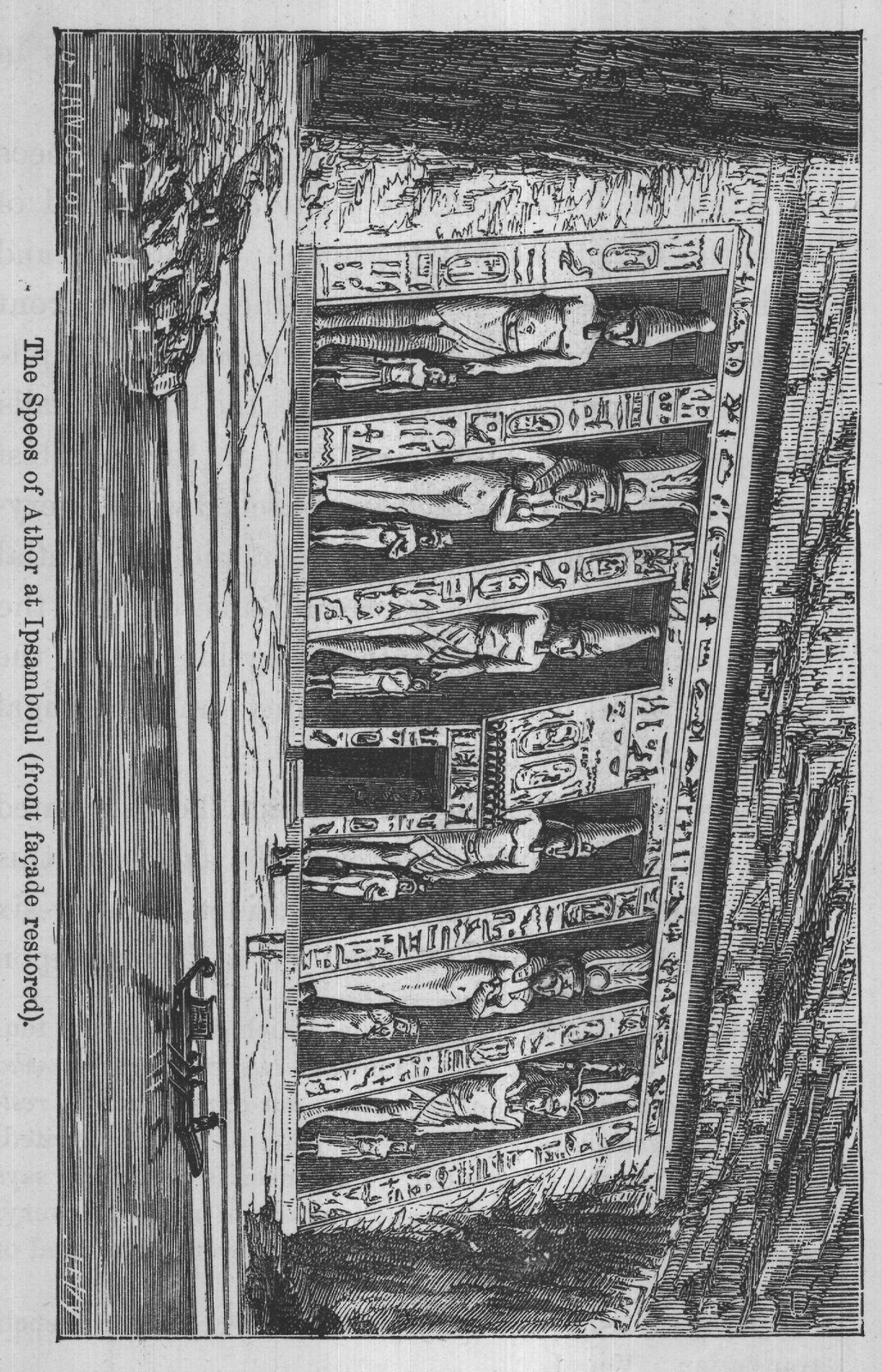
It will be understood that we refer to the speos of Athor at Ipsamboul, the grotto of purity and of love, the details of which are full of interest and artistic charm, and where, from the gigantic front excavated in the rock to the ornaments on the pillars that support the vault of the three halls scooped out in its flanks, and even to the minutest adornments of its chiselled and frescoed walls, everything reveals, as it were, a tender and reverential association of thought between Rameses and the fair companion of his youth; everything bears the impress of a feeling of harmony and conjugal equality.* When, in the time of our fathers, the celebrated traveller Burckhardt discovered the façade of this monument, and measured its caryatides of thirty-six feet in height, he believed that he had come upon legend of Rameses, is read this line, which discloses the tenderness of the Queen for Rameses: His royal spouse who loves him, Nofre-Ari, the great mother, has constructed this resting place in the grotto of purity. Ampère, at the place cited. * Ampère in the place cited. The queen is charming, says the traveler, and one never grows weary of meeting every. where with her likeness, which Pharaoh never grows tired of reproducing. † In 1817. See the Voyages de Burckhardt. French translation. Vol. I.
The Speos of Athor at Ipsamboul (front façade restored). the grandest thing that Egyptian art had created.
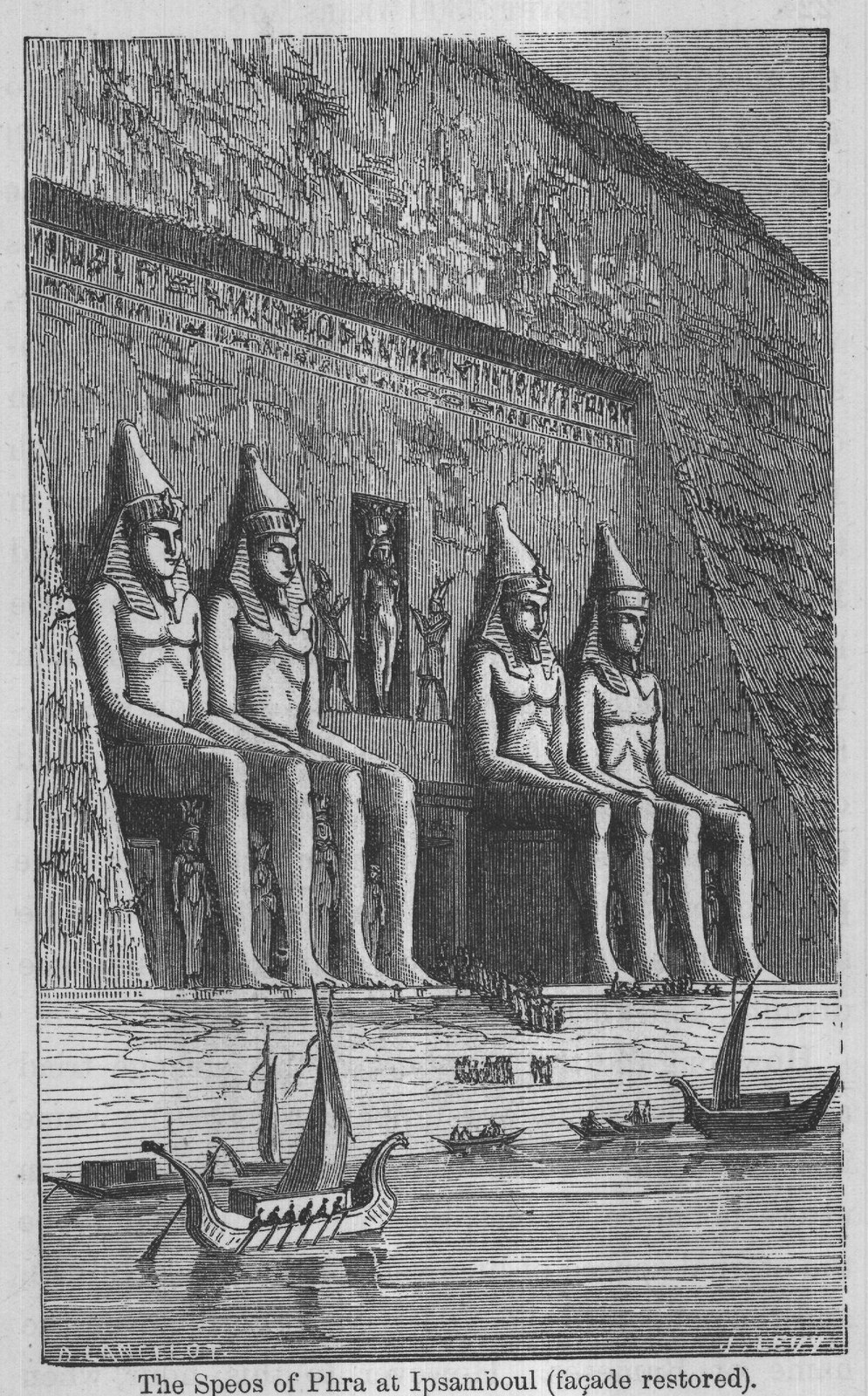
What then was his astonishment when, on turning an angle of this rocky cliff, he found himself confronting four colossal figures of double dimensions, cut out in a second mountain, raising their fronts bound with the pshent, and their huge shoulders, high above the avalanche of sand which the wind of Libya continually rolls down from the top of the stony wall of which they form a part. There the seemed to be waiting, amid the silence of the desert, the approach of some representative of modern civilization who should extricate them from the oblivion in which renown had let them sleep for thirtythree centuries. XV.
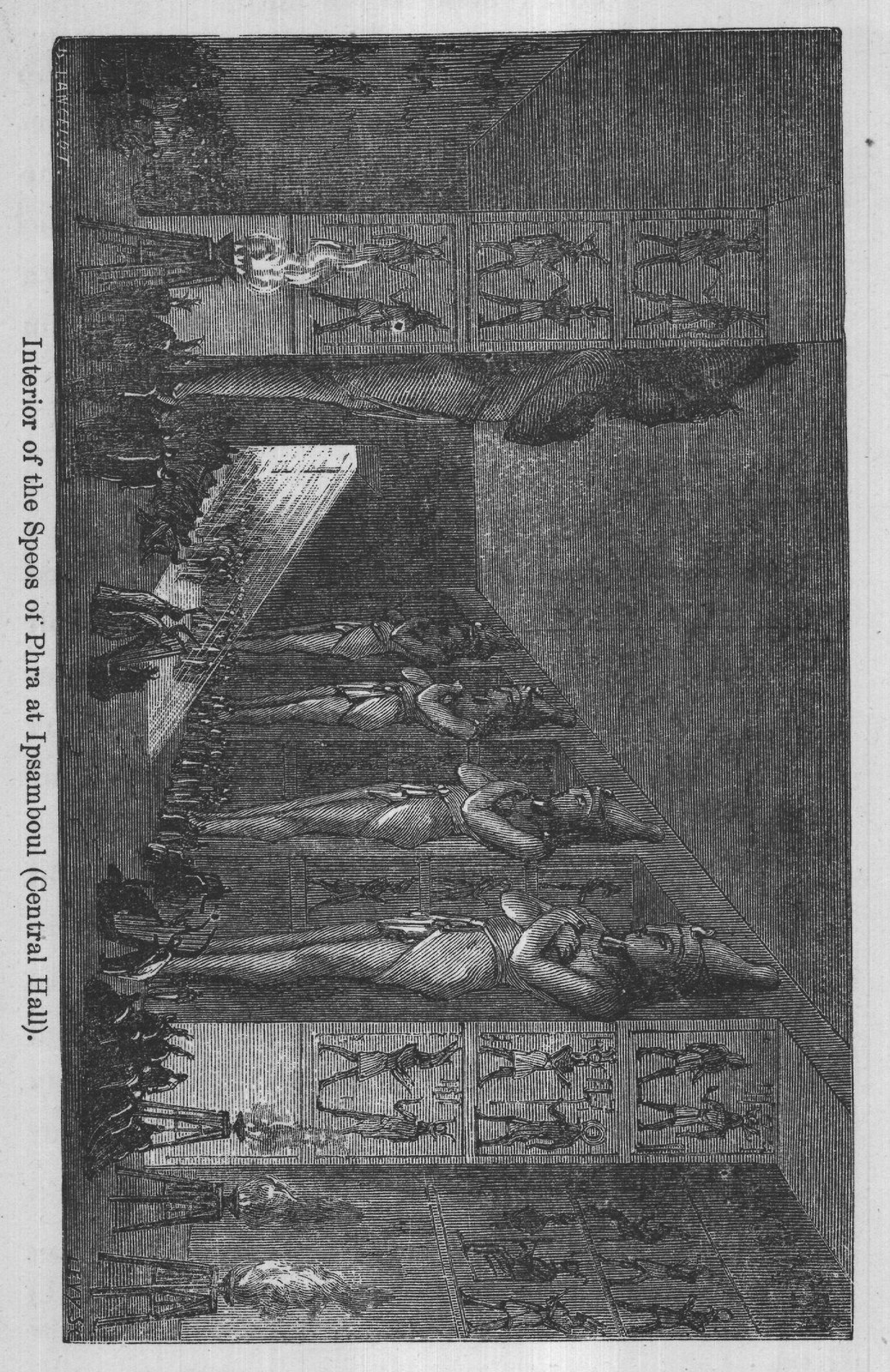
SINCE Burckhardt's adventure, many other visitors have reached the spot, and the great temple of Ipsamboul has become the goal of the numerous tourists which Europe daily sends to the banks of the Nile. In the four stone giants, which have none like them in the world excepting the two colossi of Bamian that, from an unknown date in the past, have recalled to the inhabitants of the Paropamisus the nameless features of a king and queen of the South,* have been recognized, even previous to any aid through the interpretation of the scroll cases, the pure and delicate graciousness and the majestic placidity that characterize all the portraits of Rameses Mei-Amoun. The portico of the speos, when cleared of the sand of ages which had obstructed it, yielded to the study and the admiration of the explorers a whole historical museum of which Rameses is the hero. Sixteen halls carved out in the flanks of the mountain by the chisels of the old Egyptian sculptors, are dedicated only to reproduce his deeds and to glorify his memory. Upon their walls he battles and triumphs as a warrior, sits enthroned and wields the sceptre as a king, and officiates as a pontiff. His statues, erect, with their arms crossed upon their breasts, supply the place of pillars to prop up the mountain; then, he sits in the sanctuary between Ammon, the supreme divinity, and Phrah, the Sun made a deity.
How long did the members of this strange triad assemble the same worshippers, receive the same incense? For two thousand years past, Ammon utters no more oracles, the Sun has ceased to be the eternal source of life even for the black Nubian, and the echoes of the Nile have forgotten even the name of Rameses. However, to this hour, when * Alex. Burnes: Journey to Samarcand.
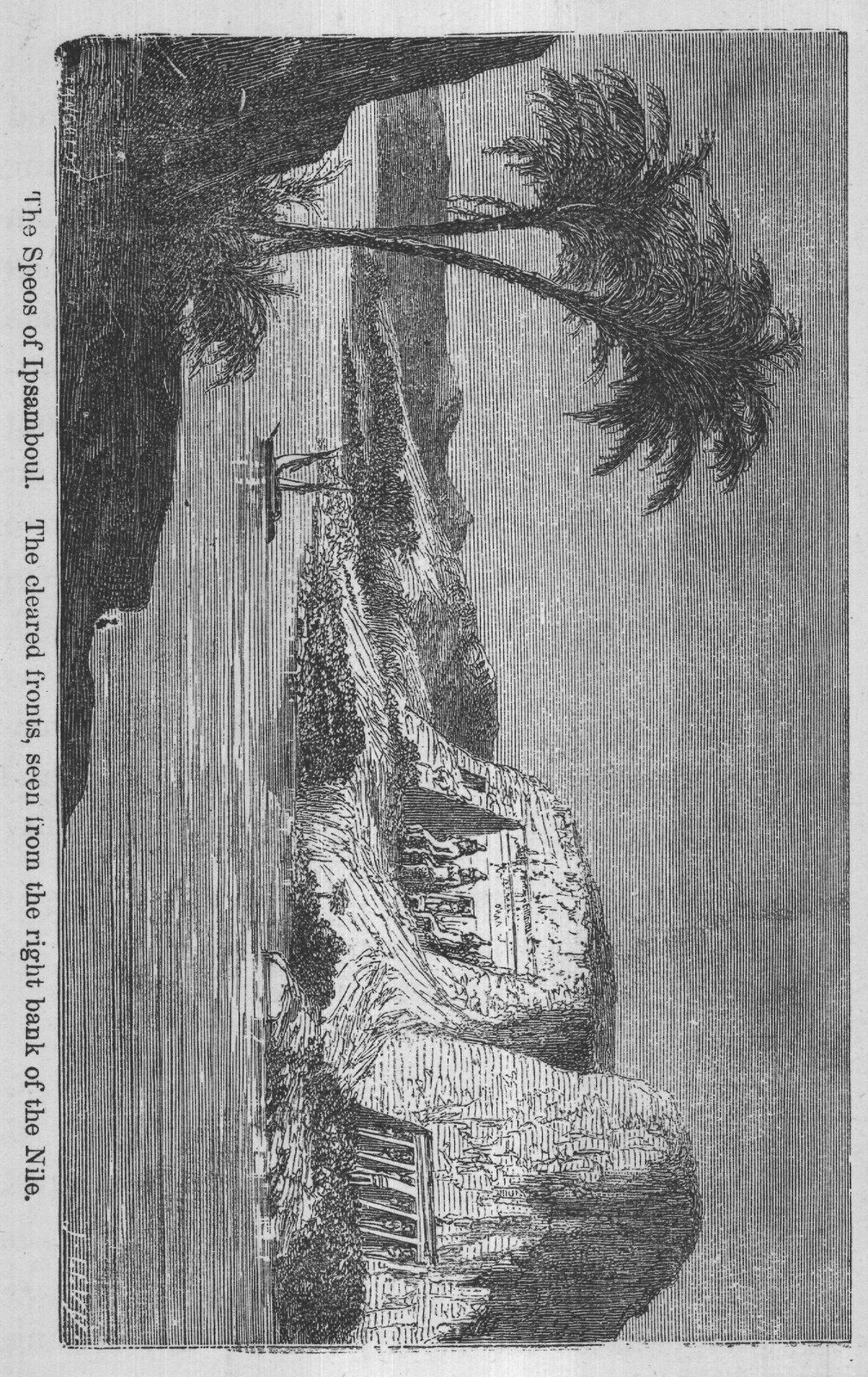
The Speos of Phra at Ipsamboul (façade restored). the star of day, emerging from the horizon of Arabia, darts its morning ray athwart the narrow portico of the great speos of Ipsamboul, and surrounds the mutilated brows of the three antique idols with a fleeting halo, it still seems to the most indifferent passer-by, the coldest and most skeptical son of mocking Europe, as though some religious mystery were occurring in the recesses of the rock.* What, then, must have been the effect upon the imagination in those periods of implicit belief or credulous ignorance, of this daily phenomenon, skillfully managed by the priesthood of the speos, when immediately opposite to the latter, a considerable centre of population, culture and commerce covered the Eastern bank of the river now so desolate? It appears that at the time of the social upheaving directed by Moses, which, not long after Mei-Amoun's day, compelled the Pharaohs and their court, as in the days of the Hycsos, to seek an asylum in Nubia, that hospitable country could not offer them a retreat better calculated than this to fortify their resolution afresh. In what * Ampère, place already cited. See in the works of Fontenelle what he states, on the authority of Ruffin, in reference to an opening made by the priests in the temple of Serapis, through which, at a certain moment, a ray of the sun fell upon the lips of the god. school could the orphaned and banished heir of the sceptre of Rameses, the young Haq-an who, afterward, was Rameses III.,* wishing to become inspired with the soul of his great-grandfather so as to resume and consolidate his work, have drawn' loftier lessons than those which exhaled for him from the subterranean temples of Ipsamboul?
XVI.
The ages and barbarism have so well respected the bas-relief pictures of the great temple, and their colors are still so fresh, that, according to the ingenuous expression of the Arabs, one would think that the workmen employed had hardly had time to wash their hands since they were completed.† All these marvels of Egyptian art at the height of its splendor offer material for study the more precious that the most of it evidently dates back to an epoch in the life of Rameses, concerning which the historians of antiquity knew as little as they did of the monuments that are now engaging our attention. * Manetho, in Josephus contra Appionem. It is evident that the Cethos of this fragment is indeed Rameses III., son of Seti II., son of Menephtah, son of Rameses the Great. † Ampère, place cited.
Interior of the Speos of Phra at Ipsamboul (Central Hall). According to the legendary opinion followed by Herodotus, Diodorus and Josephus, Rameses II. from the tenth year of his reign had closed his career of battle and conquest, and the friendly fates had imposed no other care upon him than to enjoy in peace the fruit of his youthful exploits. The walls of Ipsamboul, on the contrary, along with the inscriptions that we have been enabled to put together among the ruins of the two Rameseums of Thebes, the most dilapidated of all the great king's monuments, and, also, one of the bas-reliefs of Beit-el-Wally, show him to us in his riper years, surrounded by numerous sons, and in their company fighting the same enemies against whom he had directed the expeditions of his youth, viz., the black tribes of the South and the white or yellow hordes of the North.
The picture of the grand hall of Ipsamboul, inscribed by Champollion under No. 1, offers, in this respect, along with that which the same learned antiquarian copied from the half crumbled pylon of the western Rameseum, such analogies of detail, that it is impossible to avoid considering the one a reproduction of the other. In both of them, Rameses, accompanied by three of his sons, already men grown and mounted like himself in war chariots, is pursuing, at headlong speed, a hostile army whose heavy garments covered with mantles, hair gathered up in a single lock in the middle of the cranium, and pallid complexion, would indicate their origin to be from beyond the Oxus, even did the legends of these historic pages fail to give them the name of Khetas. At Thebes, as at Ipsamboul, these obstinate antagonists of Rameses are seen seeking refuge in a fortified place, the walls of which four Egyptian princes, other sons of the conqueror, have just assailed. We know not whether the name of the besieged town has been discovered at Ipsamboul, only the last half of it having been preserved among the ruins of the Theban monument. But that termination is quite significant, for it reads: apur, and this Sanscrit ending alone indicates some locality far to the Eastward.
XVII.
IT has not been allotted, so far as we know, to men who have been summoned to make themselves felt in the world on the eve of great upheavals in the social strata or in the human mind, to find repose anywhere but in the tomb. Everything, therefore, induces us to believe that, contrary to the assertions of the ancients, Rameses must have The Speos of Ipsamboul. The cleared fronts, seen from the right bank of the Nile. passed the long years of his reign struggling, sword in hand, to maintain outside, the eminent influence of his name and the completeness of his conquests.
More than once, no doubt, he was obliged, as Charlemagne was, in long after ages, to hasten, in his grey hairs, from his Southern frontiers, still threatened, as they were, by the savage barbarism of the Nahazis, to those of the North which were still agitated by the movements of the Aryan communities pushing the Semites and the Pelasgians before them on all the routes of the West. More fortunate than the son of Pepin, was he spared the sight of the tempests that were to sweep away the dynasty that had been the labor of his life? And if his iron constitution secured him the honor so coveted by the Pharaohs, of twice celebrating the trentenary panegyric of his coronation, could he in this enjoyment of his old age carry his sceptre and his harp as high as the level of his pride? No one can tell. History and the monuments are silent on this score. The first accords to him a reign of from sixty-six to sixty-eight years, but dating from the sixty-second, the monuments preserve a mournful silence in reference to this great name.* * The latest date found at Ipsamboul is of the 38th year. The rocks of Silsilis mention the 40th and the 44th; the walls of the Serapeum the 55th. Finally, a stele in the Florence Museum is dated in the 62d. Like the patriarchs his contemporaries, Rameses saw a numerous family born and reared around him. The monumental inscriptions have acquainted us with the names of twenty-three princes, his sons, and thirteen of his daughters, of whom five are dignified with the title of queens. One, with a name anything but full of euphony for our ears- Baunt-Ant seems to have been the female Benjamin of his declining years. But he also lived to see most of his children die one by one, around him, including all of his sons who had taken part in the struggles, the combats, and the triumphs of his riper age. He survived by thirteen years the man who, among all the rest, he and his subjects regarded as the most worthy to succeed him, viz., the prince Sha-em-Jom, and, at last, he had to leave his sceptre in feeble hands.