Home › Eygpt 3300 Years Ago › Eygpt 3300 Years Ago: Sesostris
Eygpt 3300 Years Ago: Sesostris
HERODOTUS, who preceded Germanicus by more than 450 years on the borders of the Nile, and Tacitus by at least five centuries in history, likewise reports, in accordance with the statement of the priests, that Sesostris (Rameses II.), after the sub- * See the Annals of Tacitus, Book II., chap. lx. 1 jugation of Ethiopia, marched with a numerous army to the conquest of Asia, and subdued all the nations he encountered on the way, taking care, after each victory, to erect landmarks upon which inscriptions narrated the details of the combat, the name of his country and his own.
Thus traversing the continent, he passed from Asia into Europe, and subdued the Thracians and Scythians; "but I do not think," adds the historian, "that he penetrated any farther in that direction, for, although we find among the last named nations the trophies that he set up, none are discovered beyond their confines." "Retracing his steps, he halted on the banks of the Phasis; but I do not make out clearly whether it was voluntarily that he left a part of his army there to colonize the country; or whether detachments of his soldiers, fatigued and exhausted by their long marches, settled there in spite of him. • "However that may be, it appears positive that the Colchians are of Egyptian origin. I suspected this fact; others had mentioned it to me, and I wished to make certain of it for myself. I can affirm that the two nations have retained remembrances of each other, which are much more vivid, however, among the Colchians than among the Egyptians.
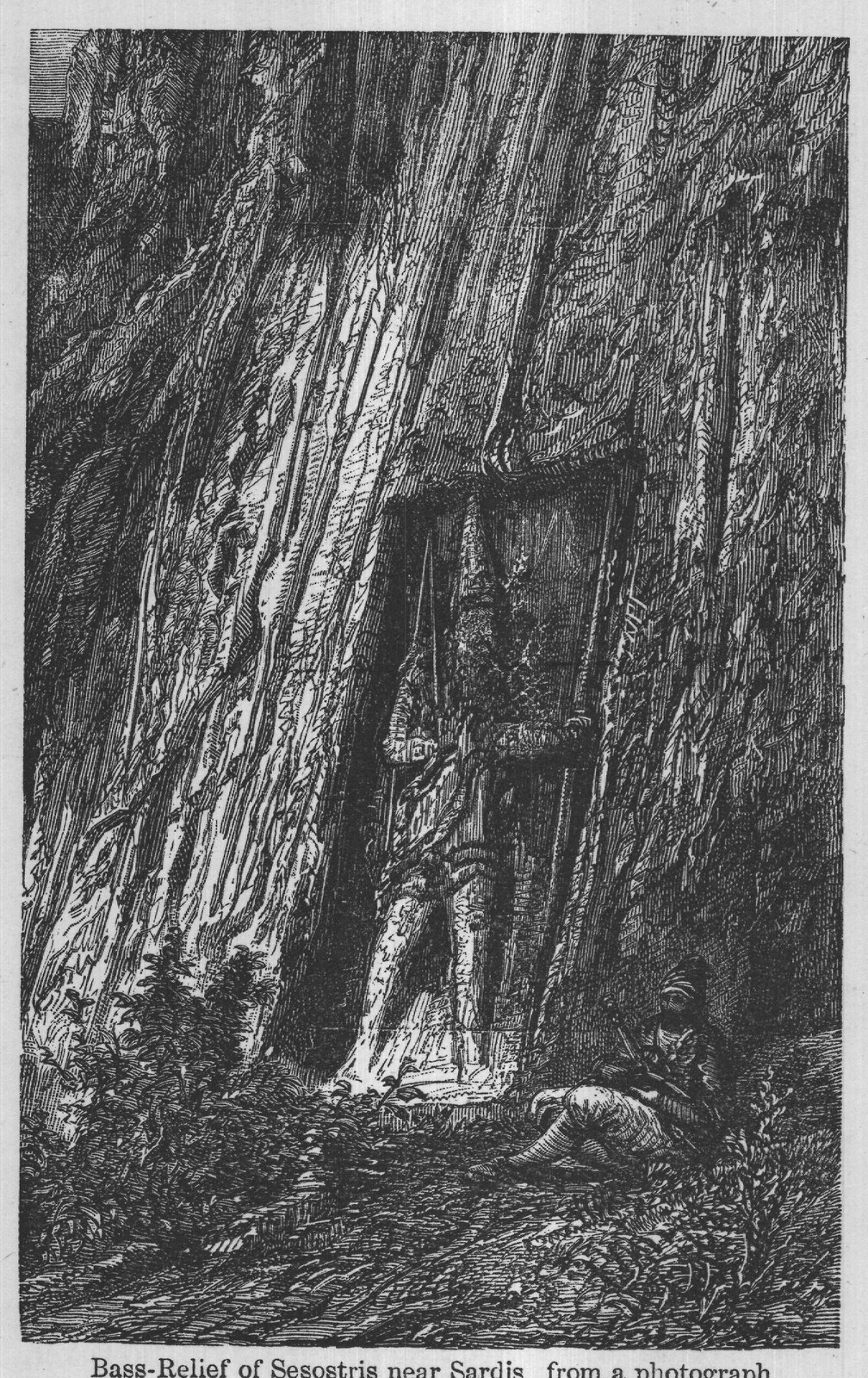
Bass-Relief of Sesostris near Sardis, from a photograph. These nations both have a black skin and woolly hair practise circumcision, live in the same manner; cultivate and work flax in the same style; in fine, speak the same language.' Herodotus adds that most of the monuments which Sesostris had caused to be set up in commemoration of his victories had already ceased to exist, in his day; but that he had, with his own eyes, seen as many as three, which have been found in our time, at the places pointed out; one in Syrian Palestine and the other two in Ionia, on the roads from Ephesus to Phocæa and from Smyrna to Sardis. "Each one of these, carved in relief on a wall of rock, represents a warrior five cubits in height. holding a.javelin in his right hand, and in his left a bow. The rest of his equipment is equally Egyptian and Ethiopian. On his breast, he bears an inscription in sacred characters, to this purport : " It is I who have conquered this country by the strength of my arm."* Strabo, whose birth in Asia Minor and long journeys in the East gave him the opportunity to verify or correct with his own eyesight the assertions of the father of history, declares that the routes followed by Rameses-Sesostris had been dot * Herodotus, Book II., chaps. 102, 103, 104, 105. ted with commemorative columns, inscriptions, bas. reliefs and temples.* The great historical pages of Ipsamboul, Luxor and Karnak confirm in most of their details, without invalidating any, the preceding attestations of the two great historians of Greece and Rome, and of the erudite geographer of Amasia; only that one must not expect to find in these monumental inscriptions the ethnical data of the nations and empires enumerated in the text of those writers. The ethnography of the days of Rameses transmitted but very few names to those of the Hellenic and Roman epochs. If appellations like Luki and Naharain may be easily translated in them by "Lycians" and "Mesopotamia," the wandering tribes of Arabia figure there only as the children of the red soil: the Rotenians hold the place afterward occupied by the Assyrians; Sengar is the name of the country of Babel, and in the regions where the empires of Media and Persia were to be reared, the Remeni, the Moshaushs and the Robust range themselves along from north to south, between the Caspian Sea and the Ocean.
Then, farther on, beyond that zone, in the vanguard * Strabo. Book XVII. t See Appendix VIII. of the East, the offensive designation of the plague of Kheta marks out upon an immense space not limited toward the north, the numberless and warlike nomadic hordes which, since the days of the Hycsos, had supplied the most implacable enemies known to the warriors of the borders of the Nile.
It is not without some emotion that the historian records these names, effaced so many centuries ago from the memory of mankind; but especially is it not without profound interest that, amid these forgotten generations, which however took part, according to their gifts and opportunities, in the humanitary task of their period, he is enabled to ascertain the presence of the ancestors of a people who, after having long held the sceptre of antique civilization, have arisen before our eyes from the tomb in which the ages had buried them, to claim a place among the modern nations. It will be understood that we are here referring to the Iouni, evidently identical with the Javans of the Hebrew books, and the Yavanas of the Hindoos, whose tribes, scattered and floating about over Western Asia after their expulsion from Ariawarta, their original country, undoubtedly owed to their invasion by Rameses Mei-Amoun, to their struggles with that conqueror and their flight before his victorious armies, their concentration in the region surrounding the Ægean Sea, and thereby, too, the germ of their long subsequent history.
This double fact of an ancient antagonism in the heart of Asia, between the forefathers of the Greeks and the warriors of the Nile, and of the alliance of the former with the ancestors of the Medes and Persians, would no doubt have awakened singular incredulity among the contemporaries of Themistocles or Plato. Nevertheless, it has been repeatedly affirmed by Champollion, who, in the inscriptions at Karnak and in the Rameseum existing side by side, with the names of barbarous nations, in northern costumes, with shaven heads or their hair raised in a single lock or wisp like that of the "Red Skins" of America or the Mongols of Asia, declares that he read the title of these Iouni whose blue eyes and golden hair * Homer was to celebrate some ages later. * This version of the illustrious Egyptian scholar is sustained by Messrs. Birch and Lepsius, who think that they have again come across the same name of a nation which they spell Ya-bu-na in the inscriptions attributed by them to the 12th and 13th dynasties. / VII.
For Champollion, the Khetas were Scythians; but M. de Rougé, followed by all the Egyptian scholars of the present day, considers them no other than the Chets or Hittites of the Bible, whose powerful confederation comprised, in the time of Rameses, a portion of Mesopotamia and the whole north of Syria on the two slopes of the Lebanon.
Whoever coincides with the ideas that we have advanced in the preceding pages, in reference to the Scythians of Justinus and T. Pompeius, will consider the difference of opinion existing, on this point, between the founder of Egyptian research and his worthiest successor, as reducing itself to a mere ethnical question, the same thing being transcribed in two different idioms.
A formidable revolt of the Asiatic tribes summoned Rameses into the midst of their encampments in the fifth year of his reign. In following the steps of the conqueror thither, we have unerring guides. The historical pictures dedicated to this campaign adorn a great number of monuments; they moreover comprised the first bulletin of victory that history has picked up. Besides, M. de- Rougé has analyzed or translated them, here and there, with his usual penetration, in a special paper from which we borrow the following passages: "While studying the battles represented in these mural paintings, says the learned and conscientious philologist, my attention was attracted by a singular episode in which the personal valor of the King seems to have extricated him from great peril: hence, too, it is repeated, as though by emulation, in the paintings of all the temples. Twice given in the Rameseum, it is also found at Luxor, at Ipsamboul and at Beit-el-Wally. In addition to the bulletin of the campaign reproduced by these basreliefs, a manuscript which Champollion has made famous in science, the papyrus of Sallier, now belonging to the British Museum, has preserved for us the greater part of a poem composed at the very period of the battle by a writer of the court of Rameses named Penta-ur. Champollion appears to have copied only a few lines of this manuscript nevertheless, his great knowledge of the Egyptian texts, revealed to him, as by instinct, the extremely interesting character of this document. He recognized in it the characteristics of a historical poem, and gathered from it, at the outset, the names of the hostile tribes in league with the Prince of Kheta. But, neither Champollion nor his successors had discerned the real theme of this epic frag- PSTER